CANBERK
STUDENT • TÜRKİYE
First of all, we should point out that the term “Generation Z” is a reductive classification used to gather demographic data. Furthermore, it is a fact that definitions of Gen Z actions or movements tend to exclude other generations. For instance, the upper threshold of Generation Z, namely 1997, is generally used by the USbased Pew Research Center, which established this threshold for analytical convenience, to describe the generation that developed its consciousness in the aftermath of September 11 and was born directly into the Internet and digital universe.
Even if we place the importance of this definition within the context of American culture within brackets, how can we deny the unequal distribution of digitalization or the unequal development of the internet-based network society?
What kind of common context can we establish between Nepal’s Generation Z and Continental Europe’s Generation Z, simply in terms of being born in the digital age or on the basis of 9/11? For example, is the culture or narrative they currently clash with, criticize, or are imposed upon the same narrative? Or, if we place these narratives in a more realistic context, to what extent does the fact that their current political or social position and the means of indoctrination (i.e., the channel) are the same enable us to group these generations together?
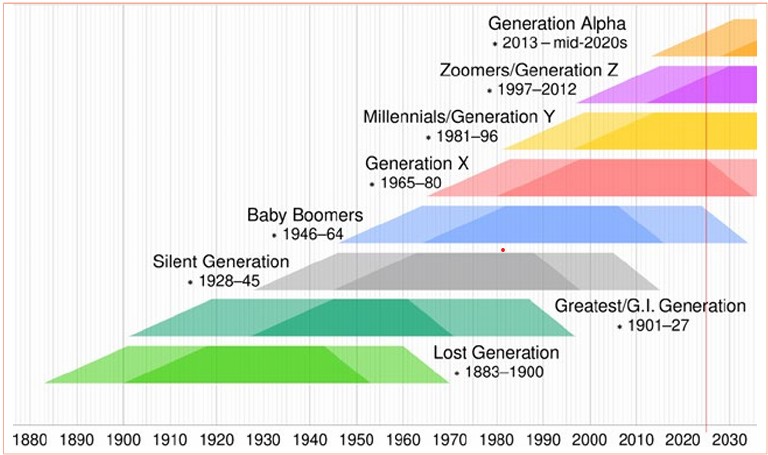 Image 1: Timeline of generations.1
Certainly, young and old are two separate groups. (Age range is still up for debate), of course, even without genetic conditions and bone age measurement, the time spent within the society we live in and its material and cultural conditions shapes us, and undoubtedly, we also shape it. In this context, the generation Z can be defined as the age groups that experience the impact of the current wave of digitalization and globalization, whose conscience develops within this paradigm, and whose existence is understood within these conditions. Although I do not consider pure channel similarity sufficient in terms of cultural commonality, as Marshall McLuhan also stated, “The medium is the message2”. It is necessary to interpret the message sent within the context of the channel that sends it and to assume that its meaning is constructed through it.
In this sense, Generation Z acquires its relative meaning. However, it is important to understand that the definition of Generation Z is always somewhat vague and can easily be twisted when speculated upon. For instance, if we consider this article as a continuation of the PoliTeknik articles written after the March 19 process (for a retrospective reading, see Canberk, 2025)3, we essentially see a large group, mostly university students, exercising their right to protest in defense of their rights within the scope of Generation Z. Here, it is important to highlight a key question: Is the main determinant the direct participation of the crowd, most of whom fit the definition of Generation Z, in the struggle, or is it this generation’s reproduction of the culture of struggle inherited from previous generations?
For example, during the events of March 19, the motto “Salute to Gezi, continue the resistance!” was prominent in the protests held in major cities. While the most intense source of power for the Gezi protests came from Generation Y, today’s prominent protests in the context of Generation Z directly reference a period of struggle from 12 years ago (Generation Z’s core scope spans 15 years).4 Similarly, a group of young people, all clearly belonging to Generation Z, are repeating the “standing man” protest in Taksim that took place 12 years ago and are not afraid of being detained for doing so. The current practices of protest organization are not much different from the calls to gather spread via social media 12 years ago. The general and common discourse on social media can quickly reverse itself during such periods, and it can be an important tool that enables the rapid mobilization of post-2000 protests. Indeed, tweets that began with hashtag #direngezi and called for action are not far away from the use of social media in today’s periods of action. Challenging rhetoric, or calls to gather, still serve the same function despite some developments in visual and graphic design.
As another example, we can examine the transformative and shocking effect of social mobilization practice. This is the reason why the current Generation Z is accused of being apolitical or, in a broader context, of having limited ability to interpret society or of being downright non-serious, which is essentially not an attack on their core identity but rather a reproduction of a longer-term discourse. For example, the song Copla Beni -Beat Me Up with Baton- by rapper TRAK, released during the Gezi Park protests, contains the same rhetoric and dismissive criticism targeting Generation Y, on the other hand, Uğur Dündar’s program on Artıbir TV during the Gezi protests, contrary to popular belief, begins with positive rhetoric about youth:5
“All this youth, the youth you say will not become anything, is becoming something…”6
Likewise, during the Gezi protests, renowned theater actor and film star Şener Şen, who was interviewed at the time, had this to say about the youth involved in the movement:
“The Gezi movement was a reminder from young people we thought were apolitical. They proved to us that they were not detached from things, that they did not spend their days in a world of their own. It was an exemplary act for everyone, whether involved in politics or not..”7
Hence, in his writings during the Gezi protests and the Taksim resistance, Akın Evren described this active and rapid change among young people as the “Brotherhood of Gas” and noted that those actively parti
cipating had begun to see the world differently and had entered a period of rapid change.8
In this regard, perhaps we should see the continuity of the struggle. As a simplifying example, we can use the example of the 68 generation. When we talk about the ’68 generation,examples that come to mind include Mahir Çayan, Ulaş Bardakçı, Hüseyin İnan, and Deniz Gezmiş, who were born between 1946 and 1948 but were ideologically contemporaries and fought together with Behice Boran and Mihri Belli, born in 1910 and 1915, respectively.
Despite the passage of so many years, it would be quite difficult to interpret these people separately from the spirit of the ’68 generation. (Even though Mihri Belli had some criticisms…) Because the same gas brotherhood, for the ’68 generation too, served as a process that brought together and transformed the masses within the same struggle, albeit with different dynamics.
Moreover, the shocking nature of this situation can be detected in the critical remarks that are dismissive and rejecting. Peyami Safa, Nurettin Topçu, and Falih Rıfkı Atay accused the youth of that period, writing in newspaper columns, of exhibiting attitudes and behaviors that we could describe today as lumpenism, and portrayed them as “Anarchists” or rebels, disorganized or excessive, ultimately labeling them as imitators, which was clearly a mistake. There have always been individuals and groups who try to suppress the generations that stimulate change with their rhetoric, or worse, accuse them of weakness and incompetence in a reductive manner. In this context, neither the ’68 generation, nor Generation Y, nor Generation Z possesses the characteristic of uniqueness.

Image 2: A comment reflecting the same argument. Posted under a video related to the Gezi protests.9
In this context, Hegel’s concept of “zeitgeist” can be helpful for us. This concept, which can be translated as the spirit of the times, can be expressed at its most fundamental level as the social consciousness and general trends of the period. This concept, which emerges in Hegel as the clarification of history, is ultimately the essence of its movement. It guides social movement, unites individuals, and determines the dynamics of the struggle in this direction. For instance, reducing the 68 generation to a temporal period and a demographic series of years, rather than viewing it as a wave of struggle or a socially conscious collective mind prepared for struggle, poses the risk of denying the essence of the struggle. The same risk applies to the narrative of today’s Generation Z.
Yes, the Z generation is at the forefront of the struggle in terms of biological age, but quantitative majority comes after qualitative leadership. The Z generation is not detached from previous generations or their debates. For this reason, understanding its own essence will only be possible through understanding its historical existence. In this sense, it is impossible for Generation Z to give up hope on past generations or turn its back on them. The key is to understand, interpret, and build on them
 Image 3: A comment posted under a video related to the Gezi protests10
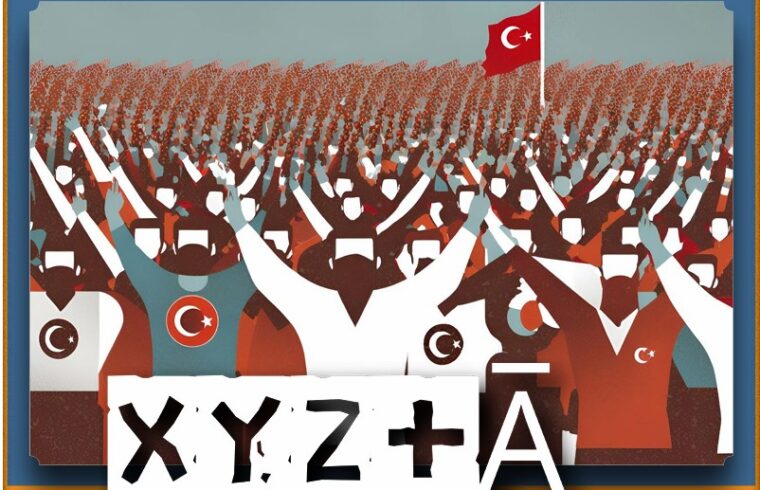
In conclusion, as a member of Generation Z, the most fundamental proposition in my article regarding the perspective on past and future generations is that the key to social struggle dynamics and change lies not in the specific movements of Generation Y or Z, but rather in the formulation XYZ+Ā11
- Cmglee, Generation timeline.svg, Wikimedia Commons (CC BY-SA 4.0).
- 2 Marshall McLuhan, Understanding Media: The Extensions of Man (New York: McGraw-Hill, 1964), 23.
- For a retrospective reading: Canberk, A View on the Ongoing Protests in Ankara, PoliTeknik International, April 28, 2025, https://politeknik-international.org/pi8075/.
- 4 Protests in support of İmamoğlu continue: Salute to Gezi, continue the resistance” Mezopotamya Ajansı, March 22, 2025, https://www.mezopotamyaajansi35.com/tum-haberler/content/view/271237.
- BirGün Newspaper, “19 youths who staged the Standing Man protest were released with a ban on leaving the country and judicial supervision,” May 29, 2025, https://www.birgun.net/haber/duran-adam-eylemiyapan-19-genc-yurtdisi-yasagi-ve-adli-kontrolleserbest-birakildi-626879.
- TRAK, “TRAK - Copla Beni #GeziyiSavunuyoruz #2013” YouTube video, 0:00-0:13, 11:30, June 08, 2022,
https://www.youtube.com/watch?v=JUnju821lsI. - Ulusal, “Şener Şen: ‘Gezi Movement showed us a completely different youth’,” accessed on November 29, 2025, https://www.ulusal.com.tr/haber/8510257/sener-sen-gezi-bize-bambaska-bir-gencligi-gosterdi.
- Akın Evren, “Brotherhood of Gas,” Bianet, Accessed on November 29, 2025, https://www.bianet.org/yazi/gaz-kardesligi-147171
- @ATSIZ1071,”90s generation was brave…”, comment, eigengrau: 5th Anniversary of the Gezi Park protests, 31 May,2018, https://www.youtube.com/watch?v=_UL6GcpJrn0
- @hakanosma9486, “Kids who used to bang spoons on pans from the balcony back then…,” comment, YouTube video, August 26, 2022, https://www.youtube.com/watch?v=AP58_bBa4IQ.
- The formula is expressed by the current struggles of Generations X, Y, and Z, and the Alpha generation, the next generation, with the line added above the letter A, which adds meaning to the passing on. The “+” sign indicates future accumulation, while the line above emphasizes the continuity of the struggle.