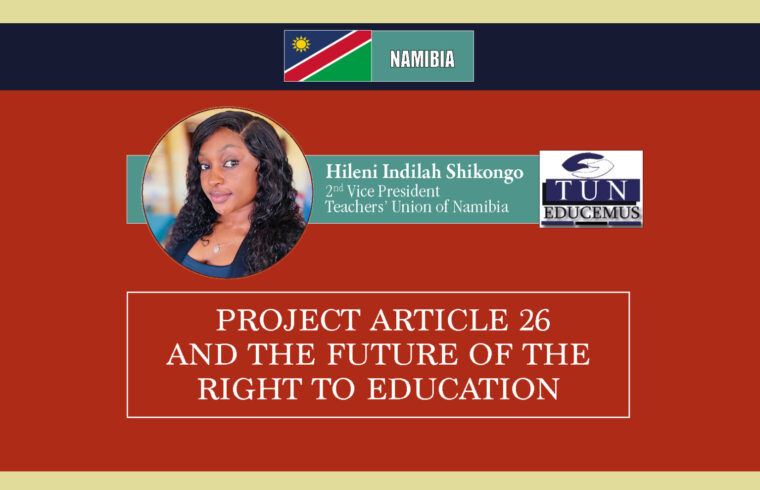
Hileni Indilah Shikongo
2nd Vice President Teachers’ Union of Namibia
Distinguished colleagues, partners, and friends,
Thank you for the opportunity to reflect on the future of Project Article 26 at this critical moment in global history. The United Nations, once envisioned as the moral and legal guardian of global peace and human dignity, is increasingly weakened by political crushing, selective compliance, and structural inequality. Alongside this erosion, the Universal Declaration of Human Rights, especially its social and economic rights is being treated as optional rather than foundational.
Project Article 26 was created precisely to respond to this crisis. It reminds us that education is not a privilege, a charity, or a market commodity. It is a fundamental human right, essential for freedom, democratic participation, and social justice. If the UDHR is undermined, the right to education is among the first to suffer.
Looking into the future, Project Article 26 must position itself as both a guardian and an innovator. Firstly, it must defend the original spirit of Article 26 of the UDHR: free, inclusive, quality education directed to the full development of the human personality and respect for human rights. Secondly, it must extend this vision to meet today’s realities which are digital inequality, underfunded public education, conflict, and growing social exclusion.
Defending the right to education today requires action on several levels. At the global level, Project Article 26 can continue to challenge the democratic deficit within the UN system by amplifying the voices of educators and learners. Teacher unions and professional bodies can serve as guardians of educational justice. Education policies must not be shaped solely by political or economic interests, but by the lived realities of people on the ground.
At the national and local level, education must be protected as a public good. This is especially relevant for countries like Namibia. Namibia has made commendable progress since independence by prioritizing access to basic education and aligning its education system with constitutional and human-rights principles. However, challenges remain: inequalities between urban and rural schools, limited resources, teacher shortages, and barriers faced by learners with disabilities or from vulnerable communities.
Project Article 26 speaks directly to these realities. For example:
- It reinforces Namibia’s commitment to inclusive education, ensuring that no learner is left behind due to poverty, geography, or disability.
- It supports lifelong learning, which is vital in Namibia as young people face unemployment and a rapidly changing labour market.
- It strengthens civic education, helping learners understand democracy, human rights, and their role as active citizens.
In conclusion, the future of Project Article 26 depends on our collective resolve. In a world where the UN and the UDHR are under strain, this project becomes not less relevant, but more necessary. By defending and extending the human right to education, we are not only protecting learners, we are protecting democracy, peace, and the future of humanity itself.
Let us ensure that Project Article 26 continues to be a voice of conscience, action, and hope.
Thank you.