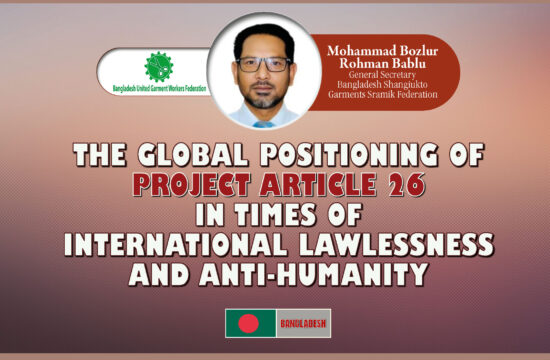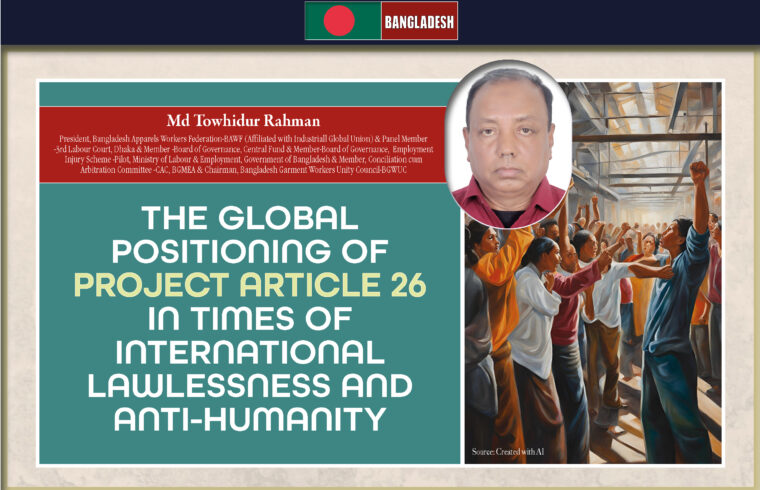
Md Towhidur Rahman
President, Bangladesh Apparels Workers Federation-BAWF (Affiliated with Industriall Global Union) & Panel Member -3rd Labour Court, Dhaka & Member -Board of Governance, Central Fund & Member-Board of Governance, EmploymentInjury Scheme -Pilot, Ministry of Labour & Employment, Government of Bangladesh & Member, Conciliation cum Arbitration Committee -CAC, BGMEA & Chairman, Bangladesh Garment Workers Unity Council-BGWUC
Distinguished guests, respected colleagues, trade union leaders, and friends,
Today, I stand before you at a time when the world is facing a deep crisis — not only of economics or politics, but a crisis of humanity itself.
Across continents, we are witnessing growing trends of international lawlessness. Human rights violations, forced labor, modern slavery, unsafe working environments, and attacks on dignity have become normalized in many parts of the global supply chain. These are not abstract problems. They are realities lived every day by millions of workers — including those in the textile and garment industry.
It is in this troubling context that we must globally position and reaffirm the importance of Project Article 26, which draws its inspiration from the fundamental principle that everyone has the right to education, dignity, equality, and justice. These values were first internationally recognized under the United Nations Universal Declaration of Human Rights in 1948.
Article 26 was never meant to be confined to classrooms alone. It was envisioned as a powerful tool for empowerment — a means by which every human being could become aware of their rights, defend their dignity, and participate equally in society. In today’s globalized economy, where textile workers are part of complex multinational production networks, this empowerment is urgently needed.
The global textile industry is one of the largest employers in the world. From South Asia to Africa, from Latin America to Southeast Asia, millions of workers — especially women — depend on this sector for their livelihoods. Yet, despite its economic significance, the industry continues to be plagued by exploitation, wage theft, unsafe factories, and systemic inequality.
In times of anti-humanity — when profit is often prioritized over people — textile unions must rise as guardians of justice.
Textile trade unions are uniquely positioned to translate the principles of Project Article 26 into real, practical change. They are not merely negotiating wages; they are defending human dignity. They are not only advocating for contracts; they are standing for the fundamental right to live and work in safety and respect.
Through education and awareness programs, unions can ensure that workers understand their rights under international law. Many workers in garment factories do not even know that they have the right to safe working conditions, freedom of association, or protection from forced labor. This lack of awareness creates a fertile ground for exploitation.
By promoting rights-based education, textile unions can empower workers to speak out against injustice. They can create platforms for dialogue, strengthen collective bargaining mechanisms, and advocate for compliance with international labor standards established by the International Labour Organization.
Furthermore, unions can engage globally — building alliances across borders to confront multinational corporations that often evade accountability by shifting production from one country to another. A globally connected union movement can ensure that no company escapes responsibility for human rights violations within its supply chain.
The role of textile unions must also extend beyond the factory floor. They must engage with governments, civil society organizations, and international institutions to demand stronger enforcement of labor laws, transparency in supply chains, and corporate accountability.
In countries like Bangladesh — where the textile sector forms the backbone of national economic growth — unions have an especially critical responsibility. They must ensure that development does not come at the cost of human life or dignity.
The tragic lessons of past industrial disasters have shown us what happens when international law is ignored and workers’ voices are silenced. Therefore, positioning Project Article 26 globally means committing ourselves to a future where education leads to empowerment, empowerment leads to organization, and organization leads to justice.
In conclusion, Project Article 26 is not simply a legal concept. It is a moral compass for our time.
In an age marked by international lawlessness and anti-humanity, textile unions must become champions of human rights, defenders of dignity, and architects of a fair and just global economy.
Let us stand together — informed, organized, and united — to ensure that the textile industry becomes not a symbol of exploitation, but a model of justice, equality, and humanity.
Thank you.