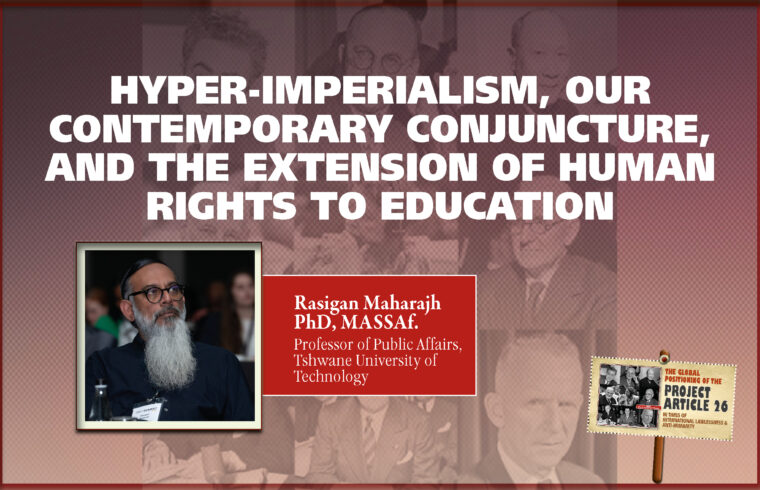
Rasigan Maharajh
PhD, MASSAf.
Professor of Public Affairs,
Tshwane University of Technology
Our current era is defined by hyper-imperialism, neocolonialism, and escalating ecological crises. The rise of “alternative facts[1]” has eroded trust in objective information, replacing it with a pervasive doublespeak (Conway, 2017). This reality was starkly illustrated by Mark Carney, a leading figure of the global capitalist establishment, who recently admitted that the “international rules-based order” was built on a convenient fiction: one where the strongest exempt themselves and enforce rules asymmetrically. Yet, he argued, this fiction was useful, as American hegemony provided global public goods (Carney, 2026). This candid admission is a striking mea culpa from the transnational elite, acknowledging the very power imbalances that progressive critics of capitalism have long identified and argued.
Over a century ago, Lenin identified imperialism as the highest stage of capitalism, a system built on colonial conquest that inevitably led to inter-imperialist rivalry and wars (Lenin, 1917). This system has since evolved through a great depression, a second world war, a cold war, and neoliberalism. Today, its unipolar moment has passed. The rise of multipolarity, spearheaded by the People’s Republic of China’s economic ascent, directly challenges the hegemony long enjoyed by the US and its G7 allies. For the world majority, this Western-led order represents not a rules-based system, but a continuation of „600 years of humiliation, racial violence, and economic exploitation“ (TriCon, 2024: 139).
The current global architecture was forged in the crucible of World War II. As the tide turned against fascism, the Dumbarton Oaks Conference of 1944 laid the groundwork for the United Nations, envisioning a new era of collective security (Hilderbrand, 2001). The post-war period, fuelled by national liberation movements and the defeat of Axis powers, sparked genuine hope for a better world. This optimism, however, was frozen in the four-and-a-half-decade-long Cold War, which pitted capitalist and socialist models against each other as mutually exclusive alternatives.
The Soviet Union’s demise was initially met with liberal triumphalism and declarations of an ‘end of history.’ Yet this unipolar moment proved brief. The rapid ascent of China, demonstrating that absolute poverty can be eradicated, has revitalised the possibility of a more equitable world system. This new multipolarity is taking institutional shape in forums like BRICS+, the African Union, and the Shanghai Cooperation Organisation amongst others. As Chung (2024) observes, while this shift is partly driven by bourgeois interests excluded from the Global North, it simultaneously „opens up opportunities to build socialism in the Global South.“
These are amongst cracks in the edifice of Western hegemony, and they must be explored and widened. Crucially, the working people within the nations of the Global North often share developmental challenges with the world majority. Forging alliances across these lines holds the key to building a world order that serves the many, not just an elite minority.
Our collective work on PROJECT ARTICLE 26 must be a catalyst for this resurgence of hope. To succeed, we must unambiguously confront the scourge of genocide and continue the fight against fascism in all its forms. We must defend the global knowledge commons from enclosure and the weaponisation of technology. Our world is fractured, and the only tools we have to mend it are our solidarity and our collective action. The struggle continues.
References
Carney, M. 2026. Special address by Prime Minister of Canada, 56th Annual Meeting, World Economic Forum, Davos-Kloster.
Chung, G. 2024. Hyper-Imperialism, 26 March, International Strategy Center, Seoul.
Conway, K. 2017. Meet the Press Interview, Meet the Press with Kristen Welker, National Broadcasting Company, New York.
Hilderbrand, R.C. 2001. Dumbarton Oaks: The Origins of the United Nations and the Search for Postwar Security. UNC Press Books, Chapel Hill.
Lenin, V.I. 1917. Imperialism: The Highest Stage of Capitalism, Progress Publishers, Moscow [1963 edition]
TriCon. 2024. Hyper-imperialism: A Dangerous Decadent New Stage, Tricontinental Institute for Social Research, Northampton.
[1] A term induced by Kellyanne Conway, a Senior Counsellor to the 45th President of the United States of America to defend Sean Spicer, the then White House Press Secretary, who had falsely claimed that Donald Trump’s inauguration had the largest audience to ever witness an inauguration on 22 January 2017.