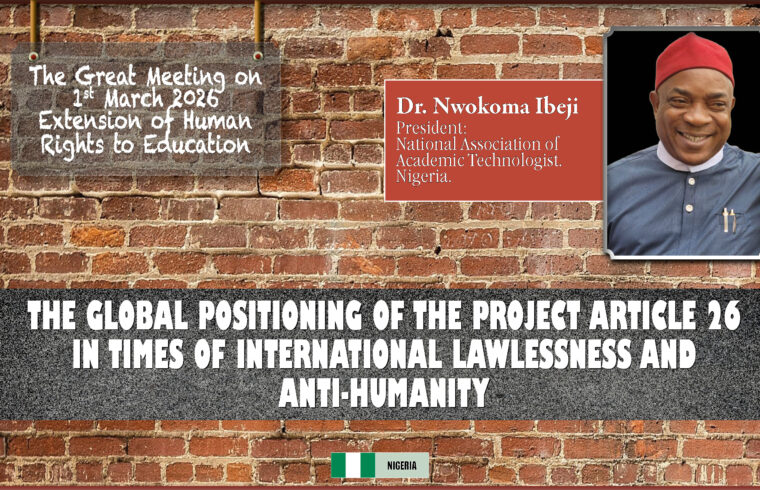
Dr. Nwokoma Ibeji,
President: National Association of Academic Technologist. Nigeria.
Introduction/Background:
Education is one of the key factors to human development, it enlightens, guides and evoke the human mind to possibilities of greater achievements at the same time, and it is the major tool of information dissemination, teaching, learning, transfer and acquisition of knowledge. Education as a human right empowers humans, safeguards children from exploitation and hazardous works or engagements. Concepts of “Literacy” has been expanded to include skills in the use of numbers, images and computers or other ways to communicate and gain fresh knowledge.
Organization.
Whereas, Human rights are inherent and ordered by our very nature of being humans, they overall make life more living. These rights include rights to life, food, education, work, health and liberty. Enacting them as laws makes them unavoidable and regardless of nationality, color, religion, language, status or cultural traits. Human rights are indivisible and interdependent, they are inalienable and universal, and in addition, they stress equality and non-discrimination in all spheres.
Education is a fundamental human right and it may be formal or informal, taking different formats and education re-engineering methods in different places. As a right, each community and nation should enforce it as a rule, a law and an imperative.
The Extension of Human Rights to Education Project was created as a grassroots initiative to enable the rapid and unavoidable spread of education to all humans (Children and Adults). It emphasis that Education is a right of all peoples and must be defended. The project brings together people of different backgrounds and societies to review and develop/expand the confines of education in order to create a universality. Thus article 26 of the UNDH is brought into play for expansion and enforcement universally. This article promotes the idea that full development of the human is only possible with Education.
Contending Issues/Challenges:
Perhaps foremost on the burner is “lack of political will” to make education a strong and inalienable human right at whatever level in a community or nation. Some agrees that it is inalienable and perhaps enforceable but claim that there is no means for enforcement, whilst others merely play lip service because of misplaced priorities or lack of good understanding or grasp of the subject matter. It is proposed that any government who fails in this regards should not be allowed to contest in subsequent democratic electoral process or simply voted out of power.
Another contender is Corruption and unruliness in some societies, more so when rivals for political power adopt “winner takes all” or “cut-throat policies”. Here they swing out of control and often veer away from what benefits the society to what benefits self. When caught, such people in power should be removed by use of contending laws and regulations and punished accordingly.
Corruption in a society may be on a corporate or personal level. Personal corruption is often seen in embezzlement of funds/material for education and conversion of means to personal or self-use. Money that could be used to build schools and develop learning techniques are diverted to prodigal and grandiose life styles for self, close friends and family. The solution here is to scrutinize whosoever has been given communal responsibilities and ensure that same has impeccable records. When an offender is caught, such a person should face the full wrath of the law.
Lack of education itself may be a deterrent to leaning in some communities. Some children show aversion to going to school and prefer to follow parent to farm or be indulged in other frivolities. Here, parents or communities should create culturally appropriate solutions and enticements to schools, schooling and learning.
Unfavorable cultural norms especially those affecting the girl child in very early marriage may hinder promotion of universal education. The proposed solution here is the establishment of regulatory and enforcement agencies in such communities or nations, otherwise, the universality of article 26 may be defeated.
Conclusions:
Although, there had been steady rise in literacy rates for the last fifty years in the world, we still have over 750 million illiterate adults around the world, most of whom are women. Through the Sustainable Development Goals (SDGs), key opportunities to ensure that all youths and most adults achieve high literacy and numeracy levels by 2030. SDG 4 in particular addresses both access to, and quality of, education, 8 is on “Decent Work and Economic Growth, 10 speaks about “reducing inequalities” and 17 talks to “partnership for goals” . With these, Article 26 of UNDP becomes achievable.