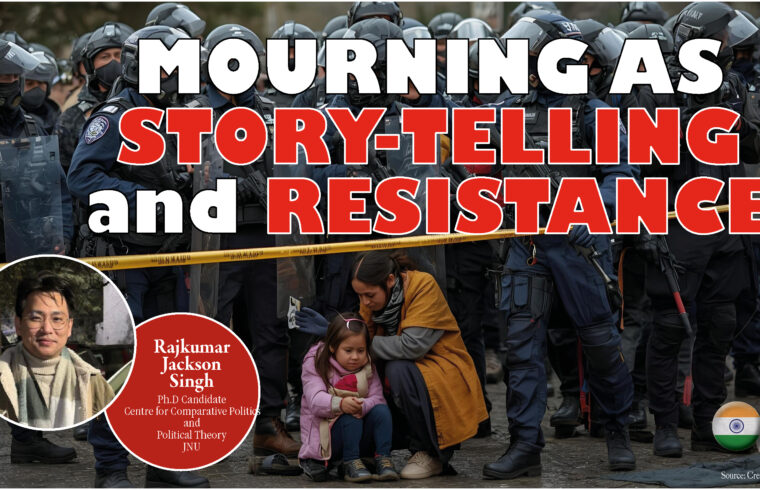
Rajkumar Jackson Singh
Ph.D Candidate Centre for Comparative Politics
and Political Theory JNU
In one of Intizar Husain’s most iconic stories, a storyteller mourns her own death,
“O my emperor and dear husband, Sheherzad spoke in a tearful voice, “you granted me life but snatched away my stories from me. I lived only in my stories. When my stories ended, my own story ended with them”[1]
Perhaps, following Sheherzad, the act of mourning refers to the end of stories. A life, as stories, comes to an end, and with it the process of mourning begins. However, differing from Sheherzad, mourning does not denote the condition of non-story; in fact, quite the opposite. It testifies to the infinite composition of new ones, alterations to the old and the emergence of new tellers just as Sheherzad’s sister becomes the new storyteller. Death itself may imply the end of some stories, but mourning is the act of composing and telling those stories that the event of death could not release. In a strange way, mourning makes the dead alive by carrying forth their stories.
In conventional consideration, mourning is a very personal, psychic and internal experience of close familial relatives and loved ones. What, then, happens when mourning crosses beyond kin relations and transmutes into an exogamous phenomenon? That is, when the individuals involved in the mourning are complete strangers in terms of kinship but allied by ideas and cause, when mourning transcends the barriers of private seclusion to be a public affair. In this transformation, or rather the revelation of its public nature, mourning comes forth as a deeply political activity which could invite suppression and/or mobilise mass movements. Mourning does mean more than the painful path to achieve emotional closure and overcoming loss, but involves active problematisation of what brought about the loss. This conception of mourning, however, should not be confused with Freud’s depiction of melancholia. Mourning in its public nature is not the withdrawal of the libidinal cathexis to ego or obsessional self-reproaches; it is, instead, the extension of the grief and problematic from the self to a collectivity. Here, the consideration of mourning as storytelling becomes extremely poignant.
At the level of practice, mourning is a ritualistic activity. It means that the process of mourning follows a certain set of activities which are repeatable and expressive, and results from a synthesis with the larger social and political environment. From Durkheimian theory to the virtual possibility of Kapferer, it has been clearly established that ritual is a dynamic process that involves interaction with the lived conditions of human society. What, however, has rarely been acknowledged is that ritual is not merely symbolic and formalistic but always open to manipulation and possesses agential quality. In other words, ritual is composed of signs and not symbols. Sign implies alter possibilities, that meanings are not fixed and exist simultaneously at multiple fields of perception. Is this not what stories are? The enjoyment of a story, in essence, arises from the variant meanings it provokes. One may receive a story entirely different from someone else; we may debate and discuss over it, and we are only contributing to its richness. It would be absurd to say that there can be only one single interpretation or a finite number of interpretations of a story (although we always make subjective judgments of some interpretations to be more correct than others). Stories imply infinity of meaning and constancy of change, which is nothing but signification. Thus, if stories are signs and signs compose ritual, this opens up the prospect of considering ritual as a mechanism of narration, where constant deviations and changes are taking place. By itself, it is an epic negotiation of humans’ relation to the non-humans, be it spirits, divine beings, material objects or living creatures. Ritual is a story of the adventure of humans and non-humans, and mourning is its most dramatic enactment.
Mourning as a collective activity is commonly experienced in societies where conflictual relations are the general norm. Such societies are defined by varied forms of hierarchical, unequal power relations, in which human lives are readily dispensed with, and any antagonistic resistance is met with violent force. In such an unbearable state, ritual readily becomes the resource pool around which political resistance is organised. In such a conflictual society, mourning the death of a person at the hands of the political authorities is a recurring act and also the ritual around which resistance is organised. In a conflict-ridden society, where death and upheavals are a constant feature of social life, the political response is, unsurprisingly, informed by the symbols of death, the community response to the passing and the ritual system devised to make sense of it. Among the Meitei communities of Manipur, a province in the north-eastern region of India, the act of mourning for those who died at the hands of the state is fused with protest politics. The private bereavement becomes public, where the suffering of one becomes the suffering of many. The mourning protest represents this transformation. Exclusively a site ruled by women, the sit-in protest becomes indistinguishable from a mourning ritual. The unwritten customary norm is that protest participants should observe the dress code for mourning rituals, and each was to offer solemn prayers. The site of the protest itself is transformed into a ritual space of mourning, which is accompanied by the necessary paraphernalia of sacrificial offerings to give the effect. Additionally, a cavalcade of political slogans and placards overlayed upon the scene of mourning women, producing a very unusual scene of solemnity and excitement at once. Thus, among the Meiteis, mourning and sit-in protest are hardly distinguishable. Mourning becomes protest, and protest cannot be imagined without, at the same time, mourning for the dead person. The mourning ritual infused into the protest sites, thus, tells the story of pain caused by the lost lives while immediately drawing to the limelight the unnatural, political cause behind the death.
However, the mourning protest is not merely a passive gesture of condemnation. It also involves the creative structuring of political sites to institute an immediate community through the shared act of mourning. This occurs when mourning emerges as the centrepiece of political mobilisation. During the mass movement against the alleged rape-murder of Thangam Manorama at the hands of paramilitary forces in 2004, sites of public mourning became a significant zone of political mobilisation. One way in which resistance movements were organised is through the political strategy of what I call ‘ritual of deference.’ It is the simple strategy of refusing to accept the dead body until and unless certain political demands (such as the punishment of the perpetrator, resignation of ministers, etc.) are fulfilled. Strictly speaking, refusal to accept the body is the denial of the last rite, and, consequently, mourning for the dead enters into a prolonged state. The protestors believed that the performance of the funeral ritual releases the body from political obligations, an obligation to epitomise the injustice suffered by a body under an oppressive, militarised society. Deferring the funeral and extending the mourning phase kept alive the story of how the death suffered was an unnatural occurrence. And it is through this extension that mass movements are built.
In death, Manorama’s body is not hers anymore but modulated into a collective body in pain by means of public mourning. Her lifeless body became the strategic point of mobilisation. The corporeality and the actual existence of the body served as a real basis for the grievance and the injustice against which the movement rallies. It seems the affective power of the movement is not sustained only in abstract political discourses and public consciousness but also in the material body itself. Through mourning, the dead body becomes animated. It enters into what Gregory Bateson termed the ‘plateau of intensity’, where the climax (funeral) is replaced by sustained intensity (mourning). Thus, through mourning for the dead, a political assemblage is drawn up which problematises the legal and military apparatus that sanctioned the death and where the refusal for climax re-energises the body as a political actor upon which the resistance movement is hinged.
Beyond the event of Manorama’s death, there are numerous other cases where mourning as an act of protest and as a progenitor of resistance have sustained mass agitations. It has become an embodied practice of political protest in Manipur. Among the many, it is worth mentioning the case of the Kuki community of Manipur, where the mourning process, which involves the deference of the last rite and sustained mass movement, of nine dead bodies killed at the hands of the state police, went on for almost two years. Their bodies were only consecrated after the state acceded to their demands by dint of the sheer moral pressure applied.
The political potency of public mourning is also confirmed in other ways. In the majority of cases, the state does not act in an agreeable manner. Sites of mourning were constantly disrupted and made illegitimate by invoking penal codes that banned political assembly. In Manorama’s case, the state government in Manipur was quite eager for the family members to claim the body and perform the necessary funeral rites. After her family members and protesting masses refused to do so, the lifeless body of Manorama was forcefully cremated by the state police without the consent of family members. However, despite attempts of a disproportionately powerful force to curtail the capacity to mourn, mourning has been asserted by protesting masses as a right in itself and as a means to enact mass action. It is inconceivable to imagine protest in Manipur without it being shaped by the rituals of mourning. In a society structured by conflictual relations and disposability of lives, mourning cannot be dissociated from condemnation of such social relations and the desire to resist the same.
To mourn is to resist and to resist is to mourn. Mourning tells the story of the lost lives and why they passed— did the children, the women and young boys deserve the fate they encountered? Further, the act of mourning itself recalls and critiques the excess of the sovereign’s monopoly over life in two ways. First, it brings into focus that mourning is an unnecessary act made necessary by the violence inherent in a society shaped by unequal power relations. Thus, mourning is not only a sign that tells a certain story of dominations and injustice, but is also a manifestation of the sign, the appearance of symptoms, by mere existence. Secondly, since it is an unnecessary necessity, the ritual of mourning is functionally one of effacing the aetiology that brought about its necessity and, through it, itself. In this way, the ritual of morning presents a challenge to dialectical logic. It does not effect contradiction between two logical oppositions or material conditions. It does not oppose existence to death, potential to actual, material to abstract. Instead, mourning necessitates itself yet presupposes its own annihilation. In this way, the ritual of mourning weaves a tale of resistance and necessity. It manifests the signs and makes the struggle to erase itself the foremost priority by critiquing and problematising the social and political conditions that made it possible.
In the end, mourning tells the tale of the lost lives, creates new tales in expressive ways, embeds the tales in public memory and, then, in a fugitive fashion, questions its own existence and attempts self-effacement by critiquing the conflictual relations that engendered it.
Bibliography:
Husain, Intizar. “The Death of Sheherzad.” In The Death of Sheherzad, translated by Rakshanda Jalil. Harperperennial, 2014.
Freud, Sigmund. “Mourning and Melancholia.” In The Standard Edition of the Complete Psychological Works of Sigmund Freud, Volume XIV (1914-1916), The Hogarth Press, 1917.
Bateson, Gregory. 1987. “Bali: The Value System of a Steady State.” In Steps to an Ecology of Mind: Collected Essays in Anthropology, Psychiatry, Evolution and Epistemology, Reprint. Jason Aronson Inc.
Singh, Rajkumar Jackson. “Ritual Politics as a Cultural Intervention to Political Movements.” Economic and Political Weekly 60, No. 23 (2025). https://doi.org/10.71279/epw.v60i23.37375
[1] Husain, “The Death of Sheherzad,” 131.