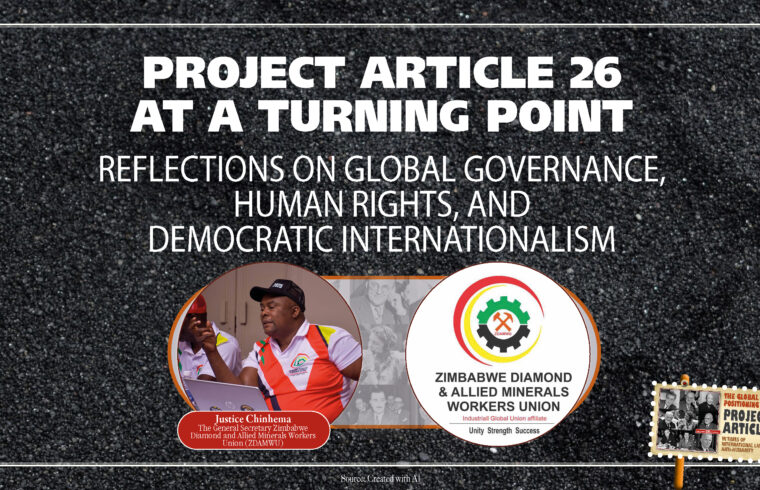
Justice Chinhema
The General Secretary Zimbabwe Diamond
and Allied Minerals Workers Union (ZDAMWU)
Introduction
It is an honour to participate in this vital conversation at a critical juncture for humanity and for the international system established in the aftermath of the Second World War. Over the past decade, Project Article 26 has served as both a moral appeal and a political framework—designed not merely to defend the abstract idea of universal rights, but to actively renew the practice of international cooperation for the common good of all peoples.
The project, conceived ten years ago and formally launched in January 2017, represents a distinctive contribution to contemporary debates on global governance. It is, in essence, a call for the democratization of the United Nations and the broader multilateral system—a demand that these institutions authentically serve the human family rather than narrow geopolitical or corporate interests.
The Contemporary Crisis of Multilateralism
Today, we confront a world in which the foundational principles of multilateralism are profoundly destabilized. Powerful states increasingly act outside established legal frameworks; global institutions struggle to reflect the democratic will of their constituent populations; and millions remain effectively voiceless within systems ostensibly designed to protect their interests and dignity.
The erosion of respect for the UN Charter and the Universal Declaration of Human Rights (UDHR) is not simply a technical or legal crisis. It represents a fundamental challenge to our shared humanity and to the post-1945 consensus that sought to place international relations on a foundation of law, cooperation, and universal human dignity rather than naked power.
We observe:
- The selective application of international law, where principles are invoked when convenient and discarded when inconvenient to hegemonic interests
- The marginalization of voices from the Global South in institutions claiming universal representation
- The growing gap between the formal commitments enshrined in international instruments and their practical implementation
- The weaponization of humanitarian discourse to justify interventions that violate the sovereignty and self-determination of peoples
Historical Patterns of Crisis and Renewal
Yet history instructs us that periods of regression and institutional decay often precede moments of profound renewal and reconstruction. Just as previous generations rose from the devastation of world wars to construct the United Nations and articulate the Universal Declaration of Human Rights, our generation now faces the responsibility—and the opportunity—to reimagine and rebuild global governance on firmer foundations of equality, genuine solidarity, and democratic accountability.
The history of the twentieth century demonstrates that seemingly permanent systems of domination can be challenged and transformed through organized collective action. The colonial system, once presented as natural and inevitable, was dismantled through the struggles of colonized peoples. Apartheid, defended as immutable by its proponents, was defeated through sustained resistance and international solidarity.
Project Article 26 as Democratic Renewal
Project Article 26 embodies this tradition of transformative internationalism. The project draws its name and inspiration from Article 26 of the UDHR, which affirms not only the right to education but specifies that education shall be directed toward „the full development of the human personality and to the strengthening of respect for human rights and fundamental freedoms“ and shall „promote understanding, tolerance and friendship among all nations, racial or religious groups, and shall further the activities of the United Nations for the maintenance of peace.“
This formulation is remarkable in several respects. First, it establishes education as inherently linked to peace, human rights, and international cooperation rather than as a mere technical skill or credential. Second, it envisions education as a tool for building global consciousness and solidarity. Third, it explicitly connects educational rights to the strengthening of the United Nations itself as an instrument of peace.
Project Article 26 insists that education, knowledge, and participatory governance are not privileges reserved for elites but universal rights belonging to all members of the human family. To democratize the United Nations is not to weaken it, but rather to complete its original mission—to make it genuinely representative of and accountable to the peoples in whose name it claims to act.
Strategic Tasks for the Movement
As we assess the positioning of this campaign under current conditions of global instability, several strategic tasks present themselves with particular urgency:
Defending International Law and Human Rights Frameworks
First, we must protect and reinvigorate the moral and legal authority of international law against the corrosive forces of cynicism and brute force. The UDHR and related human rights instruments represent hard-won achievements of previous struggles. Their defense is not merely conservative preservation, but rather the protection of legal and moral tools essential for future advances toward justice.
Strengthening Democratic Participation in Global Institutions
Second, we must advance concrete mechanisms for citizen participation in global governance institutions. This requires moving beyond the rhetoric of stakeholder engagement toward substantive democratization—ensuring that the voices of workers, peasants, students, women, indigenous peoples, and marginalized communities are heard and carry weight in international decision-making processes.
The current structure of the UN Security Council, with its permanent membership and veto powers reflecting the geopolitical balance of 1945, exemplifies the democratic deficit that must be addressed. Project Article 26 provides a framework for articulating demands for structural reform grounded in principles of equality and universal representation.
Revitalizing the UDHR as Living Practice
Third, we must ensure that the spirit and letter of the UDHR become the living foundation of international relations rather than merely ceremonial language invoked at anniversaries. This requires constant vigilance against attempts to relativize, hierarchize, or selectively apply human rights principles. It also requires demonstrating the interconnection between civil and political rights on one hand and economic, social, and cultural rights on the other—rejecting false dichotomies that serve to fragment and weaken human rights discourse.
Building Cross-Border Educational and Organizational Networks
Fourth, we must strengthen the educational and organizational infrastructure that can sustain long-term movement building. This includes:
- Developing curricula and pedagogical approaches that embody the principles of Article 26
- Creating networks linking trade unions, social movements, educational institutions, and civil society organizations across national boundaries
- Producing and disseminating analytical materials that connect local struggles to global dynamics
- Training cadres capable of articulating the connections between workplace issues, community concerns, and international governance
Challenges and Opportunities
The challenges facing Project Article 26 and the broader movement for democratic internationalism are substantial. We confront well-resourced opposition from forces invested in maintaining current hierarchies of power. We operate in a context of rising nationalism, xenophobia, and authoritarianism that seeks to discredit international cooperation itself.
Yet the very depth of the current crisis also creates opportunities. The failures of the existing system are increasingly apparent to wide layers of the global population. The contradictions between stated principles and actual practice have become too glaring to ignore. New generations are questioning inherited assumptions about the inevitability of current arrangements.
Project Article 26 offers a positive vision—not merely critique of what exists, but articulation of what should be. In a period of disillusionment with existing institutions, this constructive dimension is particularly valuable. The project provides a framework through which diverse struggles—for workers‘ rights, environmental justice, peace, decolonization, gender equality—can recognize their common interest in democratic global governance.
Conclusion
This gathering represents not only an assessment of current conditions but an affirmation of continued commitment to the vision that animated Project Article 26 from its inception. The task before us is to translate that vision into expanded organizational capacity, deeper analytical clarity, and more effective strategic intervention in the contests that will shape the international order of the coming decades.
Let this meeting mark not only our concern for the present crisis but our determination to act as architects of a more just future. Project Article 26 began as a vision articulated by a smaller circle; it must now advance as a movement uniting justice, peace, and knowledge across borders and sectors.
The democratization of the United Nations and the revitalization of universal human rights are not utopian fantasies but practical necessities for human survival and flourishing in an interdependent world. Our task is to make that necessity into reality through patient organizing, clear analysis, and unwavering solidarity.
The work continues.
About the Author
Comrade Justice serves as the General Secretary of the Zimbabwe Diamond and Allied Minerals Workers Union (ZDAMWU), an affiliate of IndustriALL Global Union, representing workers in Zimbabwe’s Mining sector. He has participated in regional and international forums addressing labour rights, natural resource governance, and democratic participation in global institutions.