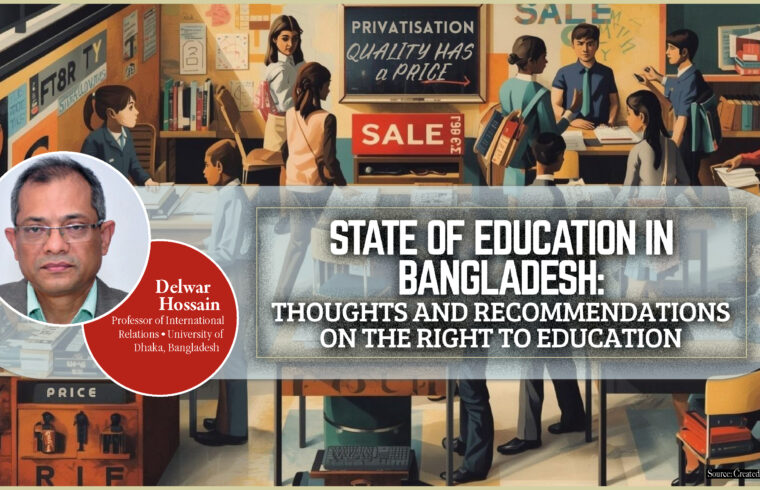
Delwar Hossain*
Professor of International
Relations•University of Dhaka, Bangladesh
Education has been the most effective means of advancing civilizations in human history. Social changes are instrumentalized by education, from personal life to the collective context. Education has facilitated interconnectedness, internationalization, globalization, and transnationalization of individuals and communities across borders. At the individual level, education is both the means and the end to a better life. It is the biggest source of enlightenment and advancement of people and societies. The role of education is recognized by the Universal Declaration of Human Rights (UDHR) in Article 26. Article 26 (1) says,
“Everyone has the right to education. Education shall be free, at least in the elementary and fundamental stages. Elementary education shall be compulsory. Technical and professional education shall be made generally available and higher education shall be equally accessible to all on the basis of merit.”
Global instruments such as the “International Convention on the Elimination of All Forms of Racial Discrimination”, 1969, the Convention to “Eliminate All Forms of Discrimination Against Women” (CEDAW), 1984, “Education for All” 1990, “Convention on the Rights of the Child”, 1989, World Education Forum in Dakar, Senegal in 2000 and Sustainable Development Goals (SDGs), 2015 have further highlighted the significance of education as an inalienable right for human beings. The UDHR article 26, adopted by the United Nations in 1948, has been further vindicated by subsequent international commitments to promote the cause of education.
Although the world has achieved unprecedented progress in education, science, and technology since the end of World War II, this remains extremely uneven and heterogeneous. Countries of the developed world had achieved remarkable success in education more than a century ago. Some countries from the Global South, such as Turkey, South Korea, Thailand, and Malaysia, have also registered great success in the education sector since the 1970s. In general, most countries in the least developed countries (LDCs) and developing countries (DCs) groups are struggling to achieve full literacy and ensure quality education in their respective societies. Right to education remains a fundamental campaign in these societies. It is also a fact that the privatization of education has created challenges for low-income people in developed nations. Therefore, the right to education is a global challenge that needs increased attention from every corner of the world.
Bangladesh became an independent nation through sacrifices of blood on 16 December 1971. The struggle for liberation in Bangladesh stemmed from discrimination across various socio-economic fronts, including education, during the pre-Independence era. The Constitution of Bangladesh emphasized the need for education since the early days of independence. It is observed that the first Constitution of Bangladesh inserted articles on education. It has duly recognized the importance of education as a right of citizens in the country.
The Bangladesh Constitution (Articles 8, 15, 16, 17, 19, and 26 to 47) guarantees human rights such as equality before the law, the right to protection of law, the right to life and personal liberty, freedom of thought and conscience, and freedom of speech. These constitutional provisions indicate that this will usher in a democratic process to ensure a society free from exploitation and in which the rule of law, fundamental human rights, freedom, equality, and justice are secured for all citizens. Bangladesh’s constitutional obligation for the right to education is also reflected in the provision of Article 8 (2), the constitutional provisions of “equality clause” contemplated under Article 27, “equality of opportunity in public employment” contemplated under Article 29, and “protection of right to life and personal liberty” contemplated under Article 32.
Specifically, Articles 17 and 19 of the Constitution are significant for education. According to Article-17 that focuses on free and compulsory education stipulates, “The State shall adopt effective measures for the purpose of – (a) Establishing a uniform, mass oriented and universal system of education and extending free and compulsory education to all children to such stage as may be determined by law; (b) Relating education to the needs of society and producing properly trained and motivated citizens to serve those needs; (c) Removing illiteracy within such time as may be determined by law.” Article-19: Equality of opportunity guarantees, “(1) The State shall endeavor to ensure equality of opportunity to all citizens. (2) The State shall adopt effective measures to remove social and economic inequality between man and man and to ensure the equitable distribution of wealth among citizens, and of opportunities in order to attain a uniform level of economic development throughout the Republic. (3) The State shall endeavor to ensure equality of opportunity and participation of women in all spheres of national life.”
In line with the constitutional guarantee, successive governments of Bangladesh have adopted a myriad of policies and measures to promote the growth of education in society. The various political regimes of Bangladesh have adopted a myriad of policies and measures to promote the growth of education in society. These governments had established several Education Committees and Commissions to modernize education in the country. They have commonly emphasized the significant role of education through fulfilling the core goals such as inspiring and creating enthusiasm among the learners in their thoughts, deeds and daily life to establish moral, humanitarian, religious, cultural and social values of personal, social as well as in national life; creating awareness among the learners to protect the independence, sovereignty and integrity of Bangladesh; making education pragmatic, productive and creative with a view to bringing about changes in the socioeconomic conditions of the country and making the students into a dutiful and responsible manpower with scientific outlook and help them develop the qualities of leadership; and promoting fraternity, secular values, generosity, and fellow-feeling in people and make them respectful of human rights.
As far as legislative undertakings are concerned, Bangladesh enacted an important act to ensure primary education as the backbone of the country’s education system. The Compulsory Primary Education Act 1990 (implemented from 1993) makes primary education free and compulsory for all children in Bangladesh. The 1990s saw a renewed commitment to expanding primary education, and as a result, the Bangladeshi primary education system experienced significant improvement. The Compulsory Primary Education Act 1993 makes the five-year primary education program free in all government schools and declares education for girls in rural areas free up to grade eight. It also demands additional interventions, such as the Female Stipend program, the Food for Education (FFE) program, and most recently, the Primary Education Development Program (PEDP II), a six-year program beginning in the year 2000, which aims to increase access, quality, and efficiency throughout the primary education sector.
Education has been highlighted in Bangladesh’s annual budgets, five-year plans, and perspective plans (2010-2021, 2020-2041). Bangladesh has prioritized global collaboration to promote education in society. Apart from its commitment to the UDHR, Bangladesh has become a signatory to the International Convention on the Elimination of All Forms of Racial Discrimination, CEDAW, the Education for All 1990, CRC, 1989, and relevant global documents.
Despite constitutional guarantees and successive governments’ policy priorities in Bangladesh, the state of education remains underperforming and far less satisfactory. In its fifty-four years of history as an independent nation, Bangladesh has not achieved full literacy. Bangladesh began its journey as an independent nation in 1972 with a literacy rate (7 years and above) of 16.8%, and the adult literacy rate (15 years and above) of 25.9% in 1974. By taking necessary steps, the literacy rate gradually increased, from 25.8% in 1974 to 29.2% in 1981, 35.3% in 1990, and 52.8% in 2000. In 2010, the literacy rate was 59.82%, which increased to 77.9% in 2023 (Bangladesh Bureau of Statistics, Statistical Yearbook 2024). The adult literacy rate was 58.6% in 2010 and increased to 75.6% in 2023. Nearly three-fourths of Bangladesh’s population has reached the literacy and adult literacy thresholds. This demonstrates Bangladesh’s modest success in attaining a basic educational requirement: literacy. Still, one-fourth of the population is illiterate. It is a major failure in implementing policies and guidelines to promote education.
Although an Act for free and compulsory education was passed in 1990, the first government of Bangladesh inaugurated free, compulsory primary education for all children in 1972, and nationalized over 36,000 primary schools in 1973. There has been continuous emphasis by governments on ensuring education for all, but the on-the-ground performance remains less satisfactory. It may be noted that the large non-governmental organizations (NGOs) sector is also contributing to improving literacy rates in Bangladesh through formal and non-formal education programs.
However, Bangladesh has achieved phenomenal success in ensuring the enrollment of primary school-age children (5+) over the past two decades. By 2007, Bangladesh achieved a gross enrolment rate (GER) of 98.8% and a net enrolment rate (NER) of 91.1% in primary education. This increased to 104.53% GER and 97.76% NER in 2023. From a gender perspective, girls are ahead of boys in GER, 109.83% against boys of 100.71%. Similarly, enrollment of boys and girls at high schools and college levels has substantially increased over the last two decades. While enrollment has increased in Bangladesh, analysts express concerns about the quality of education at all levels, including tertiary education. It is partly related to Bangladesh’s complex education system.
There are three major streams of education in Bangladesh: the vernacular, the English-medium, and the Madrasah (religious schools). Madrasah education is also divided into two categories: Aliya Madrassah and Qaomi Madrassah. Additionally, in terms of education management, there are public and private academic institutions at every level. The vernacular education system in Bangladesh has three major stages: primary, secondary, and higher education. Primary education is a 5-year cycle, while secondary education is a 7-year cycle, with three sub-stages: 3 years of junior secondary, 2 years of secondary, and another 2 years of higher secondary. The National Education Policy 2010 proposed broadening primary education from class one to class eight, but it has not yet been implemented. Experts note that the right to education is not listed as a fundamental right in the Constitution of Bangladesh. It appears in Part II of the Constitution as a Fundamental Principle of State Policy (FPSP), meaning the state will formulate its laws and policies based on these principles.
Bangladesh faces challenges in fully realizing the right to education for all, including policy ad hocism, budgetary constraints, weak governance in the education sector, the commodification of education, and low school attendance among underprivileged children. Education rights in Bangladesh need to be strengthened through several initiatives. The following recommendations may be considered to improve education from a multidimensional perspective.
Recommendations
- Constitutional recognition of education as a fundamental right through the necessary amendments
- Emphasizing the rights of education in the national policy
- Establishing policy continuity irrespective of changes in political regimes
- Increasing the education budget commensurate with the economic size of the country, as observed in other countries of different regions in the world, including South Asia
- Enhancing the dignity of teachers at all levels of education
- Establishing meritocracy in the recruitment of teachers from primary to tertiary levels
- Ensuring good governance in the education sector through eradicating corruption, irregularities, and nepotism
- Building a unified education system, combining multiple streams prevailing in the current system
- Establishing a permanent education commission to deal with human resources management, performance, quality, and policy development in the entire education sector
- Addressing the problems of privatization and commodification of education based on equity and fairness
- Special attention to children from low-income families, unprivileged, and physically challenged backgrounds
- Modernizing academic curricula from elementary to tertiary levels of education
- Pedagogical reforms at every level – elementary to tertiary education
- Instilling moral and ethical elements in the curricula, pedagogy, and administration of education
- Assessing the impact of Artificial Intelligence, technology, and social media on education, and bringing the necessary changes
- Developing and implementing a holistic education approach in Bangladesh immediately.
About the author
*Delwar Hossain, PhD, is currently serving as a Professor of International Relations at the University of Dhaka, Bangladesh. Dr. Delwar led the implementation of the Teaching-Learning in International Relations (TLIR) project supported by the University Grants Commission (UGC) and World Bank (2010-2013). He is involved in education management at the tertiary and secondary levels. He served as the Chairman of the school managing committees at the village level in Bangladesh (2019-2024).