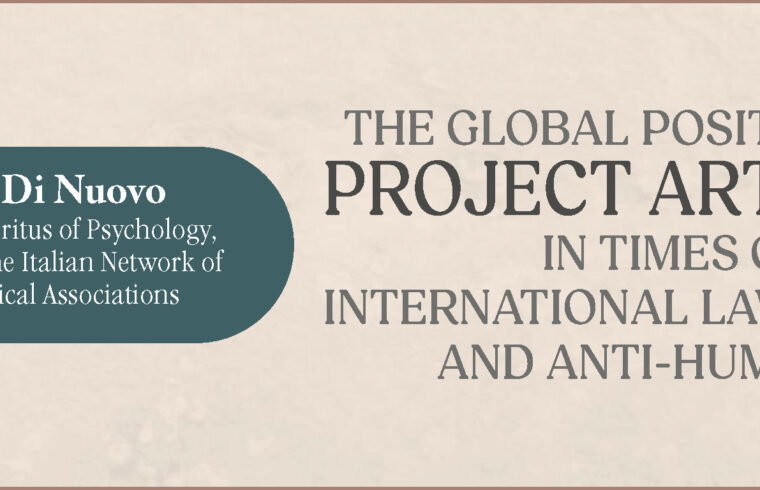
Santo Di Nuovo
professor emeritus of Psychology,
President of the Italian Network of Psychological Associations
In the age of widespread deregulation of international relationships, we should refer to the main objectives published ten years ago in the U.N.’s Agenda for Sustainable Development.
One of these principles is aimed at providing inclusive and equitable quality of education, at all levels from early childhood to secondary grades, and also to technical and vocational training. All people “should have access to life-long learning opportunities that help them acquire the knowledge and skills needed to exploit opportunities and to participate fully in society” (n. 25).
Education should broaden career development to larger social systems, it can further promote human health and well-being, equality, quality education, formation to decent work for all people
These rules are not homogeneous in the different countries and continents, and an effort should be made by international cooperation to make them more effective all around the world, as “a unique human family” (in the words of Edgar Morin).
Globalization has many limits and risks. But it could be positively applied to education, with new international rules to assure this aims are fulfilled in all the countries of our world.
- Exchanges of teachers, educators, and students in different national institutions, like Erasmus project in Europe, to extend globally in the world with adequate funding by UN organizations;
- More attention to the cases of neurodevelopmental disorders, producing disabilities or special educational needs;
- Appropriate use of the new technologies and artificial intelligence, extended to all people without limitations;
- Spreading and sharing, by web facilities, many educational materials, webinars, involving also politicians and opinion-makers from respective countries.
Politeknik can be the ground where the debate could be promoted and developed to pursue these aims.