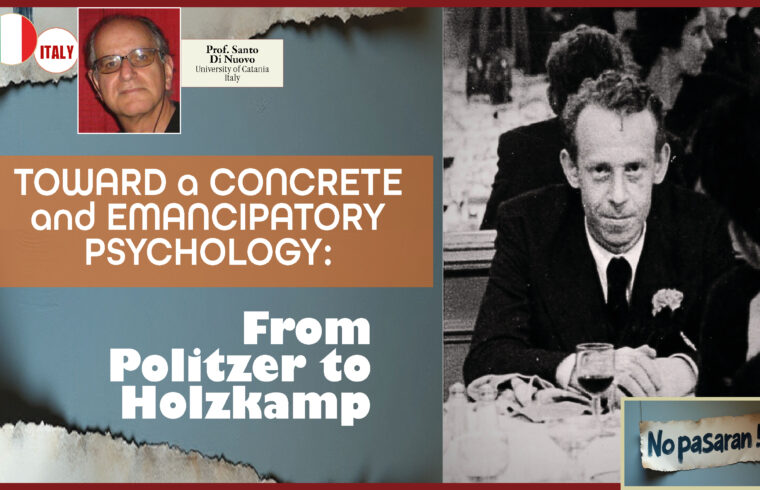
Santo Di Nuovo (University of Catania, Italy)
- Politzer and Freudian psychoanalysis
György (Georges) Politzer, a Hungarian-French Marxist philosopher killed by the Nazis in 1942, was undervalued in the history of psychology, till when the intellectual and political field during the 1970s contributed to a better understanding of his work (Bianco, 2022).
Politzer was deeply interested in psychology, but considered it purely organic or too abstract, i.e., “mythological and pre-scientific”. To emphasize the concrete aspects of psychology, he was initially attracted by Freudian psychoanalysis, whose early aim was to start from human needs. However, the meta-psychological aspects of Freud’s work were considered abstractions not useful for social advancement. Politzer defined “entirely provisional” the theoretical framework of psychoanalysis, “hypostases” the basic concepts as Libido, Repression, Censorship, and “working hypothesis” the distinction between the levels of consciousness.
For Politzer (1928) the psychology should address persons and not “physio-chemical structures”. The daily experiences of the persons constitute a drama, playing a role or being the witness of living scenes and actions. Some aspects of this drama is treated by psychoanalysis, but they are “obscured by the heavy mass of elucubrations”. Complexes are proposed in place of the real driving forces of history; an idealised unconscious overcomes consciousness of the actors of the human drama (Politzer, 1939).
This critique has been compared to that of Sartre, even though the philosophical divergence between them (Tomès, 2012).
Although Freud’s trial to rebuilt metaphysical psychology failed due to methodological shortcomings leading him to new abstractions, his work remains crucial for understanding the object of psychology, i.e. the concrete drama of the daily living. Unfortunately, psychoanalysis as a basically “concrete” approach was contaminated by abstractions of classical psychology.
Politzer rejected Freud’s operational concepts because they were abstract. But, according to Althusser (1963), “Problem is not between abstract and non-abstract concepts—that is, non-concepts—but between scientific concepts and abstract, non-scientific concepts.”
We will deal with Politzer’s scientific approach to concreteness, starting from his book “Critique des fondements de la psychologie” (1928).
- Toward a Concrete Psychology
Politzer explains how psychology should evolve to understand and transform the concreteness of human life, but taking into account that the aim is not to hold the “secret” of life, because this secret is not basically psychological, but is grounded in socio-economic background of all living dramas, overcoming the individual perspective. According to the Marxian theory, the concreteness of the sciences (including psychology) lays in these premises, rooted in the dialectical materialism.
Politzer’s “concrete psychology” (he founded a Journal of that name in 1929, but only two issues were published) had resonances both in Marxist authors as well as in psychoanalysts (e.g., Lacan). But also phenomenology was involved: To transcend the genetic and meta-psychological aspects of psychoanalysis, as Politzer suggested, explaining (and treating) existential experiences, Husserl’s concept of intentionality can be useful, as proposed earlier by Binswanger and Jaspers.
Another connection with the phenomenological approach is the search for a method to understand (different from explaining) the essential being of the mind, not reducible to its physiological components even if grounded on them: i.e. the historically experienced subjectivity, the ‘drama’ as object of psychology. The search for the significant intention of actions, concretely immersed in experienced space and time, putting aside (other phenomenological suggestion) the theoretical and schematic reconstruction of the specific case, as occurs in the natural sciences and in nosographic approaches based on abstract categories.
The method is far different from the introspective analysis typical of Wundt’s approach and from Freudian psychoanalysis: It is “understanding” which makes the subject reflect on his experiences, in a self-narration that refers to the concrete materiality of his life, and the pathology that can occur within it. Understanding the concrete lived totality of the subject occurs by bringing together the externally observable gesture and the narrative that clarifies it, expressed through language (defined as the act of the subject making himself transparent to himself), unlike both classical psychology and Freudian metapsychology.
Certainly, Politzer’s premature death for Nazi barbarity left his “concrete psychology” still in draft, without the insights being organized into a more detailed framework. We will now mention the resonance these insights had in the history of science in the second half of the twentieth century.
- Concrete psychology after Politzer
Another Hungarian-French philosopher, Ferenc Mérei, shared with Politzer not only the involvement in the Communist movement, but also a theory of psychology grounded in interactions and conflicts (the human drama), rather than in abstractions derived from laboratory psychology or from Freudian psychoanalysis. Differently from Politzer, Mérei applied concrete psychology in researches in social and clinical psychology (Pléh, 2022).
Also Lucien Sève appreciated Politzer’s thinking and drew inspiration from it for his work “Marxism and the Theory of Personality,” published in the midst of the 1968 movement (Roudinesco et al., 1990). In this book personality is defined – similar to what the social psychoanalyst Erich Fromm was writing in the same period – as a product of social relations, in strong opposition to theories considering personality as a mixture of genetics and learned behaviours.
Sève challenges the psychosocial doctrines which, while considering the individual to be determined by the environment, consider this environment external to the individual. Avoiding the “typology” of psychophysiological or psychosocial characteristics abstractly categorized, the concrete psychology should be a “topology” based on the position of historically determined persons within the network of social relations and economic systems in which they are inserted. Personality psychology is based on history and economics, and addresses the concrete problems and conflicts of human beings within society, within working and production relations. Human sciences, from psychoanalysis to sociology, including personality psychology, cannot avoid historical materialism without the risk of abstraction and loss of concreteness, what was the main Politzer’s concern.
Another author who can be linked to concrete psychology was the German psychiatrist and psychoanalyst Alexander Mitscherlich. His book “Disease as Conflict” (1966) linked critically medicine, psychoanalysis and social theory to understand the trauma induced by modern life. Inner conflicts, and consequent psychosomatic diseases, are often caused by social burdens, e.g. loss of structuration of families and social groups, decline of authority, stressors of urban life, technological changes, and work constraints. Psychology should address these issues to be useful for the concrete needs of individuals and societies. But is this possible with the classic empiric methods of psychology, or other methods have to be found?
- The critical-emancipatory psychology
The experimental psychology, which stemmed from the conception and methods of the natural sciences, based on laboratory research, ignores the historical aspect of life but dealt with “carefully demonstrated irrelevances” (Mitscherlich, 1966; Minguzzi, 1974), and therefore is not useful to the concrete person and social groups who make decisions pertaining to the reality of his life. We must find a way to bring the structure of experimental reality closer to the structure of everyday reality, so that psychology can reflect the historical contexts on which persons depend and in which they operate. The research on the “secondary dependencies” of the individual on society, and the possibilities for modification, gives to psychology “emancipatory relevance”.
In the fruitful post-1968 cultural period we find in Germany, at the Freie Universität of Berlin, the “critical psychology” of Klaus Holzkamp (1972). In a historical-systematic point of view (Teo, 1998) his work can be divided into a pre-critical period (until 1968, rising both from social movements and internal problems of traditional psychology), a critical-emancipatory period (1968-1972), a critical-conceptual period (1973-1983), and a subject-scientific period (1984-1995, when alternative critical approaches emerged).
In a critical approach to psychology, its legitimate focus is not the abstract and isolated individual, but the real, living, and historical human being. Only this radical modification of the epistemological roots can enable psychology to achieve coherent, sensible, and relevant concepts and social applications. The frame of reference for determining the relevance of psychological research is the concrete socio-historical situation of the persons and social groups (as already Vygotsky said many years before).
The functionalism, contrasting the American version of Wundtian elementary psychology, namely Titchener’s structuralism, leads to the refusal of a “consciousness in general,” the structure of which psychology should investigate, and to address humankind in the needs and conflicts of everyday life. But the methodological impulse of functionalism to study the efforts of people to fulfil and shape their own existence was overcome by the operationalisations of behaviourism and the ‘objective’ schemas of neurophysiology.
Critical psychology goes beyond the generic concept of “everyday life” as a criterion for the relevance of psychological research. Transcending the many everyday lives of individual people we should reach a “general” everyday life, i.e. the socio-historical situation representing the “objective” form of society in a specific context of space and time. This objectivity is not the pure opposite of the “subjective” perception of the life, i.e. an abstraction constructed from the ways of experiencing and behaving of individual persons, or existing only as a product of their thinking. It corresponds, in the terms of critical psychology, to “the historical-materialist conception according to which the form in which man maintains his life as a specific being through social labour decisively determines the manner of his social communication, his self-view and worldview, and his scientific and artistic production” (Holzkamp, 1972).
The general superordinate form regulates human life and relations, determining the modes of development of specific individuals, and the variations they are allowed to realize in particular – idiographic – behavioural and phenomenal possibilities of life. In this sense the general form of society, remaining objective, is always subjectively mediated, being only expressible through the subject. Therefore, the research methods should reach both these levels to trust a really concrete psychology.
The critical-emancipatory research in psychology was considered by Holzkamp as “exemplary practice conducted under controlled conditions”, which anticipates scientifically a practice to be applied to everyday life, under the conditions and in ways that research has shown to be most effective and efficient. The control of conditions during experimental practice is ensured by the research methodology: This recalls models of intervention research, “action research” in Kurt Lewin’s sense. Mayers (2019) defined “Critical Psychology as a particular approach of action research advanced”. Societal meaning structures represent opportunities for action, and research allows studying the actions, collecting them as examples for reconstructing scientifically the overall meaning, and acting for changing it in specific contexts. “The topic of the actual-empirical research [aktualempirische Forschung] is the (inter-) subjective experience of action necessities, possibilities, and restrictions, and the persons concerned, being the subjects of such experience, can in principle only appear as active co-researchers, not as passive objects of investigations” … So, the psychical is “a subject-bound active reflection of the objective reality” (Mayers, 2019).
“Subjectively grounded action” is analytical unit and unifying key category for the psychology, beyond a multiplicity of methods used in specific situations. The possibility of the research practice becoming ‚exemplary‘ depends on the diversity and multiplicity of the situations to which it can be generalized and transposed. This aspect is also reflected in the methodology of cumulative analysis of the results of individual studies, which can be achieved, for example, with recent meta-analytic techniques. As Holzkamp recalled, methodological procedures and multidimensional data analysis can be useful contributions to critical-emancipatory psychology.
In the logic of critical psychology, there is no longer a distinction between “pure” research (in laboratory, mainly psychophysiological) and “applied” research (predominantly social and clinical). Likewise, there is no room for abstract theories, generalized a priori with respect to concrete scientific validation. The relationship between theory and practice is defined by considering the former as the set of conceptions, perspectives, and programs for direct practice. Practical examples could be the study of work-correlated stress, new compulsive dependences, abuses of Artificial Intelligence, constraints in educative institutions.
The abstract man of nomothetic-generalizing psychology, like that of the “natural sciences,” whose empirical foundation is not historicized, must give way to the person inserted into a context of existential practice, whose presuppositions and effects are defined by science—with the advanced methods available today. Methods can be different, but finalised to a common epistemological design, typical of concrete, critical psychology: “In the context of such an integrative methodology, methodical specialisations—not disjunctions! —are accounted for by different aspects of the subject matter and of different research concerns” (Mayers, 2019).
Thus, psychological research can attempt to recover the specific concreteness of the actual lives of individuals and social groups, and propose methods and tools for an emancipatory practice, “at the service of a more rational ordering of human coexistence” (in Holzkamp’s words), fulfilling Politzer’s pioneering aspiration.
References
Althusser A. (1963-1964) Psychanalyse et sciences humaines: deux conférences, Librairie Générale Française, 1996.
Bianco G. (2022) Georges Politzer’s “brilliant errors”: Concrete psychology in France (1930–1980). History of Psychology, 25(2), 170–189.
Holzkamp K. (1972) Kritische Psychologie. Vorbereintende Arbeiten, Fischer.
Mayers W. (2019) Klaus Holzkamp’s contribution to the unity of psychology, Annual Review of Critical Psychology,16, 69-79.
Minguzzi G. F. (1974). La ricerca irrilevante. Giornale Italiano di Psicologia, 1(1), 3-8.
Mitscherlich A. (1966) Krankheit als Konflikt, Suhrkamp, Frankfurt am Main.
Pléh C. (2022). Two versions of Marxist concrete psychology: Politzer and Mérei compared. History of Psychology, 25(1), 68–90.
Politzer G. (1928), Critique des fondements de la psychologie. 2nd reprint, Presses Universitaires de France 2003. Retrieved at https://wikilivres.org/wiki/Critique_des_fondements_de_la_psychologie
Politzer G. (1939) La Fin de la Psychanalyse, Revue La Pensée, 3, 13-23. Retrieved at https://wikilivres.org/wiki/La_fin_de_la_psychanalyse
Politzer G. (1947), La crise de la psychologie contemporaine, Éditions sociales.
Politzer G., (collected 1973). Écrits, 2. Les Fondements de la psychologie, Éditions sociales.
Roudinesco E., Lacan J. & Al. (1990). A History of Psychoanalysis in France 1925-1985, University of Chicago Press.
Sève, L. (1969), Marxisme et théorie de la personalité, Éditions sociales.
Teo T. (1998) Klaus Holzkamp and the rise and decline of German critical psychology. History of Psychology, 1(3), 235-253.
Tomès A. (2012) Sartre et la critique des fondements de la psychologie: quelques pistes sur les rapports de Sartre et de Politzer, Bulletin d’Analyse Phénoménologique, VIII, 1, (Actes 5), p. 223-244.