DANIEL NĂSTASE
National Federation of Culture and Media Unions CulturMedia • Legal Adviser • ROMANIA
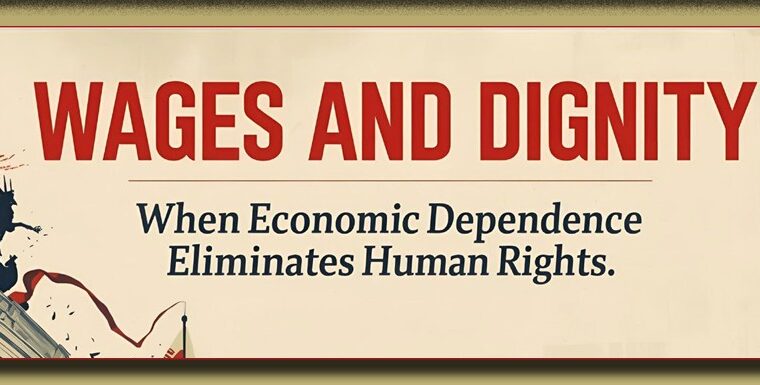
„Is not the human being, reduced to salaried dependence, already dis connected from human rights?“. This question, more philosophical than strictly legal, has the merit of placing a fundamental tension of the modern world at the center of our attention.
On the one hand, work is a pillar of dignity and of individual and social progress. On the other hand, its predominant form—the employment relationship based on a wage— carries within it the seeds of dependence that can, under certain conditions, undermine the very notion of fundamental rights.
Let us start from the foundation. The cornerstone of human dignity in the context of work is enshrined at the highest level. The Universal Declaration of Human Rights, in Article 23, stipulates that „everyone has the right to work, to free choice of employment, to just and favourable conditions of work“ and, crucially, to „just and favourable remuneration ensuring for himself and his family an existence worthy of human dignity“. This principle is echoed and reinforced by countless treaties, international pacts (such as those of the International Labour Organization), and, at the European level, in nearly all Directives that regulate labor relations.
Thus, from a normative standpoint, a wage is not a mere price paid for a quantity of labor. It is conceived as a tool for achieving human dignity, a bridge between the effort expended and a decent life.
The slippery slope:
From contract to dependence
The problem arises when the contractual balance—theoretically, an agreement of wills between equal parties—transforms into an imbalanced power dynamic. The employee, by their very nature, is in a position of legal subordination to the employer. However, when a stringent economic dependence is added to this subordination, the human being risks becoming a mere resource, a factor of production.
Salaried dependence becomes problematic when the employee, for fear of losing their sole source of income, begins to renounce, tacitly or explicitly, the rights that should be inalienable:
How many employees accept risky working conditions or an exhausting work pace that leads to burnout, for fear of being dismissed?. Here, European directives on health and safety at work act as a protective
mechanism, but their application often depends on the employee’s courage to report irregularities.
• The right to private and family
life: The pressure to be permanently „connected,“ to answer emails and phone calls outside of working hours, blurs the line between professional and personal life. The right to disconnect, a concept increasingly discussed at the European level, is a direct response to this erosion of a fundamental right.
• Freedom of expression:
In atoxic work environment dominated by fear of reprisal, an employee may censor their opinions, ideas,or constructive criticism. They are no longer a collaborator but a silent executor, and creativity and innova
tion are the first victims.
• The right to dignity:
When an employee accepts humiliating treatment, harassment, or inappropriate language from a superior for fear of not being able to pay their mortgage or rent, salaried dependence has already nullified a fundamental human right.
Good Faith:
The lifeline of dignity
Labor legislation acts as a safety net, establishing minimum limits—the minimum wage, maximum working hours, safety conditions—below which the employment relationship becomes, legally, unacceptable:
However, the law cannot regulate everything. The true disconnection from human rights occurs not only in the sphere of illegality but also in the gray area of „tolerated legality“. This is where the essential principle of good faith comes into play, which must govern the entire employment relationship.
Good faith means that the employer understands that beyond the contract, there is a human being with needs, aspirations, and limits. It means building a partnership, not exploiting a vulnerability. It means offering not just a wage, but also respect, psychological safety, and development prospects. For the employee, good faith means loyalty, professionalism, and fulfilling their duties with responsibility.
Wages as a tool, not as a goal
Returning to the initial question, the answer is nuanced. Salaried dependence in itself does not automatically disconnect the human being from their rights. It is a feature of the current economic system.
However, when this dependence is exploited to obtain submission, silence, or the renunciation of fundamental rights, then yes, the disconnection is real and dangerous.
The challenge for our society, for legislators, for employers and employees alike, is to ensure that the wage remains what it was meant to be according to the spirit of human rights: a tool for a dignified life, not a chain that binds a person to the fear of tomorrow.
Balance and good faith are not abstract concepts, but the essential conditions for work to elevate, not deabase, the human being.