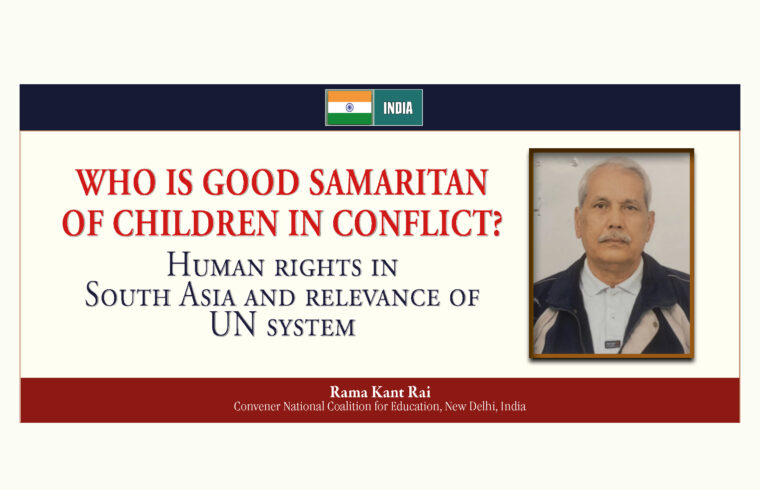
Rama Kant Rai
Convener National Coalition for Education, New Delhi, India
The league of Nations, was emerged from the Paris Peace Conference in 1919, that marked the first serious effort to create a universal system of collective security. Its mission was to settle interstate disputes peacefully and, if necessary, to deter, defeat and punish unlawful aggression. Unfortunately, these noble aspirations outstripped the league’s meagre authorities and capabilities. its lack of effective measures for peace enforcement, proved it to be a toothless tiger.
This resulted in sheer disappointment and at finally emerged the United Nation during 1945 in San Francisco. After the failed outcome lessons of ‘League’ new initiative was taken and U.N. Charter created a Security Council with the authority to pass binding resolutions on U.N. member states and authorize massive coercive power. In return for serving as joint custodians of world order, the council’s permanent members were granted the prerogative under Chapter 7 of blocking any U.N. enforcement action they perceived as contrary to their national interests.
Undoubtedly UN has done commendable work globally in terms of health, preventive measures like immunization, curbing notifiable diseases and so on. While they have saved lives in disastrous situations, but in areas of conflict and preserving human rights they are often slow, bureaucratic, and plagued by mismanagement. In the area of human rights, the UN leadership is hesitant to call out powerful nations for their abuses and to take deterrent action.
Its 2030 Agenda and the SDGs serve as a binding force for the international community. However, the noble goal of SDG can be realized only when there is peace and conducive environment free of conflict. Also the crunch of poverty and reduced investment of children education pose before UN a major concern, particularly in developing nations.
Role of security Council during conflict:
In its current form, the UNSC has failed to preserve international peace and security when a powerful and permanent member is an aggressor or a friend of a P5 member acts aggressively in a conflict.
Some cases of conflicts affecting civilians and children:
- Bangladesh
In a recent rampant mob action in Bangladesh UN has come across some findings:
Based on deaths reported by various credible sources, the report estimates that as many as 1,400 people may have been killed between 15 July and 5 August, and thousands were injured, the vast majority of whom were shot by Bangladesh’s security forces. Of these, the report indicates that as many as 12-13 percent of those killed were children. Bangladesh Police reported that 44 of its officers were killed.
It also found police and other security forces killed and maimed children, and subjected them to arbitrary arrest, detention in inhumane conditions and torture.
Hindus, Ahmadiyya Muslims and indigenous people from the Chittagong Hill Tracts were also subjected to human rights abuses. While some 100 arrests in relation to attacks on distinct religious and indigenous groups have reportedly been made, the perpetrators of many other acts of revenge violence and attacks on such groups still enjoy impunity, the report.[1]
- Hindus in Bangladesh Face Existential Threat
Centre for Integrated and Holistic Studies (CIHS) had in August 2024 released a report titled “Hindu Genocide Unfolding in Bangladesh,” . As per CIHS and UNHR reports and UNHR observations highlight a harsh reality: a systematic record of violence, displacement and persecution against a religious minority group in a state that takes pride in pluralism.
Some specific incidents highlighted in the report are torching of three temples and the looting of about 20 houses in Burashardubi, Hatibandha and Lalmonirhat.
Violence in Bangladesh mid-last year (2024) is not a lone phenomenon. The Hindu population in Bangladesh has been progressively dwindling due to amalgamation of targeted violence, legal discrimination and systemic exclusion.
According to census 2022 data, Bangladesh’s population was 165,191,648 having disappearing Hindu population substantially as detailed below:
- In 1947, Hindus comprised nearly 29 per cent of Bangladesh’s population (then East Pakistan).
- By 1971, during the time of Bangladesh’s independence, percentage ofHindu population had fallen to 19.8 per cent.
- Hindupopulation is put at 7.95 per cent in 2022 census, as consistent with exodus out of fear and insecurity.
The reason for this decline is threefold—state indifference, mob violence and land grabs through Vested Property Act which has traditionally allowed seizure of Hindu-held property on various pretexts.
One of the worrying features brought out by UNHR report is the failure of law enforcement agencies to act. In spite of large-scale nature of the attacks, there was an overwhelming failure to intervene to save Hindu communities. This institutionalized impunity has encouraged perpetrators to continue perpetrating violence against minorities in a cycle of repetition.
Organizations like Transparency International Bangladesh (TIB) have documented that minorities, including Hindus, had faced brutally in initial 100 days of interim administration. The TIB report mentioned more than 2,000 cases of communal clashes noting the growing role of religion-based politics in Bangladesh.[2]
We congratulate Bangladesh for having new Prime Minister Mr Tarique Rahman whose actions and manifestations are very secular and progressive. We hope it will develop a conducive environment and foster friendship between neighbouring nations.
- Pakistan; Our unavoidable neighbour:
Since the very inception of creation of Pakistan in 1947, the conflict between India and Pakistan
has persisted, particularly in the region of Jammu and Kashmir. This longstanding conflict has
led to four wars over the territory, following with recent conflict called “Operation Sindoor”.
Border areas of Jammu and Kashmir face shelling and displacement. Conflict and forced relocation are intricately connected, and the repercussions of displacement significantly affect an individual’s daily life. Moreover, this upheaval has a substantial impact on the educational trajectory of children, leading to disruptions and hindrances in their academic performance.
Children, being particularly vulnerable during conflict and displacement, experience profound
challenges in their educational pursuits. Relocation often leads to disruptions in their schooling, as the upheaval causes a break in their academic
Drones, shelling
As tensions between India and Pakistan escalated sharply after Operation Sindoor across India’s northern and western frontier regions.
The conflict represented the first time in recent decades that civilian populations in Indian towns and cities in the region had come under threat from Pakistani military action – attempted attacks reached as far into the Indian heartland as Sirsa in Haryana, around 260 km from New Delhi, where a Pakistani missile was shot down and crashed in a field.
Kashmir
Kashmir has been the epicentre of conflict between India and Pakistan since the lines of partition were drawn in 1947. Historically, there have been four wars between the two nations; in 1947-48, 1965, 1971, and in 1999. The most recent of these saw over 30,000 soldiers and civilians being killed. Besides these wars, both nuclear nations have been continuously at low-level conflict, with skirmishes breaking out on a regular basis.
In recent years, ground operations have seen attacks on civilians and soldiers by both countries’ forces. Explosive weapons, including grenades, mortars and other forms of shelling have caused casualties on both sides. In total, Action on Armed Violence (AOAV) recorded 1,091 deaths and injuries from explosive weapons in Kashmir, (in both Indian and Pakistan-administered areas,) according to English-language news reports between 2011 and 2016. Of these, 69% have been civilians.
The majority of civilian casualties (88%) have been caused by the use of explosive weapons in populated areas (EWIPA), such as villages, schools, hospitals, and residential areas. When explosive weapons have been used on populated areas in Kashmir, 84% of the casualties have been civilians.
Damage to schools
During recent conflict between India and Pakistan shelling along the line of control has caused major disruptions in education for both countries.
Further unrest in 2016 led to the closure of nearly 300 schools in Indian villages of Jammu, Samba and Kathua districts, which are situated within 2.5 km of the border. The order came after there was heavy shelling by Pakistani forces in the area leading to the deaths of 14 civilians.
Pakistani minister’s „open confession“
Pakistani minister’s „open confession“ to training and funding terrorists, at the United Nations, amid soaring tensions between the two nations in the aftermath of the Pahalgam terror attack that left 26 tourists dead in Jammu and Kashmir. Pakistan Defence Minister Khwaja Asif had admitted in a recent interview that his country has backed terrorism over the decades.
[3]. The Impact of Explosive Violence on Students and Education in Kashmir,, By Shehryar Ali on 24 May 2018
[4]. How the India-Pakistan fighting affected children near the border and across the country, Parents avoided shrill, fearmongering television news, and tried to drown out the sound of drones and shelling with cartoons ,Johanna Deeksha ,May 18, 2025
Way Foreword:
The continued conflicts be it in India, Pakistan, Bangladesh, Gaza, Ukraine Cambodia and so on affects not only civilians but also the schooling and wellbeing of children. This poses a big threat before SDG and other international covenants signed by the member countries. Unfortunately, children have no voice to prevent this grave situation and protect them. UN has a noble role to monitor and protect children from atrocities and violence. The UN doesn’t use deterrent actions to protect the children from such situations.
It will be imperative that UN organs, especially the UNSC, must have better representation from Asia, Africa, and Latin America.
The UN has a summoning power, bringing together leaders on a global platform. It has a voice through its Secretary-General and has been able to give a platform to suppressed causes at a time when civil society’s space is shrinking.
The US has faced severe criticism for defending Israel by vetoing several UNSC resolutions related to the ongoing conflicts and the resulting humanitarian toll in Gaza.
It is high time to make UN more responsive in calling upon responsible states to conflict to respect international humanitarian law and end grave violations. This includes signing and fully implementing Action Plans with the UN.
UN should also ensure to make it imperative that member states refrain from using explosive weapons in civil and school as well as hospital area.
Un should promoting non state actors and NGOs in protecting and rehabilitating children affected from conflicts.
All states are signatories to UNHDR and SDG. It makes them accountable to comply with these promises and UN has a strict role to monitor and ensure that member states must not ignore from these covenants.
We at POLITEKNIK strongly request UN to honour the international covenants in favour of children (Children cannot await for tomorrow)
[1] . Bangladesh: UN report finds brutal, systematic repression of protests, calls for justice for serious
[2] . Hindus in Bangladesh Face Existential Threat, CIHS, UN reports meticulously documented atrocities against minorities while Yunus government is on denial mode.Pummy M Pandita