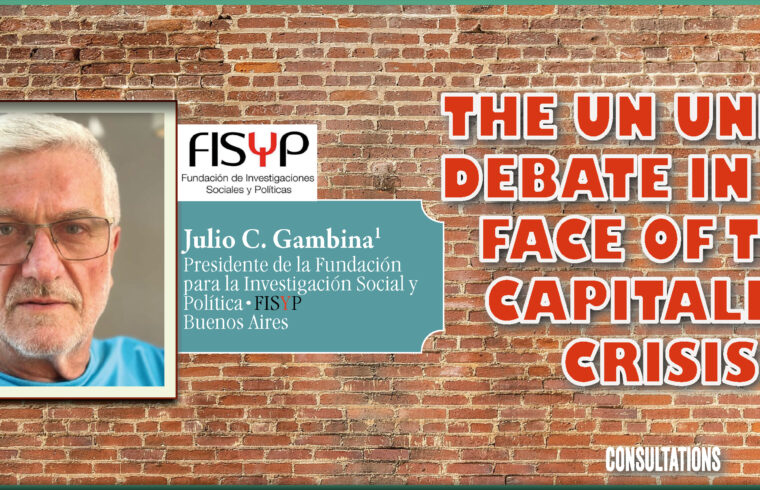
By Julio C. Gambina[1]
Presidente de la Fundación
para la Investigación Social y Política•FISYP Buenos Aires
The call to discuss the geographical location of the United Nations (UN) is part of the ongoing loss of credibility of the organization. More strictly speaking, the underlying issue is the loss of function of the organization in times of contemporary capitalist crisis and the ongoing struggle for hegemony in the global system. We should remember that the League of Nations (LN) emerged at the end of the First World War (1914-18) as an attempt to establish a framework for international relations in the postwar period. The structural limitation of the League of Nations was the non-participation of the US and the USSR, but also of Germany, in fact, the powers that would define the world order in the following years, until the current crisis.
The UN emerged at the end of World War II as part of political and diplomatic agreements between the US, the USSR, Great Britain, China, and France. The organization is the result of relative global equilibrium, which, through the Cold War, established the bipolarity of the world system between capitalism and socialism (1945-1991). With the disintegration of the USSR in 1991, a new stage in the global system of international relations began, under the anti-historical premise of the “end of history” and the “end of socialism,” which enabled an ideological logic of propaganda and manipulation of global social consciousness regarding the triumph of capitalism. This resulted in the unilateralism of the extended domination of the capitalist regime: exploitation and plunder.
Furthermore, under the conditions of the Cold War and the US foreign policy initiative, through NATO, a system of global organizations was consolidated under the UN’s orbit with clear US dominance, especially the International Organizations, the IMF, and the World Bank, with the role of the “dollar” at the center of the global monetary system, now in crisis; just as other UN agencies operated. This situation was aggravated in 1971 with the inconvertibility of the dollar unilaterally decreed by the US. This monetary crisis, together with the ecological and energy crises, led to greater conditioning of world politics under the logic of “liberalization” and the extension of the dollar’s dominance, especially with the “petrodollar” as the US response to the overall capitalist, oil, financial, and ecological crisis.
Global capitalism has changed a lot in the last half-century, between the crisis of the 1960s/1970s and the one that has been evident since 2007/2009. There are structural changes in the exploitation of the workforce, with a direct regressive impact on the forms of organization of workers and their trade unions, territorial, social, and economic organizations, deteriorating incomes and social and pension benefits. At the same time, the plundering of common goods has been intensified in response to the demand for strategic resources such as land, water, minerals, biodiversity, etc., in times of internationalization of production and transnationalization of capital.
Exploitation and widespread plundering have grown over the last half-century and are at the heart of the dispute over the production and accumulation of value and surplus value, the essential core of the dispute over hegemony.
We are witnessing the growing universalization of the capitalist regime, as we describe the essential process of capitalist development, with the spread of wage labor, increasingly irregular due to corporate impunity, and the appropriation of common goods. This defines the “capitalist offensive” against workers and peoples for half a century, which now takes on relevance in the sphere of politics and the governance of nations as an “offensive by the extreme right”.
The trend is toward growing authoritarianism at the local level in countries and in the global system, with “unilateral sanctions” from Washington that break down rule-based relationships. That is why the US hegemony is promoting a re-establishment of the world order with the so-called “Peace Council” or “Peace Board,” with Trump as permanent president, while at the same time emptying and defunding the ineffective UN and its agencies.
The comprehensive economic, political, and cultural crisis of the capitalist order demands that the voices of workers and peoples be amplified through a series of grassroots initiatives to confront the strategy of domination and create the conditions for anti-capitalist transformations and socialism at the local, national, regional, and global levels.
This debate over the relocation of the UN headquarters provides an opportunity to discuss the conflicting strategies of power and counterpower, class struggle, and the reorganization of the labor and popular movements with a view to revolution against capital, against all forms of discrimination and racism, and for peace and social and natural life.
Buenos Aires, February 1, 2026
[1] Doctor of Social Sciences, UBA, Argentine Republic. University professor of Political Economy. Member of the secretariat of the UIS of Pensioners and Retirees of the World Federation of Trade Unions. Member of the Board of Directors of the Latin American and Caribbean Society of Political Economy and Critical Thinking, SEPLA. Member of the Committee for the Abolition of Illegitimate Debt, CADTM-AYNA, as part of ATTAC Argentina. Member of the Leftist Political Movement, CPI, in Argentina.