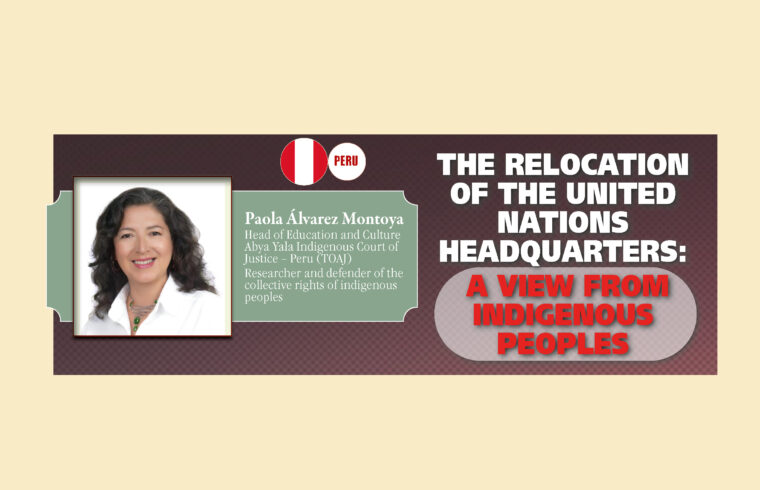
Paola Álvarez Montoya
Head of Education and Culture Abya Yala Indigenous Court of Justice – Peru (TOAJ)
Researcher and defender of the collective rights of indigenous peoples
The discussion on the relocation of the United Nations headquarters has now taken on historical significance. This is not just an administrative or logistic decision, but a deeply political and ethical debate linked to the fulfillment of the founding principles of the Organization itself: peace, self-determination of peoples, respect for territorial sovereignty, and the comprehensive protection of human rights, both individual and collective.
From the point of view of indigenous peoples, it’s legit to question why a country whose current government actions are seen by many in the international community as going against these principles should still be the permanent host country for the UN Headquarters. The neutrality, independence, and ethical integrity of the Organization are inevitably strained when its structural functioning depends on a state with internal and external policies raising serious questions regarding human rights, territorial sovereignty, and migration.
The UN’s historical debt to indigenous peoples
We, the indigenous peoples of the world, observe that, since the creation of the UN, real progress in republican states established on indigenous territories has been limited and uneven. Although we recognize that there is no such thing as a perfect legal instrument, it is also true that the UN has produced fundamental normative tools, such as ILO Convention 169 and the United Nations Declaration on the Rights of Indigenous Peoples (2007), which recognize collective, territorial, cultural, legal, and political rights that have long been denied.
However, these advances have been restricted by a structural reality: it is the States that ratify, interpret, and apply these instruments in accordance with their political and economic interests. This has often led to selective, formal, or symbolic implementation that doesn’t translate into real guarantees for indigenous peoples, especially regarding territory, self-determination, and free, pre-informed consent.
Power asymmetries and structural constraints
There is no denying that the global balance of power influences the functioning of multilateral organizations. The concentration of political, economic, and military power in certain states has historically conditioned the actions of the UN,
limiting its capacity to respond to systematic human rights violations and infringements on the territorial sovereignty of peoples and nations.
For indigenous peoples, this situation is particularly serious. Our territorial rights precede the formation of modern states and are recognized by international law. However, we continue to witness destructive policies, forced displacement, criminalization of territorial defenders, and systematic dispossession, all under the guise of development, democracy, or progress that reproduce colonial logic.
Not being passive observers
Remaining inactive or neutral in the face of these dynamics makes us passive observers of processes that threaten world peace and the survival of entire peoples. Peace cannot be sustained without justice, nor justice without respect for the cultural, ethnic, spiritual, and territorial diversity of the world’s peoples.
Indigenous peoples are not obliged to embrace Western ideologies or hegemonic cultural models. We have our own systems of organization, ancestral worldviews, forms of justice, and governance that have ensured balance with nature for millennia. What we demand is not privilege, but consistency between international discourse and state practice.
Moving towards real and structural indigenous representation
There is a growing demand among indigenous peoples for their own representative and pluralistic international organization that engages in direct and structural dialogue with the UN, respecting the cultural and organizational diversity of peoples. This process is complex and requires time, consensus, and resources; however, it cannot be postponed any longer.
While this is being consolidated, we, the indigenous peoples, demand that those who occupy representative positions within UN bodies act with real independence and fidelity to the founding principles of the Organization. Those who, by action or omission, support policies contrary to peace, the self-determination of peoples, or human rights must step aside to make way for ethical and structural renewal.
Relocation as a political and symbolic act
The relocation of the UN Headquarters should not be understood as a sanction, but rather as a political and symbolic act of institutional coherence, aimed at restoring credibility, decentralizing power, and reaffirming the truly multilateral nature of the Organization. Centralism and permanence
in a state that is questioned for its impact on international peace and human rights, weaken the message that the UN seeks to convey to the world.
A contradiction that must be resolved
It is deeply contradictory that indigenous peoples, as collective owners of territories rich in biodiversity and natural resources, are at the same time impoverished, persecuted, and criminalized. We are the ones who protect nature and sustain the ecological balance of the planet, yet we are treated as expendable populations.
This contradiction directly challenges the international system. The survival of indigenous peoples is not a sectoral issue: it is a condition for peace, climate justice, and the future of humanity.
Without the United Nations, world peace becomes a fragile balance, easily vulnerable to unilateral interests, which puts at risk not only international stability but also collective survival.
Arequipa, February 2, 2026