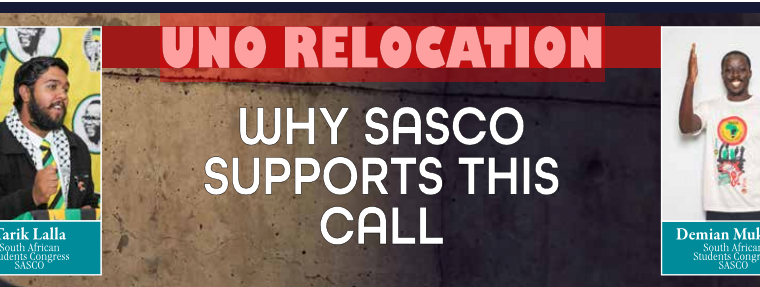
Tarik Lalla – South African Students Congress SASCO
Demian Mukansi – South African Students Congress SASCO
WHY SASCO SUPPORTS THIS CALL
WHY DOES SASCO WANT TO PARTICIPATE IN THIS CAMPAIGN?
The SouthAfrican Students Congress (SASCO) is the largest Student movement in South Africa. Contextualised by the tradition of liberation of the Mass Democratic Movement, SASCO exists as a Students’ movement, both as a vanguard of Students, but equally, as a mass-based Student Organisation.
SASCO’s commitment to internationalism is not an accessory to its politics but a fundamental pillar of organisational work, as articulated in our Strategic Perspective on Transformation (SPOT). Section 6.4 of the SPOT document explicitly identifies international work as one of the four pillars of SASCO, arguing that “we cannot improve our country and education system outside the context of the global situation we find ourselves in.” For SASCO, thestudent movement cannot be insular; the same global capitalist system that produces elitist, commodified education in South Africa also concentrates political power in Western-dominated institutions like the United Nations. Thus, when the campaign to relocate the UN headquarters and by extension, its agencies like UNESCO, emerges as a concrete struggle against Western hegemony and for a multipolar world order, SASCO recognises this as a direct extension of the National Democratic Revolution (NDR) onto the international stage.
The UNO-Relocation Dossier makes clear that the current location of the UN in New York is not neutral geography but a tool of imperial captivity, where visa denials, veto power, and structural bias serve the interests of a tiny minority of the world’s population. SASCO participates in this campaign because, as the SPOT document stresses, “the state and related institutions such as institutions of learning being the concerted expression of political power” must be transformed; and the same applies to global governance bodies. A Student movement that claims to fight for accessible, public, transformed education cannot remain silent while UNESCO remains head- quartered in the West, shaped by the very neoliberal orthodoxy that turns education into a marketable product. For SASCO, joining the relocation campaign is not a symbolic gesture; it is a strategic necessity to advance the NDR, build anti-imperialist solidarity through our existing networks (AASU, WFDY, BRICS student alliances), and demand that international law, peace,and education policy be determined by the Global South as much as the Global North.
How does SASCO view the
campaign
SASCO views the campaign to relocate, and critically, transform, the United Nations headquarters as a fundamentally anti-imperialist struggle, rooted in our organisation’s historical commitment to Pan- Africanism and the liberation of oppressed peoples. For SASCO, the UN’s current hosting by the United States is unacceptable, as Washington uses its position to dominate and systematically undermine the organisation’s democratic principles. Therefore, relocating the UN headquarters to the Global South is not merely a symbolic gesture but a necessary demand for a genuine shift in global power away from Western hegemony – what this relocation looks like remains up to the decision of the campaign. However, SASCO makes clear that it supports this call only if it is tied to deeper structural reforms: foremost among them, expanding the Security Council to include permanent members from Africa, Latin America, and elsewhere, and abolishing the veto power of existing permanent members. Moreover, the campaign must demand material change, not just geographical relocation: economic justice, a definitive end to neo-colonial relations, and the structural prioritisation of the needs of the Global South over the narrow interests of Western monopoly capital.
The Role of a Student Movement
in This Campaign
A Student movement occupies a unique and fundamental position in a campaign of this nature. First and foremost, Student movements bear the responsibility of conscientising the broader Student body and, through them, their communities. The university campus is not merely a site of learning; it is a site of ideological struggle, where future leaders, intellectuals, and workers are shaped. It falls to organised Students to draw the lines between the seemingly distant machinery of global governance and our immediate material conditions, by explaining how the functioning, location and structure of the United Nations directly impact access to education, economic justice, and the sovereignty of Global South nations. Without this educational work, a campaign for UN relocation remains abstract; with it, the campaign becomes a lived, debated, and owned struggle of the masses.
Secondly, a Student movement must act as an engine for building a popular front for the campaign. No single organisation, however large, can shift the balance of forces on an issue of global governance. The Student movement therefore has a strategic duty to reach to trade unions, community-based organisations, faith-based groups, academic staff, and political formation forging a united popular front that can lobby governments, pressure international bodies, and sustain the campaign beyond the fleeting attention span of social media. Students, positioned between the classroom and the community and between youth formations and labour movements, are uniquely placed to act as the organic link that transforms a good idea into a popular, multi-class, multi-sectoral movement. It is from this understanding of the Student movement’s fundamental roles, being conscientisation and movement building that SASCO’s specific potential in this campaign must be assessed. SASCO is a national Student organisation with structures across all provinces and all universities and colleges in South Africa, giving it the reach to conduct political education at an unprecedented scale. Through its affiliation with the Progressive Youth Alliance (PYA) and strong ties to Mass Democratic Movement (MDM) structures, SASCO already has direct access to organised labour and youth formations, providing a ready-made popular front. Nationally, the South African Youth Council (SAYC) further connects SASCO to broader youth structures, ensuring that the campaign is not confined to SASCO members alone but becomes a generational cause. Internationally, SASCO is linked to progressive student movements in the SADC region through the Southern African Students Union (SASU), the All- Africa Student Union (AASU), and the International Students Conference (ISC), in addition to bilateral student alliances with organisations in Africa, South America, and throughout BRICS countries. These networks allow SASCO to integrate the campaign across multiple fronts by (i) hosting joint political education sessions that build ideological coherence across borders; (ii) coordinating simultaneous campaign actions across provinces and countries to demonstrate collective strength; and (iii) by using existing labour and Student platforms to lobby governments and civil society at local, national, and international levels. In this way, SASCO does not merely participate in the campaign, it could form part of the campaign’s anchor. What is to be done: Activity Proposals and Organisational Preparedness SASCO proposes a mul- ti-faceted set of activities designed to build momentum for the UN relocation campaign from the campus level upward. First, political education sessions should be convened at university campuses nationwide to explain the UN relocation campaign and its direct links to anti- imperialism, drawing on the theoretical frameworks outlined in the SPOT document and the empirical arguments of the UNO-Relocation Dossier. Second, petition drives will target university Student Representative Councils (SRCs) to secure formal institutional endorsements of the campaign, transforming passive support into active political commitments. Third, public lectures and panel discussions will be organised involving academics, trade unions, and movement allies, ensuring that the campaign benefits from intellectual rigour and broad-based organisational backing. Fourth, social media campaigns will leverage existing Student platforms to raise awareness, disseminate educational content, and apply sustained public pressure on political organisations to take a stand. Fifth, lobbying through PYA and MDM Alliance structures will be undertaken to place the UN relocation campaign onto the formal agendas of broader progressive formations, ensuring that it becomes a shared priority rather than the concern of a single organisation. Finally, submissions will be prepared and delivered to the South African government and the African Union through existing Student and youth structures, translating grassroots mobilisation into formal policy advocacy. Regarding the extent of SASCO’s preparedness to undertake these activities, the organisation is fully equipped to lead political education and mobilisation at campus level across the country, drawing on its established presence in every province and tertiary institution. It is current undergoing the 4th Pillar of Struggle Petition, which can be found at the end of this submission. SASCO commits to coordinating with at least two other partner organisations for joint activities, thereby ensuring that the campaign is not siloed but embedded within a broader popular front. To guarantee consistent participation and uninterrupted communication with campaign management, SASCO will assign dedicated leadership as the primary points of coordination. Finally, campaign activities could be integrated into existing SASCO programmes and national events to ensure sustainability beyond the initial mobilisationphase, preventing the campaign from becoming a short-lived initiative and anchoring it instead as a standing feature of SASCO’s political work.