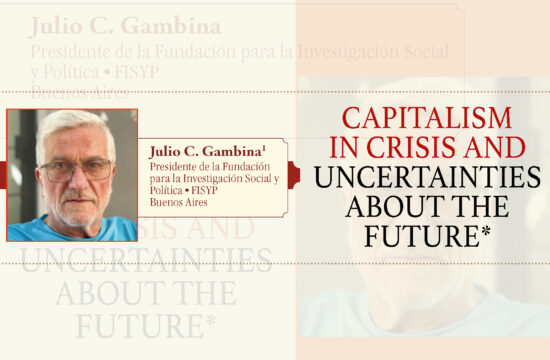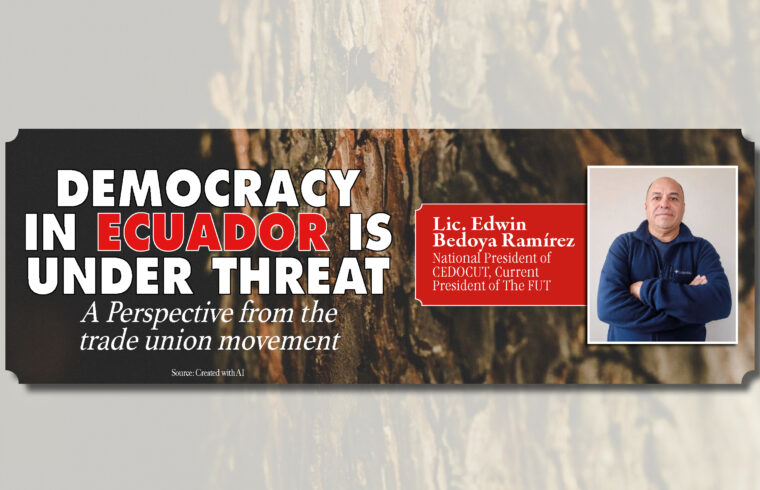
Lic. Edwin Bedoya Ramírez
National President of CEDOCUT, Current
President of The FUT
Main idea: democracy is not measured solely by elections, it is also measured by respect for rights, institutional independence, freedom of association, the right to protest, and the real opportunity for working people to participate in public life without fear.
Introduction
Democracy is not measured solely by the existence of elections. A true democracy is measured by the enforcement of rights, the independence of institutions, freedom of association, respect for social protest, transparency in government, and the ability of working people to participate without fear in the country’s political life. Viewed from this perspective, Ecuador is going through a deeply worrying situation: the rule of law is eroding, protests are being criminalized, social leaders are being persecuted, freedom of association is being undermined, and public institutions are being used as tools of political control.
The trade union movement must firmly denounce this reality. This is not just a dispute between political parties or a temporary conflict between the government and the opposition. What is being threatened is the democratic integrity of the country and the ability of workers, farmers, teachers, public servants, young people, women, and indigenous peoples and nationalities to exercise their rights without threats, without persecution, and without the state apparatus being used to silence criticism.
A democracy weakened by the concentration of power
Ecuador is undergoing a dangerous concentration of political power. When the executive branch tries to impose conditions on other branches of government, when oversight bodies are pressured, when attempts are made to control the judiciary, and when the country is governed through permanent states of emergency or decrees issued without social dialogue, democracy is emptied of its substance. This is not merely a legal problem; it is a social and political one. A government that refuses to engage in dialogue with workers, that does not listen to social organizations, and that responds to all criticism as a threat builds a democracy that is merely superficial and formal, but not a living democracy.
A worrying trend has emerged in recent years: every social demand is portrayed as an obstacle to development, every protest is treated as a threat to public order, and every grassroots organization is viewed as an enemy. Such an authoritarian perspective fails to recognize that labor organizing, protest, and social organization are pillars of any democracy. Without free unions, there is no labor democracy; without social protest, there is no citizen oversight; without political pluralism, there is no popular sovereignty.
The economic and social situation aggravates this scenario. Even though the government presents certain indicators as signs of stability, the reality for working households is quite different. According to INEC, in May 2026, full employment stood at just 36.6% of the economically active population, underemployment reached 18.3%, and unemployment stood at 3.1%. In other words, beyond a relatively low unemployment rate, the majority of the economically active population does not have full-time, stable employment with sufficient rights.
Social data revealing democratic decline
Poverty still hits hard. As of December 2025, income poverty stood at 21.4% nationwide, and extreme poverty reached 8.3%; in rural areas, poverty reached 37.6% and extreme poverty 19.7%. In addition, an individual was classified as poor if they lived on less than $92.40 per month per capita, and as living in extreme poverty if they lived on less than $52.07 per month. These figures reveal a painful truth: while there is talk of efficiency, austerity, and modernization, millions of Ecuadorians live on incomes insufficient to ensure a decent life.
The social crisis cannot be separated from the democratic crisis. An impoverished population, living in precarious conditions and lacking quality public services, has fewer real opportunities to participate on equal terms. Democracy is weakened when the right to health care, education, work, and social security become privileges rather than universal guarantees.
Corruption also erodes democracy. The 2025 Corruption Perceptions Index, released by the Citizenship and Development Foundation, the Ecuadorian chapter of Transparency International, shows that Ecuador scored 33 out of 100 and ranked 116th out of 182 countries. A minimal improvement does not change the underlying reality: citizens perceive a weakened, opaque state with serious problems of public integrity.
Judicial proceedings and prosecution: protest turned into a crime
One of the most worrying signs of democratic decline is the criminalization of social protest.
When union leaders, teachers, students, farmers, human rights defenders, or local officials are persecuted for speaking out, democracy ceases to be a place for participation and becomes a system of fear.
Protest cannot be considered a crime. Protest is a constitutional right and a legitimate tool for the people when institutions fail to respond. The labor movement has historically won rights through organization, strikes, marches, collective bargaining, and social pressure. The current attempt to criminalize these forms of struggle is, in reality, an effort to discipline the working class.
Judicial persecution operates in various ways: the opening of criminal investigations against leaders, administrative threats, the selective use of the justice system, the freezing of social organizations’ accounts, obstacles to the registration of union leadership, unjustified delays in labor proceedings, and smear campaigns. This set of actions leaves people defenseless. Trade unions without a legally recognized executive board cannot operate fully; organizations with frozen accounts are paralyzed; and union leaders facing legal proceedings are subjected to economic, emotional, and political attrition.
Freedom of trade union organization under threat
Democracy is also measured within the workplaces. There is no democracy if workers are afraid to join a trade union. There is no democracy if the Ministry of Labor delays the approval of union leaderships for months or years. There is no democracy if collective bargaining agreements are blocked, if labor disputes are not addressed, if labor inspections fail to protect workers, and if reforms are implemented without tripartite dialogue.
The International Trade Union Mission held in Quito from May 11 to 13, 2026, warned of the deterioration of labor and trade union rights in Ecuador and cautioned about the risk of a complaint under Article 26 of the ILO Constitution due to systematic violations of freedom of association, collective bargaining, and the right to organize.
We, as the trade union movement, must clearly state that freedom of association is not an administrative formality:
it is a fundamental human right. When a union leadership is blocked, the collective voice of workers is silenced. When collective bargaining is prevented, the redistribution of wealth is hindered When a union leader is persecuted, a message of fear is sent to the entire working class.
The CNE and the Deterioration of the Electoral System
The electoral context deepens concerns about democracy. The National Electoral Council must be an independent, impartial institution that safeguards the will of the people. Nevertheless, viewed critically by the trade union movement and various social sectors, the CNE appears increasingly subordinate to the political circumstances of the current government. The loss of credibility of the electoral authority causes the entire democratic system to enter a crisis.
The decision to bring forward the local elections to November 2026 drastically changed the political calendar and forced organizations to reorganize their candidacies, primaries, and internal processes on a tight timeline. This move was justified by the potential impact of the El Niño weather phenomenon, but it sparked strong criticism due to its political effects on opposition forces.
On top of this comes the deregistration of political organizations. On April 26, 2026, the CNE Plenary revoked the registration of Unidad Popular y Construye, citing failure to meet the minimum number of members required by law. Regardless of the specific legal debate, the political problem is clear: in a context of polarization, persecution, and institutional weakening, removing organizations from the electoral registry reduces democratic pluralism.
As a labor movement, we must be clear: the CNE cannot become a political operator. It cannot act with selective criteria. It cannot use the law as a tool to limit the participation of certain forces while favoring the ruling party. An electoral body that does not guarantee a fair process loses its role as an impartial arbiter and becomes a party with a vested interest.
Health and education: public services in crisis
The health crisis is a dramatic example of institutional decline. Recent reports have highlighted shortages of medicines and supplies, funding problems, and difficulties in public hospitals. Primicias reported in May 2026 that, according to the Ministry of Health’s Annual Operational Plan, the budget required for medications was USD 497.9 million, but only USD 202.9 million had been allocated. This shortage directly affects patients, families, and healthcare workers.
Education is also facing a critical situation. Poor infrastructure, violence in schools, insufficient investment, insecurity affecting, teachers and students, and the lack of comprehensive policies show that the state is failing to guarantee basic rights. The UNE has denounced serious problems with school infrastructure and insufficient investment, given that thousands of schools require intervention
When health and education deteriorate, democracy is weakened. There is no full citizenship when a family must go into debt to buy medicine, when a school lacks adequate conditions, when teachers are persecuted, or when students live in environments of fear. Defending public services means defending social democracy.
Social Democracy or Neoliberal Authoritarianism
The danger to Ecuadorian democracy is not limited to the electoral arena. It is also evident in the economic model. A country where poverty is on the rise, where government ministries are being downsized without proper planning, where public employees are being laid off, where institutions are being merged without technical studies, and where labor and social protections are being weakened, is moving closer to a more authoritarian state that offers fewer guarantees of rights.
The rhetoric of “efficiency” frequently masks austerity measures, layoffs, and the concentration of power. The downsizing of the state does not affect everyone equally. It affects, first and foremost, hospital patients, public school students, workers awaiting labor inspections, communities in need of environmental protection, unions seeking legal recognition of their leadership, and families who depend on public services.
Democracy cannot be reduced to voting every so often. Democracy means a decent wage, social security, public health care, quality education, freedom of association, collective bargaining, an independent judiciary, impartial electoral bodies, and the right to protest. When these elements are weakened, democracy becomes a facade.
The role of the trade union movement
Against this backdrop, the trade union movement bears a historic responsibility. It cannot limit itself to defending wages or collective bargaining agreements within specific sectors, even though these struggles are fundamental. It must take on the comprehensive defense of democracy, because without democracy there are no sustainable labor rights.
Trade unions must condemn the criminalization of protest, demand the independence of state functions, defend the autonomy of the CNE, reject political persecution, demand transparency in the use of public resources, defend public health and education, promote an agenda for decent employment, and demand effective compliance with international conventions
It must also build social unity. The defense of democracy cannot be left in the hands of the
political elites. It must be a task for workers, teachers, farmers, women, young people, retirees, indigenous peoples, working-class neighborhoods, social organizations, and democratic sectors. Unity does not mean silence or subordination; it means building a common platform against authoritarianism, corruption, precarious working conditions, and the deprivation of rights.
Conclusion: Defending democracy means defending working class people
Ecuador is at a decisive moment. Democracy is in danger when those who protest are persecuted, when social struggle is criminalized, when freedom of association is blocked, when the CNE acts under suspicion of partiality, when political pluralism is reduced, when health care and education are weakened, when corruption spreads, and when power is concentrated in the hands of a few.
The trade union movement must say this clearly: defending democracy means defending the people’s right to organize, to demand, to elect, to hold officials accountable, and to live with dignity. There is no democracy when there is fear. There is no democracy when unions are persecuted. There is no democracy when institutions are
hijacked. There is no democracy when there is hunger, unemployment, poverty, overcrowded hospitals, and neglected schools.
The urgent task is to build a strong national defense of a social, participatory, and popular democracy. A democracy where working people are not spectators, but protagonists. A democracy where institutions serve the country and not the government in power. A democracy where the CNE guarantees pluralism and not exclusion. A democracy where justice is not a weapon against opponents or a shield for the powerful.
History shows that rights are not begged for: they are won and defended. Today, defending democracy in Ecuador also means defending freedom of association, social protest, decent work, health care, education, social security, and popular sovereignty. That is the task of the trade union movement at this historic moment.
Summary of indicators used
| Indicator | Data cited | Source |
| Decent employment | 6.6% of the PEA in May 2026 | INEC, ENEMDU May 2026 |
| Underemployment | 18.3% of the PEA in May 2026 | INEC, ENEMDU May 2026 |
| Unemployment | 3.1% of the PEA in May 2026 | INEC, ENEMDU May 2026 |
| Income Poverty | 21.4% nationally in December 2025 | INEC, Poverty and Inequality, December 2025 |
| Extreme Poverty | 8.3% nationally in December 2025 | INEC, Poverty and Inequality, December 2025 |
| Corruption | 33/100; ranked 116th out of 182 countries in the 2025 CPI | FCD / Transparency International |
| Health | USD 497.9 million required for medicines; USD 202.9 million allocated | Primicias, May 2026 |
Sources consulted
- INEC – ENEMDU Labor Statistics, May 2026. https://www.ecuadorencifras.gob.ec/estadisticas-laborales-enemdu/
- INEC – Income Poverty, December 2025. https://www.ecuadorencifras.gob.ec/pobreza-por-ingresos/
- INEC – Poverty and Inequality Indicators, December 2025. https://www.ecuadorencifras.gob.ec/documentos/web-inec/POBREZA/2025/Diciembre/202512_PobrezayDesigualdad.pdf
- Citizenship and Development Foundation / Transparency International – IPC Ecuador 2025. https://www.ciudadaniaydesarrollo.org/2026/02/10/ipc-ecuador-2025/
- Citizenship and Development Foundation – Democratic plurality under threat: the dissolution of Unidad Popular y Construye. https://www.ciudadaniaydesarrollo.org/2026/05/13/pluralidad-democratica-bajo-amenaza-cancelacion-de-las-organizaciones-politicas-unidad-popular-y-construye/
- El Comercio – CNE Approves the Dissolution of Unidad Popular y Construye. https://www.elcomercio.com/actualidad/politica/cne-aprueba-cancelacion-a-unidad-popular-y-construye/
- El País – The early election in Ecuador shakes up the political landscape and corners the opposition. https://elpais.com/america/2026-04-14/el-adelanto-electoral-en-ecuador-sacude-el-tablero-politico-y-arrincona-a-la-oposicion.html
- CSA / CSI – International Trade Union Mission Denounces Serious Violations of Freedom of Trade Union Activity in Ecuador. https://csa-csi.org/2026/05/13/mision-sindical-internacional-denuncia-graves-violaciones-a-la-libertad-sindical-en-ecuador-y-alerta-sobre-posible-queja-ante-la-oit/
- Primicias – Spending on Medications and Medical Supplies for Public Hospitals. https://www.primicias.ec/economia/medicamentos-compra-crisis-salud-ministerio-gasto-insumos-equipos-medicos-122082/
- INREDH – Public Health System: a crisis that claims lives. https://inredh.org/sistema-de-salud-publica-una-crisis-que-cobra-vidas/
- Expreso – UNE denounces educational crisis and questions government investment. https://www.expreso.ec/politica/une-denuncia-crisis-educativa-inicio-clases-cuestiona-inversion-estatal-280899.html
- Ministry of Labor – Ministerial Agreement MDT-2026-019. https://www.trabajo.gob.ec/wp-content/uploads/2026/02/ACUERDO-MINISTERIAL-MDT-2026-019.pdf
Methodological note: this document includes statistical data and publicly available sources through June 2026. The political and trade union approach is based on a critical analysis defending social democracy, freedom of trade union organization, and workers‘ rights.