INTRODUCTION
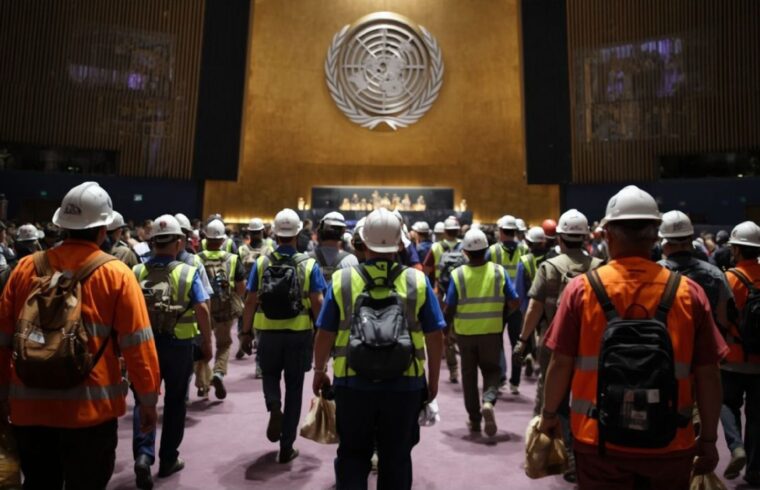
The very topic of “UNITED NATIONS SECURITY COUNCIL”(UN-SC) and involvement of trade unions sounds awkward and very unfamiliar to the audience. But it is a necessary debate for the present times. From a trade union point of view, this is part of the social activism that members expect before they are workers, they come from communities who are equally affected by the “war in Iran with US and its proxies, Ukraine v Russia and many others. The reality of the Strait of Hormuz is hitting hard on the workforce worldwide! Authors represent workers from the 3rd world global South, Afrika is feeling the pinch of high oil prices since these conflicts started. How many countries in Afrika are even members of the UN Security Council? What does this Council do that is in the interests of the working-class, poor communities? Is this a Society for the rich North-countries like EU Community, the US (now misruled by Donald Trump) and many worryingly unclarified questions to the uninitiated like the workers!
We need the basics first here…explain in very simply terms and language that workers can understand – what is this UN SC? And how can it help solve their problems with employers in their countries governments?
How and why did UN SC begin its existence?
It was at the end of the second World war in 1945 that created the need for “World peace” and who was going to be responsible for enforcing it. The idea of “Four Policeman” by the US President Franklin D. Rooseveldt gained popularity, so the US, UK, Russia and China were designate “four policemen”, with France being added later to make up the “five permanent members” of the United Nations Security Council succeeding the ineffective ‘League of Nations[1]’ in maintaining international peace and order.
In 1946 UN-SC started with 11 members!
- Who/which countries are members of the UN-SC? These were to be known as the “permanent” and “temporary” or non-permanent members as the war ended in 1945! The inaugural members in 1946 included these countries: China, France, Russia, United States (USA), United Kingdom (permanent) with Bahrain, Colombia, DR Congo Denmark, Greece, Latvia, Liberia, Pakistan, Panama and Somalia as “non-permanent members” elected by the UN General Assembly that rotate.
The 15 Members of the Security Council constitute the “5 permanent members with veto powers” (China, France, Russia Federation, UK of Great Britain & Ireland, and USA – then 10 non-permanent members of the SC, five of which are elected each year by the General Assembly for a two-year term.
It remains a call for the disenfranchised masses of the world, that the UN Security Council needs a drastic revamp to properly represent the desires of disenfranchised working-class people in international affairs.
In 2026, the United Nations will celebrate its 81st anniversary, promoting multilateralism, peace, and security among member states. However, given the number of wars, conflicts, and hostilities engulfing the world as a result of geopolitical dynamics, one can conclude that the global body and its agencies are failing civilians who are constantly subjected to high living costs, suffering, hunger, poverty, unemployment, inequality, zero levels of happiness, and a burden of diseases.
Attaining the Sustainable Development Goals appears to be moving slowly, despite massive resources being spent on weaponry and wars.
In its current form, the UN Security Council continues to give the so-called superpowers more status and respect when making decisions on behalf of the world’s poor working classes, in this day and age.
For example, Africa still has only two representatives, namely the Democratic Republic of Congo and Liberia (for 2027). There was only one African state for 2026, Somalia.
Currently, the UNSC has Russia, China, United States, United Kingdom, Bahrain, Colombia, Pakistan, Denmark, Greece, Latvia, Liberia, Panama, Somalia, France and Democratic Republic of Congo. But the question remains how does the inclusion of one or two African states (out of 54) help the continent, do they even have the mandate to speak on behalf of this vast continent? Let alone the multiplicity of languages, the continent is not homogenous in any form or content!
The African Union (AU) Call!
This is what this body has expressed.. ‚but two more non-permanent seats are still needed‘, argued the African Union recently.
The Chairperson of the African Union (AU) Commission H.E. Mahmoud Ali Youssouf, at the Ministerial Meeting on the Reform of the UN Security Council, held on the margins of the Africa–France Summit in Nairobi recently,
reaffirmed Africa’s united and principled position on UN Security Council reform demand.
The Chairperson underscored that “Africa is not asking for a favour; Africa is demanding the correction of a historical injustice,” stressing that ‚the continent can no longer remain excluded from permanent representation in the Council despite its demographic, political, and economic weight.‘
The African Union has been advocating for Africa’s representation on the UN Security Council, emphasizing the need for two permanent seats with veto power and two additional non-permanent seats.
This demand stems from the historical marginalization of African voices in global decision-making, as well as the disproportionate impact of UN Security Council resolutions on the continent. Although the International Labor Organisation’s platforms help to consolidate the voice of the international labour movement, the UNSC’s inaction on peace and security concerns has a significant impact on workers and their livelihoods.
Geopolitical tensions in the Strait of Hormuz directly impact the livelihoods of the general population; as commodity prices soar, real wages are eroded.
This pushes the masses into poverty, while capitalists reap super-profits and accumulate wealth.
Organizations like the UNSC must also take an active role in adopting actionable resolutions to protect workers and their families.
The UN Security Council lacks the political courage to fundamentally transform its institutions, prioritize grassroots democracy, and ensure economic justice and inclusive development for the benefit of workers and marginalized communities.
The UN Security Council needs a drastic revamp to properly represent the desires of disenfranchised working-class people in international affairs.
In 2026, the United Nations will celebrate its 81st anniversary, promoting multilateralism, peace, and security among member states. However, given the number of wars, conflicts, and hostilities engulfing the world as a result of geopolitical dynamics, one can conclude that the global body and its agencies are failing civilians who are constantly subjected to high living costs, suffering, hunger, poverty, unemployment, inequality, zero levels of happiness, and a burden of diseases.
Attaining the Sustainable Development Goals appears to be moving slowly, despite massive resources being spent on weaponry and wars.
In its current form, the UN Security Council continues to give the so-called superpowers more status and respect when making decisions on behalf of the world’s poor working classes.
For example, Africa still has only two representatives, namely the Democratic Republic of Congo and Liberia.
Currently, the UNSC has permanent and non-permanent members such as Russia, China, United States, United Kingdom, Bahrain, Colombia, Pakistan, Denmark, Greece, Latvia, Liberia, Panama, Somalia, France and Democratic Republic of Congo.
‚But two more non-permanent seats are still needed‘, argued the African Union recently.
H.E. Mahmoud Ali Youssouf, Chairperson of the African Union (AU) Commission, at the Ministerial Meeting on the Reform of the UN Security Council, held on the margins of the Africa–France Summit in Nairobi,
reaffirmed Africa’s united and principled position on UN Security Council reform.
The Chairperson underscored that “Africa is not asking for a favour; Africa is demanding the correction of a historical injustice,” stressing that ‚the continent can no longer remain excluded from permanent representation in the Council despite its demographic, political, and economic weight.‘
The African Union has been advocating for Africa’s representation on the UN Security Council, emphasizing the need for two permanent seats with veto power and two additional non-permanent seats.
This demand stems from the historical marginalization of African voices in global decision-making, as well as the disproportionate impact of UN Security Council resolutions on the continent. Although the International Labor Organisation’s platforms help to consolidate the voice of the international labor movement, the UNSC’s inaction on peace and security concerns has a significant impact on workers and their livelihoods.
Geopolitical tensions in the Strait of Hormuz directly impact the livelihoods of the general population; as commodity prices soar, real wages are eroded.
This pushes the masses into poverty, while capitalists reap super-profits and accumulate wealth.
Organizations like the UNSC must also take an active role in adopting actionable resolutions to protect workers and their families.
The UN Security Council lacks the political courage to fundamentally transform its institutions, prioritize grassroots democracy, and ensure economic justice and inclusive development for the benefit of workers and marginalized communities.
COSATU (Congress of South African Trade Unions), a 40-year old federation that came into existence in 1985, from inception took a keen interest in internationalism and solidarity as one of its founding principles. This Federation prides itself in that its “rich history tied to the rich history of the liberation struggle in SA that defeated apartheid and ushered in a historic 1994 democratic breakthrough. It was a deep and protracted struggle backed by powerful global solidarity that broke the back of the apartheid system”. A few examples suffice for mention where COSATU has been on the coal-face of the these protracted international solidarity struggles in the world:
- COATU has taken on global Zionism and powerful working class mobilisation in the country and globally against genocide and occupation of PALESTINE by the Israel apartheid regime – even the government of SA when it took this case to ICJ was following in the footstep of this giant federation.
- IN East Timor, COSATU has been involved with the result that Xaana Gusmao was eventually released after 28 years in jail by the military Junta in Indonesia. Similarly in Burma, we participated in the fight for democracy, resulted in the ultimate release of Aung San Suu Kyi, noted for his welcome on release by the international trade union movement in Geneva during an ILO Conference.
- COSATU has been actively involved with the Cuban revolution and the massive contributions that Cuba has made to world revolution, particularly in Afrika (from Algeria; Angola; Namibia and not least here in South Africa).
- Closer to home, in our own SADC region the Federation has played an important role in solidarity with the workers and people of Eswatini (Swaziland) under what is described ‘as the most brutal monarchies in recent history, a tragedy of the African post-colonial state in our region, still tolerated by world and the region turning a blind-eye this historic tragedy’.
- COSATU has consistently stood in solidarity with the Western Sahara (Sarawi people) colonized and denied independence by Morocco, another unfortunate tragedy of Africa!
- Last not least that COSATU has remained resolute in solidarity with the workers and people of Zimbabwe, a sustained campaign and solidarity work, also connected the federation closer with the workers led by ZCTU and its affiliates. More of this continental and regional collaboration is long overdue to accordingly build regional and continental working class movement for decent work, climate change, just-transition, industrialisation and inclusive development. There are numerous other solidarity and collaborations in the continent, including the “Tri-lateral” which has progressed into “Quadi-lateral between COSATU; GHAN-TUC, NIGERIA-NLC KENYA-KOTU.
- ON its strategic[2] analysis of global capitalism, ‘COSATU has realised and developed an understanding of how International developments increasingly shape wages, employment, industrial policy, investment, climate policy, migration and technological change within South Africa and the world over.
- Internationalism therefore becomes central to defending workers‘ interests rather than an additional area of work.
- Global supply chains, multinational capital and cross-border migration mean employers already organise transnationally’ thus it provides rationale for solidarity that must match that scale!
IN conclusion, it is our considered view from the working class perspective that the fight for not only cosmetic transformation but a complete overhaul of the international peace-keeping structures including the UNSC for the world harmony must do justice and give equitable membership shares to Africa as other continents.
BY NORMAN MAMPANE & ALFRED MAFULEKA
(COSATU Communications Chief & National Educator.)
ABBREVIATIONS USED:
AU = African Union (formerly
COSATU = Congress of SA Trade Unions
ICJ = International Court of Justice
ILO = International Labour Organisation
IRC = International Relations Committee (of COSATU)
NALEDI = National Labour and Economic Development Institute[3]
SADC = Southern African Development Community(with 15 member states)
UK = United Kingdom (include Northern Ireland)
UN = United Nations Assembly
UNSC = United Nations Security Council
ZCTU = Zimbabwe Congress of Trade Unions
REFERENCES:
- Charter of the UN (1945) Research Guide
- Amandla (SA’s progressive magazine standing for social justice; ISSUE NO.102/JUNE 2026)
- COSATU IRC to upcoming 15th National Congress (14 -17th September 2026), embargoed until congress.
- NALEDI RESEARCH PAPER – 2026 (unpublished).
[1] Being the first worldwide intergovernmental body to maintain world peace after the 1st World war, itself a successor of numerous other peace initiatives like International Red Cross and Paris Agreement from Paris Peace conference that ended the first world war. Founded on 10 January 1920.
[2] Extract from: COSATU International Policy Review with NALEDI Preliminary Research Findings (28 July 2026)
[3] NALEDI is a Research wing of COSATU, established in 1993 to conduct research and surveys on labour and economic to support policy development and generally deal with challenges facing SA society.