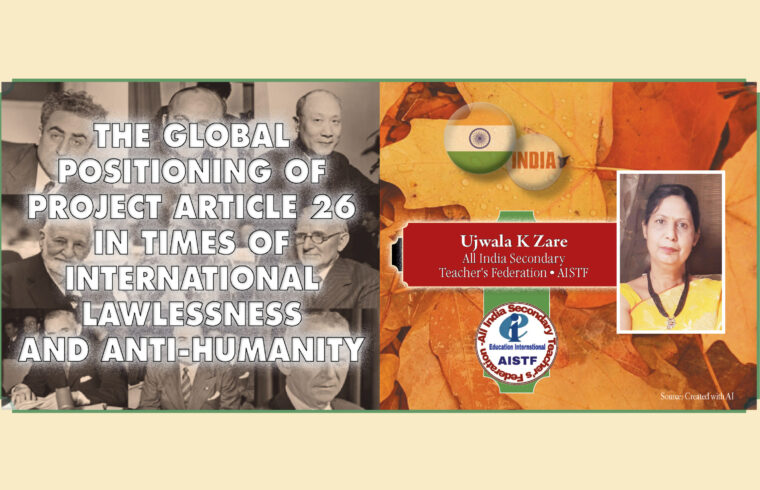
Mrs. Ujwala K Zare
All India Secondary Teacher’s Federation • AISTF
UNIVERSAL DECLARATION OF
HUMAN RIGHTS – ARTICLE 26
(RIGHT TO EDUCATION)
Article 26 explains the right to education. It has three main parts:
1) Education is a Basic Right
Everyone has the right to education.
2) Elementary (primary) education must be free and compulsory.
Technical and professional education should be available to all.
3) Higher education should be equally accessible based on merit.
This means every child, no matter their background, must get at least basic schooling.
Purpose of Education
Education should:
1) Develop a person’s full personality
2) Strengthen respect for human rights and freedoms
3) Promote understanding, tolerance, and friendship among nations and groups
4) Support peace.
5) Education is not just about jobs — it helps build responsible, respectful citizens.
6) Parents’ Rights
Parents have the right to choose the kind of education their children receive. Families can decide on schooling type (public, private, religious, etc.).
Article 26 Is important because
1) It reduces poverty and inequality.
2) It empowers individuals.
3) It promotes peace and social harmony.
In simple words, Article 26 says education is a right, not a privilege.
The Right of Children to Free and Compulsory Education Act, 2009 was enacted to provide free and compulsory education to all children aged 6 to 14 years. It came into effect on 1 April 2010. The Act makes education a Fundamental Right under Article 21A of the Indian Constitution.
Key Features of the Act:
Free and Compulsory Education
The government must provide free education to children between 6–14 years. No child shall pay any fee that prevents completion of elementary education.
25% Reservation in Private Schools
Private unaided schools must reserve 25% of seats for children from economically weaker sections (EWS) and disadvantaged groups.
No Capitation Fee and Screening
Schools cannot charge donation or conduct admission tests/interviews.
Age-Appropriate Admission
Children who were never enrolled or dropped out must be admitted to an age-appropriate class and given special training.
No Detention Policy
No child can be failed or expelled until completion of elementary education (up to Class 8).
Infrastructure and Teacher Standards
Schools must provide proper classrooms, toilets, drinking water, playground, and qualified teachers as per prescribed norms.
Ban on Physical Punishment
Corporal punishment and mental harassment of students are prohibited.
School Management Committees (SMCs)
Government schools must form SMCs with parents as majority members to monitor functioning.
Conclusion:
The RTE Act aims to ensure equality, improve literacy, and provide quality education to all children in India. It plays an important role in promoting social justice and inclusive development.
In India, children face several specific challenges in accessing and completing primary education, despite laws like the Right of Children to Free and Compulsory Education Act (RTE Act, 2009) which guarantees free and compulsory education for children aged 6–14 years.
Here are the main problems:
- Poverty
Many families cannot afford uniforms, books, transport, or private tuition.
Children are often required to work to support household income.
- Child Labour
Children work in agriculture, small industries, domestic work, and street vending.
This leads to irregular attendance or dropping out.
- Poor Infrastructure in Government Schools
Lack of proper classrooms, electricity, clean drinking water.
Inadequate or non-functional toilets, especially affecting girls.
Some schools have multi-grade teaching due to limited staff.
- Teacher Shortage and Quality Issues
High pupil–teacher ratios in many states.
Absenteeism and lack of proper teacher training in some areas.
- Gender Inequality
Though improving, girls in some rural and conservative areas still face:
Early marriage
Household responsibilities
Safety concerns while traveling to school
- Caste and Social Discrimination
Children from Scheduled Castes (SC), Scheduled Tribes (ST), and minority communities may face exclusion or bias.
Tribal areas often lack adequate schooling facilities.
- Migration
Seasonal migrant workers move frequently.
Their children often drop out due to lack of transfer facilities.
- Language Barriers
Many tribal and rural children speak regional dialects at home.
Teaching in Hindi or English creates learning difficulties.
- Malnutrition and Health Issues
Poor nutrition affects concentration and learning ability.
Frequent illness leads to absenteeism.
- Learning Crisis
Even when enrolled, many children struggle with basic reading and arithmetic skills.
This leads to poor learning outcomes and eventual dropouts.
Although enrollment rates in India are high today, the major challenge is retention and quality of learning.
Education is the foundation of a strong and progressive nation. Our government is making sincere and continuous efforts to overcome various challenges and ensure that education reaches every child. Through several innovative schemes and projects, it is working to create equal opportunities for all children. These efforts are helping to build a knowledgeable and empowered society. We sincerely hope that in the near future our nation will proudly achieve the goal of becoming a 100% literate country.