“The state has settled in Russia like an occupying army.”
– A.I. Herzen
“A patriot must always be ready to defend his country from its own government.”
– Ed Abbey
The rams march in line. The drums are beating.
The skins for the drums—they’re from the rams too.”
– B. Brecht
Abstraсt
This text emphasizes the fundamental distinction between genuine politics in the Aristotelian sense, and manipulative politicking. It describes theoretically historical, moral, and sociological dimensions of the geopolitical paradigm, revealing its inherent deficiencies and diverse negative consequences. Its historical origins and evolution of the political worldview underlying geopolitics, from ancient China to the European version of Machiavellianism, are considered. Such pathological elements of geopolitical consciousness as myths of national exceptionalism and the supposed uniqueness of different countries’ “special path” are subject of exploring. In several European countries, including Russia, these elements were exacerbated by a post-imperial political syndrome.
Keywords: geopolitics, political consciousness pathologies,, psychological trauma, moral values, Russia, democracy
GEOPOLITICS: IDEOLOGY, COLLAPSE, REVIVAL
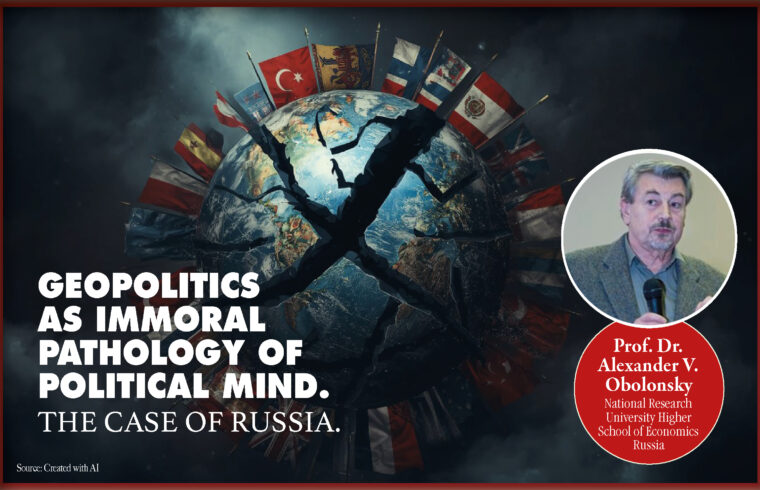
Until recently, geopolitical logic—and all the paradigm of geopolitics seemed, if not entirely archaic, but at least something outdated. Unfortunately, the political developments of recent years have shown that such assumptions and hopes proved to be mistaken. Geopolitics has returned, reemerging in a slightly modernized but not less dangerous and bloody guise. One manifestation of this revival is the reappearance at the global political stage of geopolitical behavior with its charactering logic and phraseology. The rebirth of this phantom has already caused immense suffering and loss of a number of human lives. Therefore, the concept of geopolitics today requires urgent attention, as its reincarnation carries real, global-level threats.
Currently geopolitics—sometimes camouflages in the terminology of international politics. But by the nature it reproduces the same ideology of a social Darwinist worldview. It considers the world solely as a battlefield for interspecies struggle between states, where goals, methods, and intermediate objectives may shift, but the fundamental premise remains unchanged: nations are enemies, the world is a boxing ring, states are its fighters, and conflict is the foundational principle of existence and interaction. Alliances, coalitions, and blocs are seen merely as temporary tactical tools that do not alter the essence of inherent hostility. Viewing one’s neighbors „through the barrel of a gun“ was a dominant ideological approach in many European countries at the turn of the 19th and 20th centuries, though it reached its most extreme forms—indeed, as a basis of state policy—in Nazi Germany and, to some extent, easter. Many other European nations were not immune to this logic either. Humanity has paid a heavy price for poisoning itself with geopolitical toxin: two world wars, countless „smaller“ wars, and inside-state, domestic purges against so-called „internal enemies“ have brought unprecedent suffering and devastations in Europe and beyond.
In short, geopolitics is a form of false consciousness deeply drenched by human blood. Consequently, it must be studied and scrutinized—rigorously—but mostly as a dark chapter in the history of human illness or as a kind of political criminology. To adopt a worldview that sees the world as a chessboard, where entire nations are mere players and people are, at best, pawns—or at worst, less then specks of dust—are absolutely unhuman and fundamentally immoral. Such logic, regardless of the thoughts and intentions of its proponents, may leads humanity only into new abysses of sorrow, humiliation, and ruins.
A logic underpinning such thinking is as old as the time of human history. However, the first person who theoretically formulated the geopolitical concept was the German scholar of the 19th century Friedrich Ratzel. He described the state as a growing biological organism that inevitably seeks more „living space“ (Lebensraum) and trying to develop it. The very term „geopolitics“ was introduced by Swedish scholar Johan Rudolf Kjellén, whose major work The Great Powers was published in 1916, during the height of the First World War. His ideas—rooted in a mix of geography, biology, and Malthusian demography—were popular then. In more recent times, this thinking has branched out into some modernized, more specialized subfields such as geo-economics, geo-culture, and information geopolitics. Nonetheless, the fundamentally confrontational nature of geopolitics has remained intact.
One would have hoped that the horrors of the 20th century would have should discredit such views forever, to relegate the geopolitical paradigm to the dustbin of history, left it buried together other crimes against humanity. Unfortunately, the events went another way. and the „zero-sum game“ approach to international politics—when one party’s gain inevitably presumes another’s loss – proved to be vital and its practical influence has endured. Diplomacy and its academic proxies in various countries still interpret frequently global affairs like the Cold War in „chessboard logic”—despite the catastrophic toll of two world wars, which claimed over sixty million lives and shattered entire generations.
This political alchemy remains too tempting and gains promising for those who, through it, can imagine themselves as rulers of global destiny—or at least of the lives of millions—and derive for that various forms of profit. It also benefits those who serve them: power corridors filled with loyal experts, think tanks, and media outlets who, being equipped super modern technologies, spread artificial narratives of „post-truth,“ and engage by means of it in mass manipulation. These scientifically “learned clerks” and ideological “tailors” are tasked for dressing inhumane goals in palatable ideological clothing, applying political makeup to masquerade and legitimize cynicism of politics deceiving the masses of ordinary people by lies, pseudohistorical myths for provoking nationalism and militarism, Unfortunately, they have often succeeded. In doing so, these orchestrators of mass manipulation actually exclude themselves from both science and journalism—professions that, as Max Weber once noted, require not only technical skills but also a deep sense of moral responsibility and social conscience. Simply speaking, things like conscience and feeling of social responsibility for their own deeds either totally absent at these persons or covered by different mechanisms of psychological defense like substitution or displacement.
The Rebirth of Geopolitical Myths and the Politicization of Historical Geography
Neo-imperial fantasies are being revived—and even “justified”—once again. In the best-case scenario, it based on semi-scientific constructs; more often, however, they are mythological and romanticized recollections of some imagined and lost “historical homeland” which historically belongs to some ethnic groups. In the anthropological literature it describes as essentialism or primordialism. Ancient borders of former states, which have either long since disappeared, or seriously changed, or, conversely, clear territorial demarcations of some territories historically had not existed. However, under influence of geopolitical logics it transforming into emotional political totems. Appeals to “restore historical justice” are repeated like incantations. New, supposedly “right” borders are drawn on maps, appearing in political declarations and speeches. Eventually, they are internalized by the collective imagination as a dream of something tragically lost and now should be returned. These imaginaries become volatile fuel—awaiting only a political spark. And inevitably, such a spark arises. Sooner or later, these phantoms of establishing “fair” borders, acquire flesh and blood. This is what occurred in the early 1990s in Yugoslavia, in the late 1990s in Kosovo, and continues to erupt periodically across the African continent in extraordinarily violent forms with staggering death tolls. In recent years, Ukraine, Artsakh (Nagorno-Karabakh), and now the tragic escalation in Israel also have been dramatically added to this grim list.
In reality, the politicization of historical-geographic settlement patterns—whether from the distant past or more recent times—is not only absurd, but extremely dangerous. Attempts to turn this logic to practical policy almost always brings massive human suffering. The coincidence of political borders with compact settlement of ethnic groups is rare case. In fact, monoethnic states are virtually nonexistent today. Even in tiny Luxembourg exists small Herman minority. They conduct annually public meetings, purposed, probably, to remind on the own special identity. I watched incidentally their meeting at the Grand Place of Brussels. But nobody considers to reshape any borders for this reason.
In contemporary Russia, the yearning to redraw borders has fused with nostalgia for a lost “great multinational state,” and, regrettably, it has found fertile soil. This is despite the fact that it is not politicians or their ideological entourage suffer and die for the ambitions and delusions of elite geopoliticians. Instead, the foreign policy agenda continues to be dictated by geopolitical illusions born in the minds of politicians and their cronies hunched over oversized maps and globes. This entire logic of this approach is soaked in the blood of millions around the world. And yet, as the Russian saying goes, “the dead grasp at the living.”
THE MORAL DIMENSION OF THE GEOPOLITICAL PARADIGM: PAST AND PRESENT
Historically, the relationship between politics and morality mostly considered only just a philosophical dilemma, as a “perennial question,” unless the fact that it too frequently takes on blood-soaked dimensions and color. In European thought, the theoretical justification for political amorality is often traced back to Niccolò Machiavelli. However, this is only partially accurate. While The Prince undoubtedly offers cynical recipes for manipulating power, the other works of Machiavelli—such as The History of Florence and Discourses on Tit Livy show that he was not entirely ideologically identified himself with these tactics. Hence, one may suggest that writing The Prince he just worked as a kind of political technologist of the 15 century who carried out some indirect political order of Florence autocratic family Medichi.
In fact, a far more detailed and chillingly candid guide to political manipulation was written almost two thousand years earlier, on the opposite side of Eurasia by Chinese Legalist philosopher Shang Yang. His Book of the Lord of Shang is an unprecedentedly cynical justification of ruthless state rule, containing a lot of recipes how to bring the population to total obedience. This book remained however, practically unknown in Europe until its translation in the 20th century. Hence, it was Machiavellianism—not Chinese Legism—that formed the Eurasian tradition of political cynicism.
Indeed, in nearly every historical era, one can find manifestations of an “anti-Machiavellian,” morally grounded view of politics. Aristotle, for example, regarded politics as an extension of ethics—a kind of “ethics-in-action”—while also seeing ethics as the highest form of political science. As early as the fourth century, Christian philosopher Augustine wrote: “Without justice, what are states but great gangs of robbers, and what are states unless gangs of robbers in miniature?” assuming that without moral foundations, the state becomes indistinguishable from organized crime.
Beginning in the 15th century, during the dawn of humanism, “moral philosophy” became both a factor of public reflection and an integral part of education, particularly within the framework of the studia humanitatis. However, until the second half of the 20th century the geopolitical logics remained the prevailing approach in political practice of states. But the tragic examples of totalitarianism and two world wars taught some hard lessons. Politics gradually became more public and moral. The notable revival of moral thought in politics began to happen in the 1960s and 70s.
The Moral Turn in Politics: From Cynicism to Ethical Expectations and back.
The first notable impetus toward re-moralizing politics evolved during the so-called “student revolutions” of the late 60s in Europe and America. This wave of young activism echoed in 70s through the Watergate scandal, which led to shameful downfall of Richard Nixon – politically rather effective and functionally competent but devoid of moral self-restraint – U.S. president. This period also was characterized by the process what came to be known in US history as the time of “political muckraking” when the human rights and moral purity became to consider as one of really important factors of politics. Moral values began to play an increasingly substantial role in judgement of political actions of different states. In particular, it stimulated constant international pressure to USSR behavior in the issue of Jewish emigration.
Political elites in various countries, although often reluctantly, were forced to respond to these changes in public political consciousness. Ethical standards in government gradually became subject to stricter societal control and even legal regulation. It was recognized that the legitimacy and viability of a political system depended, in part, on the extent to which public institutions and high-ranking officials correspond to prevailing societal values—and whether their conduct adhered to norms of public morality.
Of course, this transformation was neither smooth nor linear. There were—and continue to be—dramatic regressions back to traditional patterns of political cynicism and narrow pragmatism. Unfortunately, in recent years, we are witnessing one of such regressions up to downfall of medieval barbarism. However, conduct of political leaders now more frequently evaluated through moral imperatives and value-based criteria. In the same time we also face, unfortunately, some distortions and returning “loops” at this way.
In post-Soviet Russia, for example. due to its tragic historical trajectory—
not to mention the political opportunism that exploits the myth of Russia’s “unique mentality and the highest spirituality”—the process of moralizing politics began later and remains barely visible. What is far more prominent is political amorality. Moreover, the old mem that politics and morality are incompatible acquired a new popularity. Indeed, one could argue that the 2000s and following years marked a full-blown “renaissance” of Machiavellianism in Russia, cloaked in populist rhetoric but expressed in stark, cynical forms.
The Russian state increasingly came to a military-bureaucratic system of governance, what always occurs at the expense of human rights and freedoms. We witnessed at the moment a deliberate attempt to slam shut again the door to an open society—just as it had begun to open. This is precisely the scenario that philosopher Karl Popper warned against. He regarded the transition from a closed society—where the individual is solved within a collectivity, but enjoys a false sense of protection—to an open society—where the individual is free and responsible for personal decisions—as one of the deepest, yet still incomplete, revolutions in human history. Such a transition inevitably entails a fear of freedom, and often results in attempts to retreat from newly gained liberties. History shows that this regression can indeed happen—but it brings only fresh suffering. Any return to the illusion of a “lost paradise” of totalitarianism, even if temporary, carries unacceptable and long-term consequences. “The more vigorously we try to return to the heroic age of tribal spirit, the more surely we will find ourselves facing the Inquisition, secret police, and romanticized gangsterism… We must find support in the clear understanding of the simple choice we face: We can return to a beast-like condition. But if we wish to remain human, there is only one path—the path toward an open society.”
– Karl Popper, The Open Society and Its Enemies, Vol. 1, 1992, p. 248.
However, despite all the tragedies and hardships of our “sad and long-suffering” history—as Herzen once put it—despite severe economic and psychological challenges, and despite laments about Russian supposedly eternal servile mentality, Russia, as a society, did manage in 90s’to take several important steps forward.
The sad and painful question is why this process reversed—and why it proved so brief. In my view, one of basic reasons us the resurgence of a geopolitical paradigm that has become a near-official ideology. This ideology not only legitimizes the rollback of democratic progress but is also linked to a peculiar pathology—an almost mystical animism of the state itself.
We are witnessing a deliberate and targeted revival of imperial and messianic narratives, centered on Russia’s so-called “special path.” Natural patriotic sentiments are cynically exploited and substituted with ideas of “national greatness,” “legitimate geopolitical interests,” the notion of a unique “Russian world,” “conservative values” and other pseudo-patriotic constructs. Compounding this is an uncured “post-imperial syndrome.” (Admittedly, we are not alone in this—Britain suffered a similar disease after the collapse of the British Empire, fortunately in rather light form, and Austria after the fall of the Habsburg monarchy. But in Russia’s case, this syndrome is further compounded by the legacy of post-totalitarianism.) A whole this logic is fundamentally immoral and contradicts the genuine needs of contemporary people and the role and place of democratic state in their life.
In my view, morality and democracy are closely linked—at least in countries with working democratic institutions and traditions. There so-called “ordinary people,” learned by the horrors of two world wars, are no longer willing to accept a false geopolitical symbols and manipulations of political demagogs. They expect and demand that actions of all branches of government should be transparent and accountable to them. The drive toward political openness is one of the defining forces behind of modern time, with some temporal setbacks, unfortunately. However, it is only democracy what can provide at least a relative alignment between politics and the values of justice, honesty, conscience, fairness, and responsibility. As the Protestant theologian Reinhold Niebuhr wrote: “Man’s capacity for justice makes democracy possible; but man’s inclination to injustice makes democracy necessary.” (Krug P., 2004, p. 50)
Between Moral Politics and Authoritarian Regression
History does offer examples of attempts to implement moral politics through autocratic methods—figures such as Gaius Julius Caesar, Ludwig II of Bavaria, and Alexander I of Russia come to mind. These rulers were initially well-intentioned, genuinely wishing to improve public morality for their people benefit. Indeed, much depends on the individual qualities of the autocrat. However, in general, their efforts were unsuccessful—and sometimes ended in tragedy. As the saying goes, “Power corrupts, and absolute power corrupts absolutely.” Even the well-meaning ruler needs effective public control. Moreover, under autocratic rule, there is no guarantee that power will pass from a “good” sovereign to an equally “good” successor.
In periods of collapse primordial value systems for some reasons, a certain moral anomie seems inevitable. Consider the postwar spike in crime rates in Germany and Italy. Also the habitants of Soviet Union, country having triumphed over external fascism—completely lost their internal “war” to build a society with decent conditions for human life. Notably, much of the crimes and immoral acts during Russia’s notorious “wild ‘90s” was committed not by “ordinary people,” but by political mutants and chameleons—those who had prospered under every regime. These individuals quickly shed their Soviet skin, rebranding themselves as “men of the new time.” Exploiting the far from perfect conditions of economic freedoms in the 1990s, the time looked like as a kind of Klondike era or “A Guilded Age” (title of Mark Tween novel), they unbelievably quickly made fortunes, huge sometimes, and providing their wellbeing they discarded after that the very freedoms that had enabled their success. In doing so, they betrayed and discredited democracy itself.
Therefore, those who deny the inherent connection between politics and morality are swimming against the wind of history. The presence—or absence—of moral foundations marks the line between authentic politics and its degenerate forms: politicking, manipulation, and intrigue. Of course, as every sailor knows, it is possible to sail a certain time against the wind by tacking skillfully. Unfortunately, much of our post-Soviet political trajectory has resembled this kind of maneuvering. Under the banner of “rising from knees,” we have faced the revival of authoritarianism and political amorality.
Priority of “systemic interests” over individual rights and freedoms cannot be balanced by economic liberalism alone. This serves, by the way, as further evidence against the thesis that the economic factors are inherently more fundamental than moral or cultural ones. No matter how one tries to conceal the revival of Machiavellianism under populist gestures and rhetoric. It is always happening for account of ordinary people freedoms. Under the slogan of “enforcing a unity of power,” citizens have been deprived of some basic constitutional rights and civil liberties.
The Consequences of the “Special Role” of the State in Russia
In recent years, it has become in style in official and semiofficial Russian circles to label oneself as a “statist” (gosudarstvennik) on nearly any occasion—or even without one. Implicit in this label is the idea that “statists” are in opposition to supposed “anti-statists.” This stigma is frequently applied to liberals, who are also branded as the “fifth column” or “national traitors.”
Yet being a “statist” is not the antithesis of being a liberal. After all, who, if not the state, should be the guarantor of the basic economic, civil, intellectual, and spiritual rights and freedoms of individuals? If ordinary people lack real mechanisms for realizing their values and ideals, then even the most eloquent liberal rhetoric becomes just little more than the hypocrisy of the privileged. This is especially relevant in the context of underdeveloped civil society—where a culture of voluntary associations around shared interests is weak, and where ordinary people cannot even defend themselves by means of appeal to the law or to the very institutions that are supposed to provide it.
Indeed, state-centered thinking has deep roots in Russian history—particularly in the practice of the state itself. Compared to the West, the Russian state has always been “larger” than society. Its influence over public life has been far more active and multidimensional. The state has historically played a more universal role than in most European countries, let alone the United States. It has acted as a primary force, often preceding and overpowering the development of society.
Indeed, a strong state sometimes serves to progress. For instance, during the second half of the 19th century, the liberal-minded wing of the Russian bureaucracy played a quite positive role in advancing reforms—though Russian bureaucrats have always served as convenient scapegoats under every regime. On the other hand, the imbalance of a strong state and weak society blocks the development of independent civil forces—an essential element of genuine social modernization. Moreover, if the state, dominates over society, it naturally ignores the individual even more. It is no exaggeration to say that the Russian subject historically owed everything to the state, while the state owed nothing in return.
The keen French traveler Astolphe de Custine, walking along Nevsky Prospekt in St. Petersburg in the middle of the day of 1836, noted: “The streets were swarming with officials, and in each man’s manner of walking one could see the will of the one who sent him.”
(de Custine, Vol. 1, 1966, p. 130) As a result, those unwilling to live as conformist servants of the state often removed themselves from “normal” life—moving to the North, to religious retreats, into the steppe, joining the Cossacks, later into emigration, or becoming “nihilists.” One way or another, Russia’s most potentially active human capital has historically been estranged from the state. and the country at all.
Psychologically, this produced a deeply ingrained suspicion, up to rejection- of any state-led initiatives, even when they were beneficial. Ironically, initiatives that promised some tangible gain were often met with even stronger resistance. The repeated negative experiences of sujects’ had with the state fostered a durable stereotype: “Old evils are more familiar and therefore more reliable than unfamiliar goods,” or more bluntly: “Nothing good ever comes from government plans.” This quote, only slightly paraphrased, reflects Klyuchevsky’s damning verdict on the fate of Catherine the Great’s early attempts at participatory governance. A classic example is the public’s reaction to her Commission on the Law Code in 1766.
The Legacy of State Dominance Over the Individual in Russia
The Soviet period was the dramatic culmination of the state’s dominance over the individual. Mass repressions—at times reaching apocalyptic proportions—never ceased, not even during the regime’s comparatively moderate phases. It solidified the stereotype of the omnipotent state and the powerless individual, reduced to a mere cog in the machine, expendable in the pursuit of supra-individual national or ideological goals.
Unfortunately, both the dominance of the state over the individual and the underlying causes of that dominance have also persisted into the post-Soviet era—albeit in modernized forms. In recent years, open displays of governmental contempt toward the populace have practically become the standard of officials’ behavior.
The transformation of conservative „statism“ into the leading official ideological trend has led to the devaluation—and even discrediting—of liberty as a fundamental liberal value. What has emerged instead is a reactionary and utopian nostalgia for „order.“ Riding that wave, a frothy surge of political reaction has swept across society. One of the mechanisms that camouflaged this state of affairs was the appropriation of the concept of patriotism by the state itself.
Our present-day ultra-statists, alas, draw from a powerful cultural-historical tradition. The stronger the state become, the worse life grew for those living under it. Consequently, the state came to be perceived as a hostile force toward the individual—and in reality, it almost always true. Our historian V.O. Klyuchevsky brilliantly captured this in just four words: The state swelled, the people withered”. (Klyuchevsky, Vol. 3, 1958, p. 12) However, since we are now living in an era of traditions’ rethinking, it is essential to reconsider the nature, meaning, and consequences of this historical phenomenon: expansive, intrusive state—and weak and passive society.
Neither Russia nor other nations with a heavy burden of authoritarian or totalitarian traditions are doomed to run endlessly like a squirrel in a wheel, reproducing the same anti-human patterns of state power and social subjugation.
Russia, too has something positive to present —both to itself and to the world. Alongside the dominant culture of subjugation, an alternative counter-culture of resistance has always existed and survived, even in the darkest times. And despite all my respect to the great writer Vladimir Nabokov, I cannot accept his devastating description of Russia as: “A nation of moral monsters, smiling slaves, and dim-witted thugs… a place where vulgarity and despotism camouflaged by counterfeit culture.” (Nabokov, V.V., 1996) No, Russia was never a nation of slaves. Rather, it was a nation enslaved by irresponsible and predator authorities.
The Psychology and History of Escape from the State
Throughout the history of Russia, with only brief exceptions, there have been virtually no real constraints on state power over its subjects. The very concept of the rule of law—as a mutual limitation on both the rights and powers of rulers and citizens—was absent. Any unsanctioned civic initiative was, at best, viewed by authorities as suspicious. Protest activity, in particular, was crushed ruthlessly. In response, what the historian Klyuchevsky called the “Moscow people” developed a peculiar form of political protest: instead of rising up, those who could not accept the existing order simply exited it. They “wandered off in all directions”—they fled the state. Klyuchevsky interpreted this form of reaction as a kind of “servant syndrome” or “tenant syndrome,” in which a subject, rather than confronting a tyrannical landlord, simply leaves: “When subjecs, linked to their government by a shared notion of the public good, become dissatisfied with a ruling power that no longer protects that good, they rise against it. But when servants or tenants, whose ties to the landlord are based only on conditional benefits, no longer receive those benefits, they just leave the house.” (Klyuchevsky, Vol. 3, 1958)
And so they did: peasants fled into the wilds, to the free frontier, or joined the Cossacks. Nobles chose exile abroad or the solitude of their estates. In Soviet times, the equivalent was “internal emigration.” In all these cases, the most potentially active segments of the population—those capable of contributing to general development – were drained out of mainstream life.
Meanwhile, those who entered into service of the state, were not the most talented, nor certainly the most principled, but rather the most obedient. These were the conformist subjects, those willing to execute any command without hesitation or reflection.
From this, some have drawn fatalistic conclusions about Russians’ “inherent unfitness” for freedom, a kind of national deficiency, or even a deep-rooted inferiority complex. I strongly disagree with it. I could cite numerous examples of behavior among my fellow citizens that clearly reflect a deep-seated aspiration toward freedom and dignity. But without veering too far from our central topic, I will instead share a perspective I find compelling—articulated by G.P. Aksenov. He argued that Russians were never devoid of a “sense of freedom.” The tragedy, he said, was that this instinct was never realized within the political body of the state, but rather always outside it—via expansive colonization. The state constantly had to “catch up” to its runaway subjects and re-enslave them. “Russia was betrayed by geography. There was always somewhere to flee.” “This national life can be described as one of external orientation. The instinct for freedom remained just that—an instinct. It never evolved into conscious thought or political action. Life was lived outside the state, not within it. Figuratively speaking, the state had a perpetual hole in its side—through which all transformative energy and freedom leaked out.” (Aksenov G.P., 2000). I may not fully agree with every aspect of this description, but its core insight strikes me as profoundly meaningful.
From “Sacred” State to Service Provider: Global Shifts in Governance
Over the past few decades, the traditional model of trust in government has undergone a serious reassessment—even in democratic countries. One of the most significant social inventions of the late 20th century has been the desacralization of the state. This process is an essential development in the history of liberal thought. The idea is straightforward: the state should no longer be revered as a divine or absolute authority, but rather understood as a servant—a tool subordinate to the real needs of individuals. In philosophical terms, this marks a revival of liberal conceptions regarding the role and function of the state. Hegelian paradigm of the state is intellectually dead. This fact is not universally acknowledged—nor is it universally welcomed—but it is undeniable. Gradually and unevenly, with all the contradictions and setbacks, rather dramatic sometimes, as a Tramp case, a new model of citizen-state relations however is taking shape. In this context a problem of trust—and distrust—toward political institutions becomes especially central.
Roughly three decades ago, the philosophy of New Public Management (NPM) gained traction in policy-making circles. Though not without flaws or disappointments, NPM and its offshoots have been adopted, in various forms, across many countries. At their core lies a recognition: the traditional bureaucratic state is increasingly ill-equipped to respond to the demands of time.
These reforms—some initiated from above, others from below—vary widely in scope and intensity. Continental European countries have taken cautious and partial steps, while Anglo-Saxon countries have undergone more radical “anti-bureaucratic” transformations. At the other end of the spectrum, we find the Arab Spring and grassroots movements like Occupy Wall Street in the USA. What we are seeing globally—manifesting in different ways and to varying degrees, but rooted in the same fundamental reality—is a growing crisis of trust in public institutions and a corresponding surge in civic skepticism toward those who claim to represent them. Some call this an “administrative,” “post-bureaucratic,” or “managerial” revolution. That might be a rhetorical exaggeration—but it should not obscure the depth of the ongoing transformation in very foundations of state-society relations. We are in the midst of a profound shift in the relationship between citizens and the state
These trends began 30 to 40 years ago. I believe the full scale and implications of this transformation have yet to be fully appreciated—particularly in Russia. Our governmental institutions, and the dominant culture of those who work within them, remain largely incapable of responding adequately to these changes. They default to self-protective reflexes rather than constructive, development-oriented engagement.
Of course, none of this is entirely new. Let us recall that the Declaration of Independence of the United States (1776) is, in essence, a beautifully articulated justification for citizens’ right to withdraw their trust from a government that has betrayed its duty. This “great American tradition of mistrust toward government” became one of the foundational myths of the “American Dream,” passed down through generations—not only in spirit, but in law.
For example, in 1939, the U.S. Congress passed the Hatch Act, which prohibits government officials from participating in electoral remarked back in the 19th century: “Distrust of authority should or using their official positions be the and to forbid the abuse of public office for private political ends. (The Russian Criminal Code and Civil Service Law campaigns machines contain similar prohibitions—but, as we all know, they are widely ignored.) Still, it would for partisan gain. The law reflects an anti-totalitarian impulse: to prevent bureaucrats from merging with political be a mistake to think that this cautious mistrust is uniquely American. As the Scottish writer Norman Douglas first civic duty.”
And yet, such engagement is precisely what is required. We cannot underestimate the moral motivations behind human action. As David Hume wrote in A Treatise of Human Nature, people are driven by three primary motives: interest, affection, and principle. In practice, these often intertwine. But importantly, there is no fixed hierarchy among them—contrary to what strict rationalists or egoists claim. Yes, self-interest is a powerful motivator. But not always. Sometimes—indeed, not infrequently—principle prevails. Conscience can outweigh gain. As liberal theorist Chandran Kukathas observes: “In analyzing human behavior, conscience is as important as self-interest—not because people always follow their conscience, but because sometimes they do. That, in itself, changes everything.”
(Kukathas, 2011, p. 94) So, even leading economists today acknowledge the importance of non-material, moral, and psychological factors in development.
Political Conscience and the Crisis of Integrity
In contemporary Russian scholarship, some of the most insightful researchers of political ethics have emphasized the central role of conscience in politics. They write: “Conscience cannot tolerate dirty political practices cloaked in sophistry, justified by expediency, or excused by the minefields of realpolitik. It rebels against the cynical erosion of moral norms and political decency. At the same time, conscience also resists the dogmatic claim that all politics is inherently ‘a dirty business’—a claim that conveniently serves scoundrels and only deters honorable individuals from fulfilling their civic duties.”
(Bakhtanovsky V., Sogomonov Y., 2004, p. 29) The fact that we so rarely observe the triumph of principle and political conscience over self-interest in our current public institutions, I would argue, is not due to some congenital defect in “Russian nature” or mentality. Rather, it is the result of deliberate and long-standing negative selection—a systematic “downgrading” of those who enter the halls of power. And this shift has been driven—perhaps more than anything else—by the intellectual vanguard of civil society, responding to a deeply felt mistrust of traditional authority.
The Moral Factor in Political Decision-Making
Yes, morality and conscience often remain dormant, and even when it awakens, it does not always prevail. But the very fact that it exists—that it can awaken and act—means that politics is not doomed to remain a playground for cynics, manipulators, and careerists. As noted by Kukathas: “If human beings were purely self-interested maximizers of utility, many of the institutions we value would never have come into being. And if those institutions had emerged by chance, they would never have lasted.” Kukathas, 2011, p. 95)
The very emergence of democratic institutions was made possible by people who acted not of self-interest, but of conviction. The same holds true for many social and political achievements—civil rights movements, the abolition of slavery, resistance to totalitarian regimes, and so on. Conscience serves as a kind of “second voice” in decision-making. It often contradicts the “first voice” of self-interest. Yet, in a democratic system, it is this second voice that protects the political system from degrading into populism or authoritarianism.
In authoritarian or totalitarian systems, the voice of conscience is silenced—either by force, censorship, or ideological indoctrination. That is why such systems, even when seemingly stable, are always fragile at their core. They are built not on trust, but on fear. And fear, unlike trust, has a very short shelf life. Fear paralyzes initiative. It suppresses independent thought. It erodes the capacity for civic cooperation. It disintegrates society into atomized individuals, each hiding from the others, each distrusting the rest. The result is not unity, but loneliness. In such a society, collective action becomes nearly impossible. Not because people are “lazy” or “apathetic,” but because they have been conditioned to believe that action is futile or dangerous.
That is why conscience—and the moral courage to follow it—must become a political value. It is not a luxury. It is a necessity. Of course, political conscience does not imply infallibility. Those who act according to conscience may still be wrong. But their actions stem from a sense of responsibility—both to themselves and to others. And in a democracy, responsibility is the very foundation of legitimacy.
The Political Function of Conscience in Democratic Systems
In a democratic context, morality and conscience perform a important political function. It serves as a mechanism of self-restraint—not imposed from above, but internalized. It moderates behavior, fosters responsibility, and reminds officials and citizens alike of the moral weight of political decisions. This function is especially important because democratic systems, unlike authoritarian ones, rely on the voluntary compliance and engagement of citizens. Coercion and surveillance may keep an authoritarian regime afloat for a while, but democracy depends on trust, initiative, and mutual respect.
Moreover: full meaning democracy is not sustainable without conscience. The strength of democratic governance lies in its ability to convert moral impulses into political action—through elections, protest, public debate, volunteerism, and institutional accountability. In this way, democracy transforms private morality into public ethics. This transformation is not automatic. It requires effort, culture, and institutional support in any new generation. But most of all, it requires people—people who are not afraid to act according to their conscience, even when it is inconvenient or costly.
The great challenge of our time is not just political or economic—it is moral. We face a global crisis of meaning and legitimacy. Institutions are distrusted. Leaders are seen as self-serving. Citizens feel disempowered. Under such conditions, cynicism flourishes—and conscience retreats. This creates a vicious cycle: the more cynical society becomes, the harder it is for moral voices to be heard. And the quieter those voices became, the more cynical society gets.
Breaking this cycle is possible—but only through conscious choice. It is not enough to passively hope for better governance. We must demand it. We must embody it. Each citizen, each official, each voter, each educator, each journalist must ask: What does my conscience tell me? And am I willing to act on it? Because if we do not listen to that inner voice—if we ignore or suppress it—we abandon the very foundation of democratic life.
Conclusion: Between Fear and Dignity
Despite all negative events of our daily life around the globe, I still believe in historical progress. Although it does not come automatically. It must be resisting the tendency to push the country into the same unpromising, futile historical „rut“, albeit in outwardly technologically modernized forms. FREEDOM IS NOT FREE. Especially under the conditions of unfinished modernization. For it, as the historical experience of many countries shows, one must be ready to give something and risk something. Non acceptance of evil has many forms, from high risky, heroic to moderate, quite ways, which allow, however, to save personal dignity by means of not participation in morally and politically bad deeds.
Let me complete by a historical anecdote. In Prague Castle, under the windows of the Old Royal Palace, there are two small obelisks with crosses on top. They mark the place where four centuries ago, in 1618, the imperial advisers „landed“, being thrown out of the windows of the royal chancery by indignant citizens. That time everything was bloodless and limited by shame: the advisers were saved by piles of manure into which they had fallen, and having climbed out and ran away. But this was not always the case. The last time this happened was in the 20th century. In the Czech language, there is even a special word, borrowed from Italian or Spanish, for describing the procedure of physically throwing politicians and their cronies out of windows – „defenestration“. And for Russia, as is known, the practice of throwing boyars from the front porch onto the spears of the crowd was not alien. So, there is nothing unusual, „special“ here. Fortunately, civilization has now elaborated more humane forms of lustration of those in power.
REFERENCES
Aksenov, G.P. (2000). The Wings of the Eagle. Moscow, pp. 262–266.
Arendt, H. (2008). Eichmann in Jerusalem: A Report on the Banality of Evil. Moscow. Also: Arendt, H. (2013). Responsibility and Judgment. Moscow: Gaidar Institute Publishers.
Aristotle. (1984). Politics. In: Aristotle. Collected Works in 4 vols, Vol. 4. Moscow: Mysl.
Bakhtanovsky, V.I., & Sogomonov, Y.V. (2004). How is Political Ethics Possible? In Political Ethics: Socio-cultural Context, Vedomosti, Issue 24, Tyumen, p. 29.
The Great Soviet Encyclopedia, 30 vols, Vol. 28. Moscow, 1978, p. 570.
Grafsky, V.G. (2005). History of Political and Legal Doctrines. Moscow: Prospect-Velbi, pp. 185, 567.
Gudkov, L.D. (2022). Return of Totalitarianism. Moscow: NLO.
Ancient Chinese Philosophy, Vol. 2. (1973), pp. 210–233.
Zaitsev, V.F. (1966). Our and Their Patriotism. In Prometheus, No. 1, pp. 295–296. Moscow.
Zimbardo, P. (2013). The Lucifer Effect: Understanding How Good People Turn Evil. Moscow, pp. 677–678.
Karamzin, N.M. (1991). Memo on Ancient and Modern Russia. Moscow, p. 114.
Klyuchevsky, V.O. (1958). Course in Russian History, Vol. 3. Moscow: Gospolitizdat, p. 12.
Kovalev, S. (1999). The Pragmatics of Political Idealism. Moscow.
Kon, I.S. (1975). Dictionary of Ethics. Moscow.
Krasnov, M.A. (2006). The Personalist Regime in Russia: An Institutional Analysis. Moscow.
Kropotkin, P. (1911). Mutual Aid: A Factor of Evolution. London.
Krug, R. (2004). Foundations of Christian Ethics. Moscow: Triada, p. 50, 314 pp.
Kukathas, C. (2011). The Liberal Archipelago: A Theory of Diversity and Freedom. Moscow, p. 94.
Custine, A. de. (2006). Russia in 1839, Vol. 1. Moscow: ROSSPEN, p. 130, 479 pp.
Lec, S. (2005). Almost Everything. Yekaterinburg: U-Factoriya.
Nabokov, V.V. (1998). Vulgarity and the Vulgar. In Lectures on Russian Literature. Moscow.
Nikitienko, A.V. (1955). Diary in Three Volumes, Vol. 1. Moscow, p. 136.
Novgorodtsev, P.I. (1991). On the Social Ideal. Moscow, p. 577.
Obolonsky, A.V. (1992). The Drama of Russian Political History: System vs. Personality. Moscow.
Obolonsky, A.V. (2002). Man and Power. Moscow.
Obolonsky, A.V. (2011). Crisis of the Bureaucratic State: International Experience and Russian Realities. Moscow.
Pain, E. (2009). Thaw: Political Reflections on Russia’s Predetermined Path. Moscow.
Perelomov, L.S. (1981). Confucianism and Legism in the Political History of China. Moscow: Nauka.
Popper, K. (1992). The Open Society and Its Enemies, Vol. 1. Moscow: Cultural Initiative Foundation, p. 248, 446 pp.
Saltykov-Shchedrin, M.E. (1906). Signs of the Times. In: Collected Works, Vol. 7. St. Petersburg, p. 171.
Kon, I.S. (ed.). (1975). Dictionary of Ethics. Moscow, p. 342.
Sloterdijk, P. (2009). Critique of Cynical Reason. Yekaterinburg: U-Factoriya; Moscow: ASTG.
Solzhenitsyn, A.I. (1989). The Gulag Archipelago, Vol. 2. Moscow, p. 570.
Tolstoy, L.N. (1958). Collected Works in 90 Volumes, Vol. 39. Moscow, p. 65.
Haffner, S. (2016). The Story of a German: A Private Man Against the Thousand-Year Reich. St. Petersburg.
Shukshin, V. (1985). „Got Stuck.“ In Stories. Moscow, pp. 219–225.
Obolonsky, A. (2003). The Drama of Russian Political History: System Against Individuality. Ed. by Vincent Ostrom. Texas A&M University Press.
Skidmore, P., & Bound, K. (2005). Governance as Jazz: Meeting the Adaptive Challenge. London.
Volkan, V. (1988). The Need to Have Enemies and Allies: From Clinical Practice to International Relationships. Northvale, NJ, London.