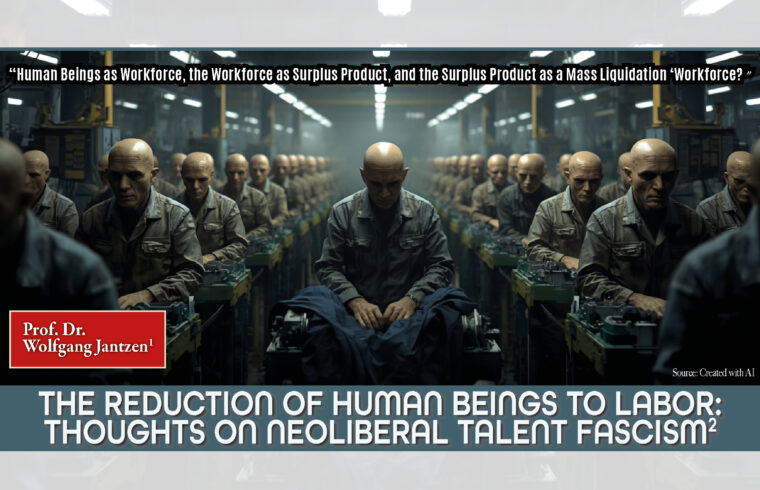
One of the topics proposed for this new edition of PoliTeknik was the following: “Human Beings as Workforce, the Workforce as Surplus Product, and the Surplus Product as a Mass Liquidation ‘Workforce?’” No one has defined workforce better than Karl Marx.
He wrote the following about labor and the workforce:
Labor is, above all, a process in which both human beings and nature participate (page 193), in which human beings initiate, organize, and control, at their discretion, the material interactions between themselves and nature. In order to obtain nature’s products in a form suited to their own needs, human beings confront nature as one of the forces of nature, mobilizing their arms, legs, head, hands, and the natural forces of their bodies. By influencing and transforming the external world in this way, they also transform their own nature. They develop their dormant powers and compel them to act as they wish (MEW 23, 193)*.
Nevertheless, active labor is an integral part of the social structure in which it takes place or from which it is excluded. Because, in order to sustain life, human labor must necessarily be in relation to nature, in interaction with nature as mediated by society. This relationship presents itself before active labor primarily in the form of a commodity. However, what is it that turns a commodity into an actual commodity, and what commodity does the worker possess to offer? In capitalist society, where the separation of property and labor is reflected as an inevitable law, how is this exchange regulated?
This exchange is regulated according to the value of the commodity, which signifies something that arises exclusively within the framework of the commodity form and which, socially speaking, is something natural or supernatural (ibid. 85). But what is this value that must be absolutely distinguished from its natural value, that is, its use value? So, what is labor power as the only commodity the worker possesses?85)
„Just by contributing a certain amount of labor, new value is created” […] “Value exists only in goods and objects that are useful for consumption; we leave aside here the representation of value in fiduciary currencies, which is entirely symbolic (page 218). (If we consider human beings as the personified embodiment of the labor force, then human beings, although they are in themselves living and conscious beings, are also natural objects, things; and labor is the manifestation, the revelation of that force within them.) Therefore, if a good loses its usefulness, it also loses its value“ (ibíd. 216 et seq.)*.
At the time when Marx developed his theory of value, force was the physical expression of energy (Toulmin 1993, 218 et seq.; Jantzen 2013). To view human beings as “mere existence of the workforce” is equivalent to viewing them as potential energy. In the case of wage labor, this workforce is acquired at the lowest possible cost, in the form of kinetic energy, in order to transform, during the labor process, the tools and objects that are the private property of the capitalist into commodities with the aim of making a profit. Through the use of the worker’s kinetic energy (workforce) marketable products are created. The sale of these products as commodities (the conversion of potential energy into kinetic energy) serves the capitalist in the form of money (potential energy) to be used in the next cycle.
But if people’s labor power is reduced to “low-value labor”, if it is not sufficiently developed relative to the state of the productive forces, or if it does not appear capable of developing, where does this lead? Abstract workforce, which creates value, always depends on the existence of concrete labor, which creates value of use. If this is not achieved, or if labor is shifted to countries where it is cheap, the material existence of active labor is maintained solely to ensure the continuity of domination under the given social conditions.
Transforming these conditions to increase profits (through tax breaks for the wealthy), while refinancing declining public revenues through the privatization of healthcare, education, and social services, that is, by restricting social rights to provide new benefits to investors, is the goal of this neoliberal project, of the Mont Pèlerin Society, or, in other words, of the economy of the “Chicago Boys,” loyal to Hayek and Friedman. Along with the torture methods developed by the CIA in collaboration with American psychiatrists, this process clearly reveals the fourth principle of neoliberalism: the destruction of solidarity. Interventions against Latin American states seeking their own paths toward social justice are an example of this. This is clearly demonstrated in the case of the quebrados in Argentina, politically active workers who were forced to betray their friends and comrades under torture (Klein 2007).
In fact, this neoliberalism manifests itself in the Hartz IV laws passed under the Schröder government and in the commodification of the social sphere, and once again, in the neo-fascist positions of the AfD (which, of course, has largely incorporated the Hayek Union into its ranks), but also in certain sectors of the CSU, in the coalition government’s immigration and domestic policies, and, of course, in the FDP, which shows its allegiance to the “Chicago Boys.”
However, this process of exploitation, considered “the first human right of capital” (Marx, ibid. 09), encounters its natural limits in both the existence of the active labor force and of nature. At the same time, in order to be as invisible as possible, a transformation must take place toward processes that give meaning to and attract those for whom religion takes priority. However, in the same way, a transformation must take place not only in the face of all forms of populist power but also with regard to the mobilization processes that have adopted the new banner of personal freedoms promoted by the electronic revolution driven by Facebook, Twitter, and others. According to the French philosophers Deleuze and Foucault, the processes of social control and discipline are shifting toward their very essence as governance. From that point, such essence is accepted as the norm for everyone else. The erosion of solidarity under neoliberal ideology is becoming increasingly widespread. But at the same time, there is another group that opposes the dominant powers and this policy with an absolute and resolute “no.” This is how the Latin American philosopher Enrique Dussel has summarized it.
“The other is the only sacred being who deserves unlimited respect.” But “to hear the voices of others, one must first be an atheist in the face of the system” (Dussel 1989, 75). “Rejecting the divinity of capital […] is the first condition for affirming an absolute deistic ‘no’” (ibid., p. 115).
In this sense, a psychology based on liberation aims, at the same time, to make the voices of others heard and to promote democratic transformation.
“We must denounce and reject all political systems, activities, and institutions, whose negative effects cause suffering to victims, the oppressed, and the marginalized, as things without a future!” (Dussel 2013, 107). Pathways to emancipation have been analyzed in depth in the political theory of the south; however, they are often overlooked in the north (see Jantzen 2015).
* FOOTNOTES
I owe my colleague Simone Danz a debt of gratitude for translating the concept of “ableism” into German as “talent fascism.” [P. 286 in: “Menschenwürde – Menschenrecht –
Ableismus”. In: Behindertenpädagogik 56, (2017) 3, 283 – 292].
Thank you so much, Simone, for this excellent translation!
* Karl Marx, Capital, Volume I, pp. 180–181, 6th edition
Sol Yayınları, Ankara, 2000.
* Karl Marx, Capital, Volume I, p. 202, 6th edition, Sol Yayınları,
Ankara, 2000.
Sources:
Aguiló Bonet, A.J. (2013): Die Würde des Mülls – Globalisierung und Emanzipation in der sozial- und politischen Theorie von Boaventura de Sousa Santos. Berlin
Dussel, E. (1989): Philosophie der Befreiung. Berlin
Dussel, E. (2013): 20 Thesen zu Politik. Münster
Jantzen, W. (2013): Marxismus als Denkmethode.
http://www.marx-engels-stiftung.de/Texte/Jantzen_Marxismus-als-Denkmethode.pdf
Jantzen, W. (2015): Inklusion und Kolonialität. In: Jahrbuch für Pädagogik, 241-254
Klein, N. (2007): Die Schock-Strategie. Frankfurt/M.
Marx, K. (1970): Das Kapital. Bd. 1. MEW Bd. 23. Berlin
Toulmin, S. (1983): Kritik der kollektiven Vernunft. Frankfurt/M.
This article was first published in 2018 in issue 19 of the PoliTeknik print publication.