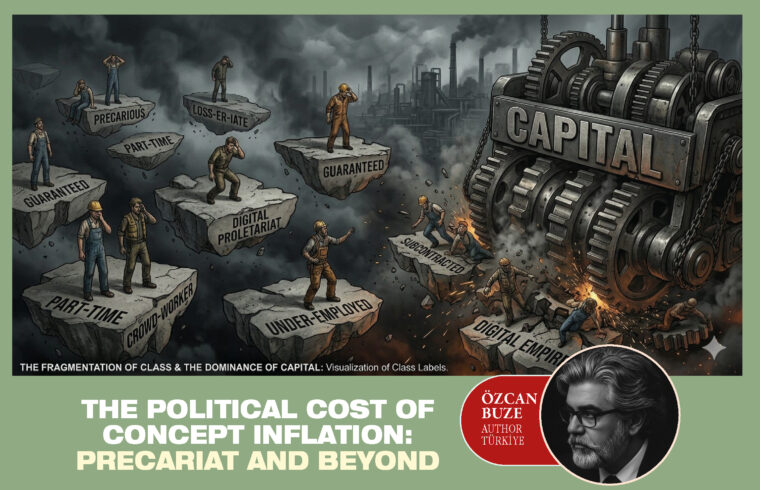
Every new label divides the working class further.
As it divides, power disappears. When concept inflation is over,
no organized class remains on the ground—only lone individuals.
I. INTRODUCTION
In the social sciences, inventing a new concept is remarkably easy. Take a sufficiently complex problem, give it an original name, produce a handful of academic texts, and watch the concept settle into the literature. The question of whether it actually describes anything new is rarely asked.
The precariat is precisely such a concept. Guy Standing and a constellation of contemporary social theorists proposed this term to designate workers in insecure, fragmented, discontinuous employment as a “new class.” It sounds compelling. But on closer inspection, every defining characteristic of the precariat — insecurity, fragmented employment, subcontracting, absence of social rights — is already fully contained within the classical Marxist definition of the proletariat. There is no new class here. There is only a new label.
This article examines the precariat and its conceptual siblings from that standpoint. The argument unfolds on three levels: theoretical, logical, and political. Theoretically, these concepts add nothing to Marxist class analysis. Logically, the methodology that produces them is condemned to its own absurdity. Politically, they serve the objective function of dissolving class consciousness — regardless of the intentions of those who deploy them.
II. WHAT IS THE PRECARIAT — AND WHAT DOES MARX ALREADY TELL US?
In his 2011 book The Precariat: The New Dangerous Class, Guy Standing laid out the concept with systematic ambition. The precariat, he argued, constitutes a fundamentally new and distinct social layer, divorced from the traditional working class. Its defining characteristics include the absence of job security, the total lack of social rights, platform work and the gig economy (a term borrowed from the music industry, where a “gig” originally meant a single, one-off performance — it has since migrated into economic vocabulary to describe project-based, contractless, discontinuous labor, roughly translatable as “working whenever you can find work”), fragmented and discontinuous employment, the dissolution of occupational identity, dependence on non-wage income, and chronic uncertainty about the future.
To anyone f amiliar with Marxist theory, thislist raises an immediate and unavoidable question: which of these characteristics falls outside the classical definition of the proletariat?
For Marx, class is not a matter of subjective experience or cultural identity. It is an objective relation of production. The proletariat is the class that, owning no means of production, has no option but to sell its labor power to survive. Built into that definition is insecurity — because the worker has nothing to sell but labor, and whether that labor is purchased depends entirely on the calculations of capital. Fragmented employment, subcontracting, discontinuous work: all of this is examined in exhaustive detail in Capital. The absence of social rights, the dissolution of occupational identity, chronic uncertainty about the future — these are consequences of the fundamental relation between labor and capital, not characteristics that could possibly constitute an independent class standing outside it.
Every criterion Standing advances for the precariat describes the proletariat in its particular historical manifestation. What emerges is not a new class but a new face of the same class. The theoretical contribution of the concept is zero. The analytical damage it inflicts is considerably higher.
III. TAKING THE LOGIC TO ITS CONCLUSION: INVENTED CATEGORIES
The most reliable way to test a concept’s validity is to apply its logic consistently and see where it leads. The logic behind the precariat is straightforward: if a subset of the proletariat experiences conditions specific to its situation, it qualifies as a distinct class category.
Let us accept this logic and apply it.
Gay workers face discrimination in the workplace, compounding their insecurity.
Therefore: the homoletariat.
Child laborers are exploited and simultaneously denied education. Therefore: the pedoletariat.
Elderly workers are forced into retirement or pushed out of the labor market. Therefore: the gerioletarijat.
Seasonal workers in agriculture and tourism are employed for only a fraction of the year. Therefore: the seasonoletariat. Drug dealers operate in the informal economy, without security, without legal protection, in conditions of constant physical danger. Therefore: the narcoletariat.
Contract killers — from the Latin caedere, to kill, the same root as homicide, fratricide, genocide — lack job security, have no access to social rights, and live with chronic uncertainty. Therefore: the cidoletariat.
Extortionists operate within informal economic structures. Therefore: the extortoletariat.
Workers whose only economic horizon is a lottery win — people for whom systemic mobility is so thoroughly foreclosed that chance becomes the sole imaginable exit — therefore: the lotoletariat.
And the colonists who will one day be dispatched to Mars to labor in the most extreme conditions, at the furthest remove from any social protection: therefore: the spatiolateriat.
The list does not end here. There is no reason it should.
Let us be explicit about something. The majority of the examples above were generated in the course of writing this article, in a matter of minutes. This is not a boast. It is a warning. The logic is so simple and so loose that anyone can take any characteristic and attach a label to it. No specialized expertise is required. The reader is invited to try.
Here is what each of these invented categories actually describes:
Homoletariat: Gay workers. Their experience of workplace discrimination is real. But discrimination does not place them outside the proletariat. Declaring a subset of workers who face discrimination a distinct class does not dismantle the discrimination. It merely relabels it.
Pedoletariat: Child laborers. Exploited, denied education, subjected to physical and psychological damage. This is among the oldest and most clearly documented features of capitalist production. Marx and Engels wrote about it extensively. It requires no new category. A new label adds nothing.
Gerioletariat: Elderly workers, forced into retirement or trapped in grueling physical labor into old age. The classic operation of the reserve army of labor — capital uses up the workforce and discards it. Already in Marx.
LGBTİQ++letariat: The expanded LGBTİQ+ category. An extension of the homoletariat with an expanding acronym. As the plus signs multiply, the boundaries of the category dissolve — but the logic remains identical.
Seasonoletariat: Seasonal workers. Discontinuous employment is among the most thoroughly analyzed phenomena in Marxist political economy. A new name generates no new analysis.
Narcoletariat: Drug dealers. Informal, insecure, dangerous. But which capital relation? Which surplus value? The question goes unanswered — because the analytical framework does not apply.
Cidoletariat: Contract killers. From Latin caedere — the same root as homicide, fratricide, genocide. No job security, no social rights, chronic instability. This is where the logic consistently applied arrives.
Extortoletariat: Extortionists. Informal economic actors. The Latin root lends the category a spurious air of scholarly precision. It is otherwise empty.
Migralateriat: Migrant smugglers and their victims. Here the list reaches its deepest point of collapse: perpetrator and victim enter the same category. Exploiter and exploited share the same label.
Lotoletariat: Workers whose only economic hope is the lottery. We are no longer categorizing economic activity. We are categorizing a psychological response to dispossession. Marxist analysis already has a name for this. It is called alienation. Under the new rules of concept inflation, alienation gets repackaged as a demographic class.
Pornolateriat: Workers in the pornography industry. The capital relation here is more visible — studios, producers, distribution platforms exist. But the question of whether the body can serve as a means of production remains unanswered.
Spatiolateriat: Space colonists. The apex of the list and the natural terminus of its logic. A working class that does not yet exist, that may never exist. But given the rules of this game, why not?
ost of these examples were invented in the course of writing this article, in a matter of minutes. But the methodology requires no satirical invention — it is already producing itself.
The Fluidity of Being a Woman Within the Precariat
Born from a doctoral thesis, designating women within the precariat, and already, in its publisher’s words, ‘poised to cross national borders’ — is already on the shelves. (Müjgan Şahin, Siyasal Kitabevi, 2026.) The femmecariat takes its place on the list.
But the atomization does not stop here. The femmecariat is merely an intermediate station. First they divided the proletariat and produced the precariat. Now they are dividing the precariat itself and producing the femmecariat. The logic continues indefinitely: women within the precariat, elderly women within the precariat, elderly migrant women within the precariat, elderly gay migrant women within the precariat — every intersection generates a new category, a new research program, a new academic career. The process is logically infinite and can advance until only single-person groups remain: the point at which every individual constitutes their own class. At that point, the concept of class has effectively ceased to exist — what remains, facing capital, is a mass of atomized, isolated, unorganizable individuals. This is not the theoretical endpoint of concept inflation. It is its political objective.
What do all these categories share? None of them owns the means of production. All of them must sell their labor power. All of them stand in the same fundamental relation to capital. They are all, in other words, the proletariat. As the concepts multiply, what they illuminate shrinks and what they conceal grows.
IV. BEYOND THE PROLETARIAT: FAKE WORKER CATEGORIES
The invented categories examined above at least concerned real workers. They artificially fragmented the proletariat, attaching a separate label to each subset. This was wrong and harmful — but it at least remained within the terrain of Marxist analysis.
The category we turn to now goes further. Here, activities that bear no relationship to Marxist class analysis are designated as labor. There is no production relation, no surplus value, no capital relation — only the label “worker.” And behind that label, beneath what appears at first glance to be a gesture of solidarity, lies an ideological operation that functions in precisely the opposite direction.
The Concept of “Sex Work”
The term “sex worker” is deployed systematically by certain currents to define and legitimize prostitution as an occupation. The term itself is already a political position — not a neutral description but the linguistic expression of an advocacy practice.
Testing it against the Marxist framework requires only three questions.
First question: what is the means of production?
In classical Marxist analysis, the worker is separated from the means of production — this is precisely why labor power must be sold. If the human body is to be counted as a means of production, then every manual worker already owns their means. If that is accepted, the foundational definition of the proletariat collapses. The concept either applies to everyone or to no one.
Second question: where is surplus value produced, and who appropriates it?
In Marxist analysis, surplus value is the portion of the value created by the worker that exceeds the wage paid, and capital appropriates it. In prostitution, this relation cannot be defined. Is the client a capitalist? Is the payment surplus value or exchange value? Does the involvement of a third party change the relation? The questions cannot be answered — because the analytical framework does not apply.
Third question: how is class consciousness formed?
In Marxist analysis, class consciousness emerges from a shared relation to production. Workers facing the same capitalist within the same structure of exploitation come to recognize their common interests. The question of how “sex workers” might form class consciousness within a shared production relation has no answer.
The False Compassion Mechanism
The objections arrive on cue: “But these people are exploited.” “Their rights must be protected.” “They are vulnerable.”
None of these objections is false. Women driven into prostitution — the great majority of them victims of poverty, violence, and trafficking — are genuinely exploited and their rights genuinely require protection. But none of this requires defining them as “sex workers.” On the contrary: that definition does not protect them. It legitimizes the system that keeps them there.
Inserting the concept of “sex work” into Marxist class analysis reframes systematic victimization as a free choice within a labor market. Defining prostitution as a labor relation prepares the ideological ground for normalizing and sustaining the industry. This is the real function of false compassion.
The pornography industry is treated within the same framework. The capital relation there is more visible — studios, producers, platforms. But the question of whether the body can function as a means of production remains unanswered. The pornolateriat carries the absurdity one step further.
The Lynching Mechanism
Those who raise these objections know what to expect: “You’re defending prostitution.” “You hate women.” “You’re blaming the victims.”
These accusations deliberately conflate two entirely different positions. Refusing to insert prostitution into Marxist categories is not a defense of prostitution. It is precisely the opposite: it insists that the genuine victimization of women driven into prostitution must be made visible, not obscured by the label of worker.
But the distinction is never drawn. Its not being drawn is not accidental. It is the fastest available method for closing down debate, silencing criticism, and morally discrediting anyone who objects. It is the instrument of ideological domination, not intellectual honesty.
The Migralateriat
A parallel collapse occurs with migrant smuggling. The migralateriat exposes the absurdity with particular force: who, in the smuggling operation, is the worker — the smuggler or the migrant? Both? When perpetrator and victim are placed in the same category, the concept does not merely become meaningless. It becomes morally untenable.
This too is not accidental. Collapsing the distinction between exploiter and exploited obscures the responsibility of the perpetrator. The “worker” label places the smuggler and the trafficked migrant within the same production relation, erasing the moral and legal distance between them. When a concept expands to cover everything, it functionally means nothing — and those who cause harm find protection in that void.
V. THE FOURTH, FIFTH, AND SIXTH WORLDS
This concept inflation is not confined to class analysis. A parallel expansion has infected international relations.
Mao Zedong’s Three Worlds Theory rests on a coherent geopolitical and anti-imperialist analytical framework. The First World consists of the two superpowers — the United States and the USSR — each operating as an imperialist force within its own sphere. The Second World comprises the middle powers — Japan and the countries of Europe — dependent on one of the two blocs but seeking independence. The Third World designates the nations that are colonies, semi-colonies, or victims of neocolonialism, standing outside the camps of both superpowers.
(The theory is fiercely contested — its designation of the USSR as “social imperialist” led Mao toward rapprochement with the United States and toward support for deeply questionable forces within liberation movements. But that is a separate argument.)
It may be right or wrong. But it has an internal logic. It is grounded in analysis, offers a coherent framework, and carries political consequences.
The Fourth World has none of this. It is used to describe indigenous peoples, the chronically poor, communities pushed to the margins within First World societies. It points to real suffering — that much should be conceded. But however much it may appear to continue Mao’s sequence, it has no organic relationship to that logic. Why is it the fourth? From which systematic analysis does it derive? The questions go unanswered. The concept hangs in the air. In Ancient Greece, ‘barbarians’ were labeled the same way—outsider (“metoikos”) pushed beyond the bounds of society. Sticking a number on something is easy; systematic analysis is hard.
Generating concepts that float free of any systematic analytical foundation is not difficult. Here are two demonstrations:
The Fifth World: The digitally dispossessed. Those without internet access, rendered invisible by algorithms, excluded from the platform economy. Those without screens. Those without passwords. Those without connections. The Fifth World is waiting — and so are the academic careers.
The Sixth World: Space colonists. Not yet dispatched to Mars, perhaps never to be dispatched, but theoretically destined to labor in the most extreme conditions, at the furthest frontier, in the deepest insecurity. The spatiolateriat has already claimed its place in the class list. The Sixth World can claim its place in the geopol itical one.
A Seventh World would not be hard to justify. Nor an Eighth. The list is open, the pen is ready. All that is required is a grievance and a number.
VI. WHY IS THIS HAPPENING?
The concepts examined here share a common feature: they are wrong. Theoretically groundless, logically incoherent, analytically useless. Yet they dominate academic literature, anchor public debate, and succeed in silencing their critics. How?
Two explanat ions, dist inct but mutual ly reinforcing.
First Explanation: The Pressure to Produce
Modern academia has become less a system for generating knowledge than a factory for generating concepts. Publication counts, citation indices, the imperative of originality — these pressures force academics to perpetually produce something new. But there is not always something genuinely new to say.
Under this pressure, the path of least resistance is to take existing concepts apart and reassemble them under new names. The proletariat is already defined — using it as it stands earns no credit for originality. But taking a fraction of the proletariat and giving it a new name yields an article, a book, a research program, an academic career. This is precisely how the precariat was born. Standing’s book has been translated into ten languages and taught in dozens of universities. What it delivers is what Marx already said — in new packaging.
This mechanism can operate in good faith. Many academics genuinely believe they have found something new. But good intentions do not cancel analytical error. The result is the same: concept inflation, fractured analysis, weakened class consciousness.
Second Explanation: The Objective Function of Dispersing Class Consciousness
The second explanation is more disturbing. Ignoring it is more disturbing still.
Class consciousness is dangerous to capital. Workers recognizing themselves as members of a common class, grasping their shared interests, and acting collectively — this is the engine of the greatest social transformations in history. Capital needs to dissolve that consciousness. It does not always do so directly. Indirect methods are often more effective.
Fragmenting the proletariat into dozens of subcategories is the most elegant form this dissolution takes. The homoletariat attends to its own concerns, the gerioletariat to its own, the seasonoletariat to its own. Each group sees its particular oppression, but the shared production relation that is the source of all of it becomes invisible. A united class movement gives way to disconnected identity politics. A more comfortable, more manageable order for capital.
It does not follow that everyone producing these concepts intends this result — and that claim should not be made. But the objective function of an idea is not measured by the subjective intentions of those who advance it. Many of the mechanisms sustaining capitalism are operated by people who have no interest in sustaining it. The analytical chaos generated by concept inflation serves capital regardless of anyone’s intentions. As one formulation puts it: this is divide and conquer executed with sociology degrees rather than strikebreakers.
Third Explanation: Superficial Marxism
There is a third factor that must be named. A significant proportion of those producing and defending these concepts have never genuinely absorbed Marxist theory. Academics included, many approach it with secondhand familiarity, adopting the vocabulary without grasping the historical and theoretical depth of the concepts — generating new labels or endorsing existing ones without the analytical foundations to evaluate them.
More revealing is how these people respond to criticism. Those who insist on the correct use of classical Marxist categories are dismissed as antiquarians trapped in 200-year-old vocabulary. The accusation sounds radical. It is hollow. Nothing on offer transcends Marxism, pushes against its limits, or proposes a new theoretical framework. There is only dilution and muddying. Fragmenting concepts is not theoretical progress. It is theoretical regression with a progressive aesthetic.
All Three Together
These explanations do not conflict. They complete each other. Academic production pressure prepares the ground: the compulsion to generate new concepts continuously erodes analytical discipline. The political function takes root in that ground: fractured analysis, dispersed class consciousness, a left rendered ineffective. Superficial Marxism provides the path of least resistance through which both mechanisms operate most freely.
The result is not a deliberate conspiracy — but it is as effective as one. Perhaps more so: because it comes from within, is generated in good faith, and is extraordinarily difficult to criticize. Saying “you don’t want to defend precarious workers” is much easier than saying “you are diluting class analysis.”
The result is not a deliberate conspiracy — but it is as effective as one. Perhaps more so: because it comes from within, is generated in good faith, and is extraordinarily difficult to criticize. Saying “you don’t want to defend precarious workers” is much easier than saying “you are diluting class analysis.”
The femmecariat is not the finish line—it is a fork in the road. First they split the proletariat and called it precariat. Now they are splitting the precariat and calling it women. Tomorrow they will keep splitting it: by age, by migrant status, by sexuality. Every knife cut births a new concept. As concepts multiply, the proletariat evaporates. The bill for replacing a class with lone individuals is paid by workers.
VII. WHY THE CLASSICAL CONCEPTS STILL SUFFICE
The greatest strength of Marxist class analysis is its level of abstraction. The proletariat does not designate a particular occupation, a particular form of work, or a particular cultural identity. Two criteria — separation from the means of production and the consequent necessity of selling labor power — make it possible to analyze workers in vastly different historical conditions within a single analytical framework.
A nineteenth-century textile worker, a twentieth-century assembly line worker, a twenty-first-century platform worker: all work differently, in different conditions, with different tools. But all are separated from the means of production, all must sell their labor power, all stand in the same fundamental relation to capital. That shared foundation is more determinative than the differences between them.
Precariat theorists ignore this. They present platform work, the gig economy, subcontracting as “new” phenomena requiring new concepts. But a change in the forms of production is not a change in the relations of production. Capital is still capital. Labor is still labor. The instruments have changed. The relation has not.
Marxist class analysis encompassed radically different categories of workers even in its own time. In Capital, Marx analyzed factory workers, agricultural workers, home workers, itinerant traders within the same framework. In The Condition of the Working Class in England, Engels documented insecure, fragmented, discontinuous labor — everything that precariat theorists now present as a novel discovery — in the nineteenth century.
Insecurity is not new. Fragmented employment is not new. Subcontracting is not new. These are chronic features of capitalism — more prominent at some moments, less at others, but never absent. Marx understood this. His concept of the reserve army of labor explains this chronic insecurity directly: capital maintains a permanent pool of underemployed workers to discipline the employed workforce. Today’s platform worker is the digital- era manifestation of Marx’s reserve army. Nothing more.
The sufficiency of classical concepts is not only a theoretical question. It is a political one. The concept of the proletariat brings workers together under a shared identity. This identity does not erase differences — the conditions of a factory worker and an agricultural worker are different, and everyone knows it. But it makes the shared relation beneath those differences visible. It enables the questions that matter: who is the common enemy, what is the common interest, how is collective action possible.
The precariat and its conceptual siblings destroy that unity. Each group, furnished with its own specific label, focuses on its own specific grievance. Collective action becomes progressively more difficult. The greatest working-class movements in history — trade unions, general strikes, revolutionary transformations — drew their force from this shared class identity. Fragment the identity and you fragment the movement.
VIII. CONCLUSION: THE PRICE WE PAY: WHEN CONCEPTS DISSOLVE CLASS
A single argument has run through this article: the precariat and its derivative concepts add nothing to Marxist class analysis. They isolate characteristics already contained within the proletariat, re-label them, push against the boundaries of the concept, and ultimately render it inoperable. This is not intellectual fashion. It is analytical collapse with a political price.
Every criterion Standing advances for the precariat — insecurity, fragmented employment, absence of social rights, uncertainty about the future — is already present within Marx’s concept of the proletariat. What is new is not the condition. It is the label.
Applying this logic consistently leads to absurdity: the homoletariat, pedoletariat, gerioletariat, seasonoletariat, lotoletariat, the femmecariat, and ultimately the spatiolateriat. Each may describe a real oppression, a real insecurity. But none constitutes a new class. They are different faces of the proletariat — and presenting those faces as distinct classes renders the underlying relation invisible. The process does not stop here: women within the precariat can be further divided, elderly women within that, migrant women within that. The atomization can advance until only single- person groups remain — at which point the concept of class has effectively ceased to exist. This is not the theoretical endpoint of concept inflation. It is its political objective.
Pushed further, activities that bear no relationship to Marxist analysis are designated as labor: sex work, the narcoletariat, the cidoletariat, the extortoletariat, the migralateriat, the pornolateriat. Here the proletariat is no longer being fragmented — there is no production relation, no surplus value, no capital relation at all. Only the label remains. And that label, far from protecting the victims, legitimizes the systems exploiting them.
The question that remains is the only one that matters: whose interests do these concepts serve?
They have not served the interests of precarious workers. They have not brought them together, enabled them to recognize their common interests, or prepared the ground for collective action against capital. They have served academic careers, research programs, and ideological domination.
Returning to classical concepts is not conservatism. It is analytical honesty. The concept of the proletariat encompasses the precarious worker, the seasonal worker, the platform worker — without fragmenting them, without erecting walls between them, without attaching a separate label to each. That inclusiveness is not a weakness. It is a strength.
The cost of concept inflation is not a theoretical error. It is a political loss. And the bill is paid not by the academics who generate the concepts, but by the workers who needed the solidarity those concepts dissolved.