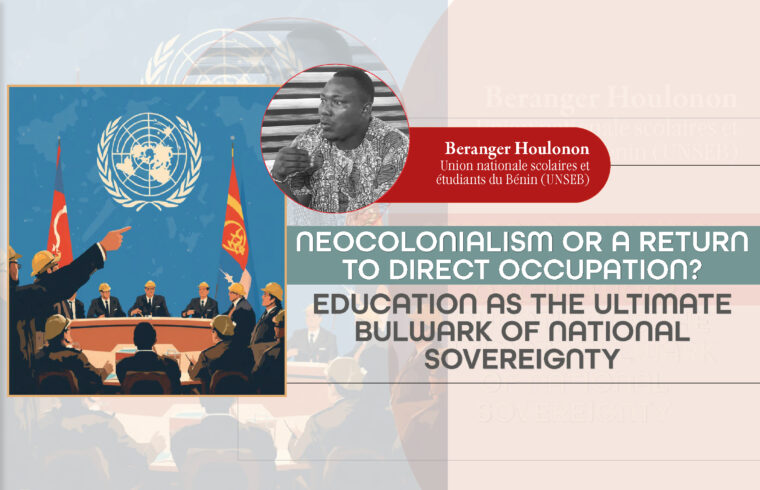
The twenty-first century was expected to mark the definitive end of colonial domination. Yet many nations, particularly in Africa, Asia, Latin America, and parts of the Pacific, continue to face forms of dependency that call into question the reality of their sovereignty. Although colonial administrations have officially disappeared, another form of control has gradually emerged: neocolonialism. However, recent geopolitical developments raise an increasingly debated question in academic and political circles: are we still witnessing neocolonialism, or are we gradually seeing the return of mechanisms that resemble direct occupation in new forms?
This question cannot be examined without considering a decisive factor: education. No nation has ever achieved genuine political independence or sustainable development without investing heavily in the intellectual, scientific, technical, and civic education of its population.
History demonstrates that all major powers first built strong educational systems before establishing their economic, military, and technological power. Western Europe, the United States, Japan, South Korea, Singapore, and China all made education a national priority well before reaching the highest ranks of the global economy. Their investments in research, innovation, universities, and skills development enabled them to create a highly qualified workforce, strong institutions, and the capacity to make autonomous decisions.
Conversely, countries whose educational systems remain fragile often find themselves dependent on external expertise. They import technologies, medicines, industrial equipment, software, infrastructure, economic models, and sometimes even governance strategies. Such dependency inevitably narrows their political and economic room for manoeuvre.
Neocolonialism no longer necessarily relies on the installation of colonial administrators or foreign governors. It can manifest itself through financial dependency, debt mechanisms, conditionalities attached to certain forms of international cooperation, control over value chains, the appropriation of natural resources, the influence exerted by multinational corporations, or technological domination. When a country controls neither its industrial capacity, its digital data, its financial system, nor its scientific capabilities, exercising political independence in its fullest sense becomes increasingly difficult.
At the same time, several international crises indicate that certain powers now favour more visible forms of intervention when their strategic interests are directly at stake. Increased military presence, the establishment of foreign military bases, the use of private military companies, influence over political processes, and geopolitical competition surrounding critical minerals, trade routes, and energy resources are all realities that fuel the debate over a possible transformation of contemporary forms of domination.
However, reducing this situation solely to the responsibility of foreign powers would provide an incomplete analysis. Internal weaknesses also play a major role. Corruption, poor governance, the embezzlement of public funds, institutional instability, political divisions, armed conflicts, the absence of coherent industrial policies, and chronic underinvestment in education considerably weaken the ability of states to defend their interests and resist external pressure.
Education is precisely where sovereignty and development converge. It trains engineers capable of transforming raw materials locally; doctors who strengthen national healthcare systems; teachers who transmit knowledge; researchers who generate innovation; lawyers who reinforce the rule of law; economists who design public policies suited to national realities; and citizens capable of exercising democratic oversight over their leaders.
Conversely, an inadequately educated population becomes more vulnerable to manipulation, disinformation campaigns, technological dependency, and the loss of human capital. When the most highly qualified graduates leave their countries permanently because of a lack of opportunities, nations lose an essential part of their development potential.
National development therefore cannot be reduced to GDP growth or the multiplication of infrastructure projects. It also depends on a people’s ability to produce knowledge, master technologies, transform their natural resources, finance their economy, guarantee the transparency of their institutions, and freely determine their strategic priorities.
Current challenges make this imperative even more urgent. The artificial intelligence revolution, the energy transition, competition for strategic minerals, cybersecurity, biotechnology, and control over data are reshaping the global balance of power. Countries that remain mere consumers of technology risk deepening their dependency, while those that invest in research, innovation, and higher education will strengthen their autonomy.
Political independence cannot be proclaimed solely through constitutions or official speeches. It is built every day through the quality of institutions, the competence of citizens, the capacity to innovate, and mastery of economic levers. Likewise, sustainable development cannot exist without intellectual sovereignty.
The debate between neocolonialism and a return to some form of direct occupation therefore goes far beyond slogans. It challenges every society to examine the true foundations of its freedom. For a nation that controls its education system, science, economy, and institutions possesses greater means to defend its interests in a world increasingly shaped by intense geopolitical competition. Conversely, a nation that neglects knowledge, investment in human capital, and responsible governance exposes itself to having its strategic choices influenced, or even determined, by external actors.
Ultimately, history teaches us that the strongest form of sovereignty is not achieved solely on battlefields or through diplomatic negotiations. It is built first in classrooms, laboratories, universities, research centres, and every institution where knowledge, critical thinking, and the capacity to innovate are developed. Education thus remains the first line of defence against all forms of domination and the indispensable foundation of genuine political independence and sustainable national development.
The debate on neocolonialism is therefore not merely about denouncing international power relations. It calls upon states to invest in what constitutes the primary source of their strength: the intelligence of their people. History shows that empires may impose their influence through force, finance, or technology, but no form of domination can withstand indefinitely a people that is educated, conscious of its interests, and capable of producing its own knowledge. The future of nations depends less on the abundance of their natural resources than on the strength of their schools, universities, research centres, and their ability to make education an absolute national priority. It is through this conquest of knowledge that the greatest guarantee of genuine sovereignty, effective political independence, and sustainable national development can be found.