Summary
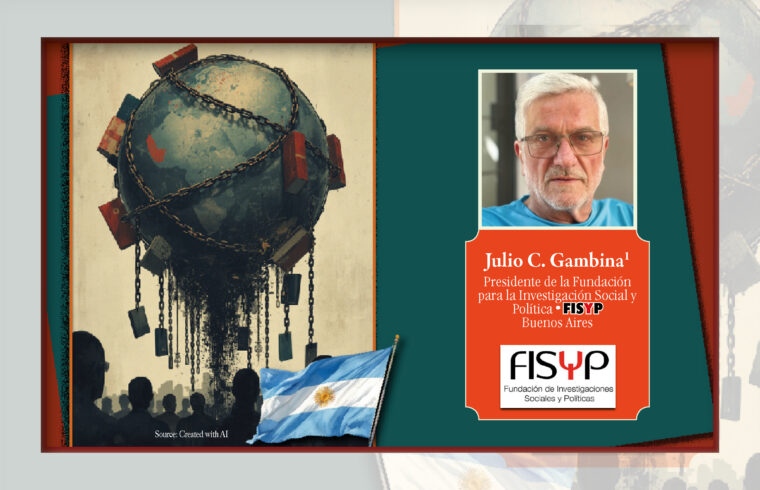
Ever since its inception, capitalism has promoted violence in the occupation of territories, a practice that came to be known as COLONIALISM in the 16th century. Struggles against occupations and for autonomy and independence led the hegemonic powers to regain economic and political control through other means, though always resorting to violence. And that is what came to be known as neocolonialism. The militarization and territorial occupation we see today are part of a strategy of interference, domination, and subordination, in Palestine, Venezuela, or the Middle East, threatening Cuba and imposing constraints on the subordinate classes throughout the world. This occurs through cultural channels, such as the media, education, or the manipulation of people’s minds through new technological developments. It is a combination based on the increased exploitation of the workforce and the plundering of the commons. Argentina is an example of a government led by the far right and subordinated to U.S. foreign policy and its alliance with the State of Israel.
I – Violence as a constant
Capitalism is not a “natural order,” as many present it, but rather the product of violent actions that determine accumulation. The origin of capitalism lies in violence, not in free markets, even though the latter is the foundational category of classical political economy.
Violence is exerted in confrontation with the previous socio-economic system. The colonial relationship is the outcome of the universalization of the capitalist system.
The “discovery” , the “conquest” , and the “colonization” of the territory we call today America took place within this framework.
The “metropolises”, England, France, the Netherlands, Spain, and Portugal, dominated the populations of the occupied territories through the brutal exercise of violence, transforming their economic, social, religious, and cultural structures.
These were not events without conflict or resistance, which are generally hidden from view by the hegemonic narrative.
The colonial order inherently implies the anti-colonial struggle, in the form of violent confrontations. This struggle and these confrontations are ongoing today and are spread across the entire planet.
Capitalism becomes universal on the basis of colonial violence, which over time has transformed into neocolonial and imperialist violence, imposing relations of domination that comprehensively subordinate the subjugated country.
That is why we allude to relations of dependence on hegemonic countries within the world system, the minority.
At the same time, a majority of subordinate, dependent countries emerges.
This is, essentially a system characterized by domination and dependence, structured around violent relationships.
While “dependence” is presented as an economic, technological, or financial phenomenon, its origin lies in the exercise of violence, which is reproduced in recurring acts of war throughout contemporary history.
There was violence in European expansion into Africa, the Americas, and Asia, and even within Europe itself (Ireland, for example).
Violence continues today in the expansion of the State of Israel into Palestine, particularly Gaza. But it also extends to the Middle East as a whole, including Lebanon and Iran, through the strategic partnership with the world’s leading power: the US.
In the Americas, it manifests in the U.S. incursion into Venezuela in early 2026, involving the kidnapping of the president and a congresswoman, as well as economic impositions on oil management and foreign accounts; it also includes threats against Greenland, Mexico, and Colombia, and especially the intensification of the blockade against Cuba.
The expansion of capitalist relations is limited by the resistance of the peoples, a fact obscured in the narrative of the victors. Although global popular solidarity with Palestine and Cuba is growing, violent actions are intensifying through imperialist power.
In the current global context, there is a rise in violence and political authoritarianism, to the detriment of the “democratic forms” upon which the notion of a link between capitalism and electoral systems was built.
The expansion of democratic regimes based on elections currently appears to be constrained by the offensive of the far right, which is intensifying the capitalist offensive of the past half-century.
In fact, in response to the rise of resistance movements and the institutionalization of social benefits across much of the world in the wake of the capitalist crisis of the ’60s/’70s, capital launched an offensive to reorganize the existing order in a regressive manner.
This was expressed through regressive changes in the relationship between capital and labor, with the repressive weight of the state and a dismantling of its direct intervention in the economy, through the deregulation and privatization of public assets, alongside a reorganization of international relations, especially those that had governed as international norms since 1945.
This is a global process that originated in the violence of the genocidal dictatorships in the southern hemisphere of the Americas during the ’70s.
It was a program called “neoliberal” that was introduced in Great Britain and the United States under conservative restoration governments in the ’80s.
The violence of the dictatorships in the south spread to the violent process of disciplining labor, social, and political organizations in the imperialist north.
In doing so, it set the course and direction for capitalism’s new era over the past half-century.
Violence is a constant feature of the origin, development, and future of global capitalism, unless resistance movements put a stop to it and create the conditions for new forms of economic, social, and cultural organization of society, in harmony with nature.
II – Military, ideological, political, and cultural intervention
Capitalism is a contradictory social relationship, based on exploitation and plunder, and serves as the material basis of civil society, as we learned from Karl Marx in his book called Introduction to the Critique of Political Economy.
Dispossession was the mechanism by which a social majority was subordinated to the capitalist system.
This is the foundation upon which the capitalist order was built and is repeatedly rebuilt.
There are two simultaneous aspects, the dispossession of people and the clearing of territories for private appropriation.
They constitute the foundations for the exploitation of the labor force and the plundering of the commons.
It is a fact that there is a global trend toward the expansion of dispossession affecting broad segments of the population who survive by selling their labor power, but no longer under social security systems that spread throughout the 19th and 20th centuries based on the organization and struggle of working people.
Also a reality is the intensified exploitation of the commons or “natural resources” to extract the essential raw materials demanded by concentrated capital in times of accelerated technological innovation.
Artificial intelligence, the Internet of Things, and robotics require vast quantities of lithium, copper, rare earth elements, and water, in addition to hydrocarbons and minerals in general, all of which are essential for contemporary production.
This demand from concentrated capital draws states into territorial disputes, which is particularly crucial in the case of the United States, which feels its global power, achieved around 1945, is under threat.
We must consider that the unipolar world envisioned around 1991, following the collapse of the USSR and the socialist camp, became, with China’s rise, an open struggle for global power within the capitalist system.
The debate centers on who exercises power within the capitalist system, and the U.S. defends and contests that position through economic, political, and cultural means, as well as through the use of force.
The global power of the dollar is the cornerstone of Washington’s economic domination.
The U.S. currency embodies power within the global monetary and commercial order. Most countries’ international reserves are held in dollars, despite a historical trend of decline. Trade and financial transactions are still predominantly conducted in U.S. dollars.
To slow down competition from China and alliances with other countries, U.S. power relies on unilateral sanctions against various nations, through a process of negotiation and renegotiation, as evidenced by the tariff war at the start of Trump’s second term in 2025.
Sanctions serve as delaying tactics while Donald Trump’s challenging reindustrialization plan moves forward. Meanwhile, it is pursuing a foreign policy aimed at consolidating its dominance in the “western hemisphere”, that is, Latin America and the Caribbean.
Therefore, in addition to its confrontation with China and its allies (Russia, Iran, among others) and its efforts to bring Europe under its control, it is consolidating the strategy of domination over Latin America and the Caribbean.
The strategy is to secure electoral support for right-wing parties in Latin America and the Caribbean, building on the ground gained in Argentina, El Salvador, Ecuador, Chile, and other countries subject to the logic of U.S. foreign policy.
That is why there has been a strong recent focus on Peru and Colombia, with Brazil and even Mexico next in line. The intention is to shape the entire region with the narratives emerging from the order promoted by MAGA, centered on the U.S. and the American continent, which is why it is expanding into Canada and Greenland.
The strategy is economic, political, military, ideological, and cultural, seeking to build consensus but also to exert coercion to impose a specific order within contemporary capitalism, especially in Latin America and the Caribbean.
The United States is the largest military power, with a defense budget that vastly exceeds that of other military powers, and it possesses sufficient power to drive an increase in global military spending.
The logic points toward intensifying the mechanisms of consensus in the service of domination, as well as processes of coercion, whether economic, political, or military.
There is, ultimately, a trend toward changing the rules established in the global order defined in 1945.
These rules were updated to favor United States hegemony around 1971 with the “inconvertibility” of the dollar and in 1991 following the collapse of the Soviet Union and the dismantling of the socialism -capitalism bipolarity around 1991.
III – Argentina as a pilot project and “model”
The new presidency of Javier Milei offers an interesting case for examining subordination to the logic of U.S. domination, at a time of global capitalist crisis and debate over the system’s hegemony.
Milei, a figure representing the far right that is on the rise worldwide, presents himself as a leader capable of steering the course of this reactionary movement.
His core argument, libertarianism, entails an ideological confrontation against state intervention in the economic order.
The argument put forward is “free market” principles taken to the extreme, reviving the original tenets of liberalism and the capitalist order: free trade, free competition, and free markets.
Its aim is to dismantle the consensus surrounding the interventionist state, which has been widespread through Keynesian policies worldwide since 1945 and under the guidance of CEPAL since its creation in 1948.
According to Milei, the key issue is the culture war, which involves dismantling the majority consensus regarding development goals built up over decades, particularly concerning economic planning and state intervention in addressing society’s needs.
Within this framework, the Milei administration has two strategic tasks.
One is associated with fiscal adjustment, which involves cutting public spending and dismantling strategic sectors of direct state intervention, especially in the area of rights, such as public health and education, among others.
The other is related to the reconfiguration of the production and development model, the restructuring of local capitalism, and its integration into the global system based on Argentina’s offering of its common goods to foreign investment, and, in any case, its industrialization.
Both seek to redesign the functioning of local capitalism and subordinate the territory and its population to the interests of big capital.
The result is the emergence of new territories for capitalist accumulation beyond the Pampas region, particularly those with mineral and energy resources, as well as the climatic conditions suitable for the establishment of data centers.
This is a process that has been underway for decades, from 1975–76 to the present, initiated under the banner of modernization and state reform, promoting a logic of privatization and encouragement of private enterprise.
This dynamic has been driven by the dispute over consensus and mechanisms of coercion, operating across different spheres of social life.
In this context, the attack on “public education” comes as no surprise in a country with a strong tradition of education at all levels: elementary, secondary, and higher education.
Dismantling the educational tradition and establishing a pedagogical framework guided by private capital is a key priority of the far right.
For the right wing, education is not a right, but a service that is bought and sold on the market, reinforcing the monetary and commercial nature of contemporary society.
Education plays a significant role in what the government defines as the “cultural battle,” associated with ideological work in the media and on social media to reinforce the path of subordination, the primary effect of which is the loss of sovereignty.
With these cultural conditions established in society, progress is being made toward the privatization of healthcare and a range of social rights, as well as the energy sector; and ultimately, this leads to the foreign ownership of the economy, resulting in a loss of sovereignty.
These are structural changes within local capitalism aimed at expanding the scope of capitalist accumulation, extending the traditional exploitation of the humid Pampas, a hallmark of the agro-export model, to include mining, energy, and the knowledge economy, all within the framework of financial subordination to external debt monitored by the IMF.
More than two and a half years of libertarian governance in Argentina, from December 2023 to July 2026, have led to a deterioration in the living conditions of the majority of the population.
At the same time, under the structural reorganization of the economic order, the country is showing economic growth figures that the government uses as propaganda to advance its strategic objectives.
Argentina is subordinate to U.S. foreign policy, while redefining a proposal for socioeconomic reorganization that has been approved by the electorate.
At the same time, it is deploying mechanisms to suppress conflict and becoming involved in imperialism’s war scenarios.
The experiment aims to be adopted globally as a model for reconfiguring capitalist relations of production.
IV – Conclusion
Lenin, in his classic 1916 analysis of Imperialism, cited Argentina as an example of a country that was politically independent but economically dependent.
Argentina’s process of political independence took place between 1810 and 1816, manifesting itself as a struggle “against all foreign domination”, not only against the colonialism imposed by the Spanish crown, but also against the ambitions of other capitalist powers, especially England, which occupied Argentine territory; Islas Malvinas.
Argentina developed capitalism in a manner subordinate to imperialist powers, particularly Great Britain and the United States.
The key point is that, at present, Argentina is promoting a logic of systemic reorganization that aims to serve as a model of liberalization on the global stage.
It is not only opening itself up to foreign capital for exploitation and plunder but is also establishing itself as a model of liberalization with electoral consensus.
The occupation is not only territorial and violent but also cultural, carried out with consensus within the framework of electoral democracy, manipulated through networks and media outlets guided by transnational capital.
It is a comprehensive strategy of the capitalist regime unfolding on our territory and serves as a pilot project to be replicated for a new stage of global capitalist development.
Bibliography:
Karl Marx. El Capital, Tomo I, sección 7ma, capítulo XXIV “La llamada acumulación originaria”. Traducción de Pedro Scaron, Editorial Siglo XXI, Argentina 2004.
Peter Linebaugh y Marcus Rediker. “La hidra de la revolución. Marineros, esclavos y comuneros en la historia oculta del Atlántico”, Edición Tinta Limón, Argentina 2024.
Blog of Julio C. Gambina. https://juliogambina.blogspot.com/
Buenos Aires, July 16, 2026