Rama Kant Rai
Convener,
National Coalition for Education, India
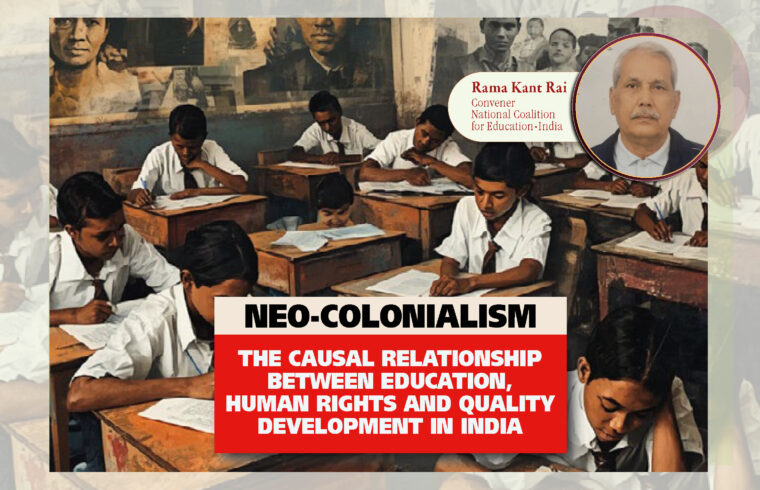
Neo Colonialism is a buzz word today and might attract attention as it is a new phenomenon of control and hegemonic dominance over the developing world by earlier rulers during colonial era. Neo-colonialism can be described as the subtle propagation of socio-economic and political activity by former colonial rulers aimed at reinforcing capitalism, neo-liberal globalization, and cultural subjugation of their former colonies. In a neo-colonial state, the former colonial masters ensure that the newly independent colonies remain dependent on them for economic and political direction. Developed countries have a way to turn things around in their favour, first, they colonised and established a direct control and now, consequently have “neo- colonised’’ which simply means that they have now established an indirect control through their products and so on. Neo-colonialism means the control of less-developed countries by developed countries through indirect means. India has a history of colonisation. Before the advent of colonial rule, India was a self-sufficient and flourishing economy. Our country was popularly known as the golden eagle. India had already established itself on the world map with a decent amount of exports. Although primarily it was an agrarian economy, many manufacturing activities were budding
in pre-colonial India.[1]
Neo-Colonialism is spreading in a new form and modus operendi in a very disguised way. It affects in social, political and economic life of third world countries. One of the most visible effect of Neo-Colonialism is increasing inequality among people. In March, Lucas, with Thomas Piketty and Anmol Somanchi of the World Inequality Lab, released a working paper titled “Income and Wealth Inequality in India, 1922-2023: The Rise of the Billionaire Raj”. This paper builds on the “World Inequality Report 2022” and updates on inequality in India up to 2022. “Billionaire Raj” sounds a rather elevating phrase to an aspirational Indian since we are high on a dreamy path to become a developed economy. “Fastest growing economy” is already a superlative that has become a poll slogan on the eve of the general elections. To make this growth look inclusive, the government has claimed to have helped 250 million escape poverty (the estimate is for multidimensional poverty, since India does not have an estimate of income poverty since 2012).
The latest update from the World Inequality Lab dissects this economic growth, its widening inequality and extreme concentration of wealth in a few hands. The paper analyses income inequality in India for 1951-2022. Interestingly, for three decades starting 1951, inequality came down. “The share of national income going to the top 10% fell from 37% in 1951 to 30% by 1982,” says the paper. But after this, income concentration went up. From the 1990s, the share of the top 10 per cent in national income leaped to 60 per cent in recent years. At the same time, the share of the bottom 50 per cent continues to be minimal. In 2022-23, inequality in income and wealth is staggering: the top 1 per cent earn 23 times the average income of an Indian. The richest 10,000 Indians earn an average R48 crore, which is 2,069 times the Indian average. “By 2022-23, top 1% income and wealth shares (22.6% and 40.1%) are at their highest historical levels and India’s top 1% income share is among the very highest in the world.”[2]
Commercialization of Education: “No country can develop unless its citizens
are educated”-Nelson Mandela
One of the latest field of Neo-Colonialism can be seen in Indian education system. Though Indian constitution guarantees “Right of children to Free and Compulsory Education” in the ages of 6 to 14 by a constitutional amendment making education a fundamental right it is being diluted by privatization of education by either Multinational Institutions or by Indian big corporate houses in collaboration with MNCs. Education is the foundation of social and economic progress. For India, which envisions becoming a Viksit Bharat @2047, a robust, equitable, and efficient school education system is crucial.
Introduction of Foreign educational settings in India in 20th century
As per the latest estimates India’s growing economy becoming the seventh-largest in the world, attracts International Institutions to invest in Education Industry in India. Despite the
advantages of education, many of the systems in developing nations like India are still not designed to address the lifestyle differences between Western and developing nations. India remains a challenging market for international education, especially for the country’s policymakers.
Since education has been recently regarded as an Industry it has changed its values tremendously. India’s overseas education market, always mean one thing: the 1.88 million Indian students currently studying abroad, spending an estimated $28–30 billion a year on degrees in the UK, US, Canada, and Australia.
But in 2025, a survey reveals the reshaping the market entirely. Foreign universities are no longer only attracting Indian students — they are coming to India directly. Setting up campuses. Enrolling students. Awarding internationally recognised degrees on Indian soil.
As of early 2026, 15 foreign universities have confirmed campuses for the 2025–26 academic year. Two are already fully operational with their first graduating cohorts. The regulatory framework is in place, the commercial model is being tested, and the implications for every UK and US education provider are only beginning to unfold.[3]
In India the National Education Policy (NEP) 2020 opens the door to leading universities across the world to have campuses in India, a new era of academic well as on the changes in the role of foreign universities in the national policy and in the pedagogy. The attraction of foreign institutions is based on both financial and cultural motives as to why the world institutions are more reliant on international students, and how this will affect their sustained ability. Meanwhile, it also takes into consideration the advantages that the Indian students and scholars could have, as well as looks critically at the issues that might be posed by this integration in the context of such aspects of it as regulatory, social, and infrastructural. Cooperation, innovation and competition is being shaped. Being the most populous country in the world with a growing population of young people, India would also be an enticing place of interest to international institutions that would want to expand their presence internationally. However, this is also an event that casts a severe doubt on the future of Indian academics and quality education as
Challenges a Foreign University in India
Though India presents a fine soil for academic growth, overseas institutions have to traverse a labyrinth of bureaucracy, cultures and institutional limits that may only hinder good performance in the long run.
Regulatory ambiguity and policy volatility:
It’s a pity that the regulation of Indian Higher education system is broken up and bureaucratic, in spite of the progressive provisions of NEP 2020. The uncertainties about UGC equivalence, taxation, accreditation, and the land acquisition process can cause campus roll-outs and raise the risk of operations. Also, the instability of the policy flow and regional differences in the exercise of state power can be a threat to the stability of an institution in the long term.
Exorbitant Fee and cost:
The foreign universities and institutions are prepared to charge higher fee and have been given autonomy so far. This situation might create difficult accessibility to marginalised population of India.
Cultural Fit and Academic Fit
The proposed pedagogies of foreign universities imported to India might break the classroom culture and expectations of the students. Relationships between lecturers and students, classroom activities, and evaluation channels typically differ significantly. Filling in this pedagogical gap and maintaining academic integrity and connection to contexts is a fine art.
Recruitment, Mobility, and Recognition of the Faculty
During the recruitment of qualified faculty internationally to join their workforce in India, there are logistical and bureaucratic challenges, such as the issue of visas and global credential recognition. On the other hand, access to the Indian academic talent can be limited by differences in remuneration, research facilities and institutional stratification.
The Reputational Risk and Brand Dilution
There is a reputational risk associated with establishing offshore campuses, especially non-flagship campuses. A loss in quality or deviation of quality from parent campus standards may result in a degradation of the brand name of the university in the international setting. Devoid of effective quality assurance systems, these ventures can find it hard to maintain their glory. 4
The Indian government has brought regulatory measures for foreign universities. FHEI (Foreign Higher Educational Institutions) Regulations — the most significant opening of India’s higher education market since independence. The key provisions that make the commercial model viable are:
- Full fee autonomy— institutions set their own tuition fees with no government cap
- Fund repatriation rights— surplus revenue can be sent back to the home campus
- Admission independence— not tied to India’s national entrance exams (JEE, NEET, CUET)
- Degree equivalence recognition— India-awarded degrees carry identical status to the home campus qualification
- Faculty recruitment freedom— hire internationally or locally, on institution’s own terms
Eligibility requires a top-500 global ranking (QS, THE, or ARWU — overall or subject-specific). Approval follows a 60-day UGC review, with a 2-year window to establish the campus and a 10-year initial operating licence.
Other patterns of Neo-Colonialism in India.
(i) Interference and trade sanctions: Recent controversial sanctions imposed on Indian goods to US and their conditional pact to buy their goods is an example of hegemonic interference.
(ii) Arms, weapons, and war trade to third world countries without technology transfer.
(iii) Conditional loans and aids with specific terms and conditions
(iv) By controlling the International Economic Institutions: World Bank and the International Monetary Fund, IMF, IBRD, IFC, IDA, FATF’s etc.
(v) Through Multinational Corporations: IBM, HP, General Motors, GEC, Standard Oil, Paytm, and Amazon etc.
(vi) imposing war: Russia-Ukraine, Gulf War, Greenland, Venezuela and Taiwan are best examples
Conclusion
India, despite being a former colony, now plays a dual role—a victim of Western economic dominance and a rising a regional power.
Programs like Make in India, Digital India, and Atmanirbhar Bharat aim to resist neo-colonial dependence by promoting self-reliance and technology sovereignty. It advocates for Global South cooperation at G20 and BRICS forums.
In a way India tries to oppose the Neo-colonialism however the domestic ne-colonialism is on the rising form in India due to disinvestment of public assets, privatisation of services and reduction in state resources on health and education.
Climate and Environmental change is neo colonial practice created by Developed nations. Under the effect of increasingly tight and expensive environmental regulations, emerging nations who have historically contributed little to anthropogenic atmospheric pollution may now become the victims of global climate policy.
SDGs in G20 summit:
“We are One Earth, One Family, and we share One Future.” This is the opening sentence of the Group of 20 (G20) New Delhi Leaders’ Declaration, in which the leaders pledge to “leverage the G20’s convening power and its collective resolve to fully and effectively implement the 2030 Agenda and accelerate progress toward the SDGs.” The G20 is made up of 19 countries and the EU.
The Great challenging crisis: The Aftermath of Covid 19 and Gulf war resulting in oil crisis has posed a great economic challenge on while world including India. This also poses a big threat to SDG achievement.
[1]. Has India been neo-colonised again even after two centuries of being colonised? International Journal of Political science and governance 2021 by Inderpreet Kaur.
[2] Neocolonial Raj has taken root in India Inequality has been widening rapidly in the country since the 1990 by Richard Mahapatra 04 Apr 2024,
[3] . Foreign Universities Now Coming to India — The 2026 Shift in Overseas Education IME Research March 12, 2026
[4]. Foreign Universities in India: Opportunities and Challenges of Global Campuses Foreign Universities in India: Opportunities and Challenges of Global Campuses – Info space Yahoo India Search Results (https://in.search.yahoo.com/yhs/search?hspart=infospace&hsimp=yhs-091&type=ud-c-in–s-p-aqpu7avh–exp-none–subid-none¶m1=0mnkhftuq9i2mshggb88o8os&p=Foreign+Universities+in+India%3A+Opportunities+and+Challenges+of+Global+Campuses)