Cheikh KONATÉ
Researcher in Public International Law
Nouakchott, Mauritania
rimafides@yahoo.fr
Towards an Evolutive Interpretation of Article 23 of the Charter
ABSTRACT
The architecture of the Security Council, established in Article 23 of the 1945 Charter, is based on a state monopoly over decision-making power in matters of peace and security. However, the veto power of the five permanent members produces a triple crisis: of legitimacy, representativeness, and effectiveness. This article proposes an evolutive reading of the Charter allowing for the integration of a sixth permanent consultative seat for the benefit of the global workers’ movement. Equipped with a right of alert and a suspensive social veto, this seat is not intended to compete with States but to remedy the democratic deficit of the collective security system. It is a matter of recognizing that security, within the meaning of Article 24, is inseparable from social justice.
KEYWORDS:
Security Council, right of veto, Charter reform, international legal personality, workers’ movement, Article 23, Article 24
INTRODUCTION
The Security Council is the only organ of the UN whose decisions are binding upon States pursuant to Article 25 of the Charter1. Its composition and voting procedure were designed at Dumbarton Oaks and Yalta to meet a political requirement: keeping the great powers within the system2. However, 80 years later, this rigidity comes up against Article 24, which confers upon the Council a responsibility on behalf of the “Members of the United Nations.” Who are these “Members” in 2026? States alone, or also the peoples and transnational actors who are affected by the decisions? The question raised is therefore one of institutional international law: can the 1945 Charter, without formal revision, integrate permanent non-State representation into the Security Council in order to correct the democratic deficit of the veto?
We will answer in three parts: I. The architecture of 1945 and its legal limitations. II. The legal basis for social representation. III. The proposal for a sui generis status compatiblewith the Charter.
THE ARCHITECTURE OF 1945:
ABSOLUTE STATE COMPETENCE AND ITS LIMITATIONS
A. The Monopoly of the P5 and the Logic of the Veto
Article 27.3 makes any substantive decision conditional upon the agreement of the five permanent members3 This “privilege” was justified by the need to guarantee the universality of the UN4. In practice, it has become an instrument of paralysis: more than 300 vetoes since 19465. Legally, the veto is not defined in the Charter. It results from an interpretation of “affirmative vote of all the permanent members.” The General Assembly has attempted to regulate it through Resolution 76/262 of 2022, requiring an explanation before the GA6.
B. The Charter’s Silence on Non-State Actors
Chapter V provides only for “Members of the Council,” who are States7. Yet other organs have evolved. ECOSOC consults NGOs pursuant to Article 71. The ILO has been tripartite since 1919. The Security Council remains the last entirely Westphalian forum. This silence creates an inconsistency: the UN recognizes civil society everywhere except where decisions on war are made.
C. The Consequence: An Infringement of the Principle of Accountability
Article 24.1 stipulates that the Council acts “on behalf of the Members.” However, Council sanctions destroy jobs, hospitals, and supply chains. Workers pay the price without ever being heard. This constitutes a rupture in the chain of accountability.
II. THE LEGAL BASIS FOR REPRESENTATION OF THE WORKERS’ MOVEMENT
A. The Evolutive Interpretation of the Charter
According to Article 31 of the Vienna Convention, a treaty must be interpreted “in the light of its object and purpose.” The object of the UN is the maintenance of peace. The purpose has evolved: human security has replaced simple State security. Nothing in the Charter explicitly prohibits the creation of new non-permanent seats with a special status. Article 23.1 establishes “fifteen Members.” It does not prohibit adding a “Permanent Observer Member with specific rights.
B. The Precedent of Tripartism
and Functional International Legal Personality
The ILO recognizes legal personality for workers’ organizations at the international level8. The ITUC represents 200 million members. In international law, personality is functional: it is granted to those necessary to fulfill a mission. Now, the mission of peace today requires social expertise.
C. The Principle of Democratic Legitimacy in International Law
The ICJ recalled in the Namibia advisory opinion that legality must be accompanied by legitimacy9. A Council that decides the fate of billions of workers without hearing them loses its moral authority. Integrating the workers’ movement means giving substance to Article 1.2: “to develop friendly relations among nations.”
III. THE PROPOSAL: A SIXTH
PERMANENT SEAT WITH A SUI GENERIS STATUS
To avoid a major revision of Article 108 of the Charter, we propose a reform by resolution of the Council itself, based on Article 30: “The Security Council shall adopt its own rules of procedure.”
A. The Proposed Status
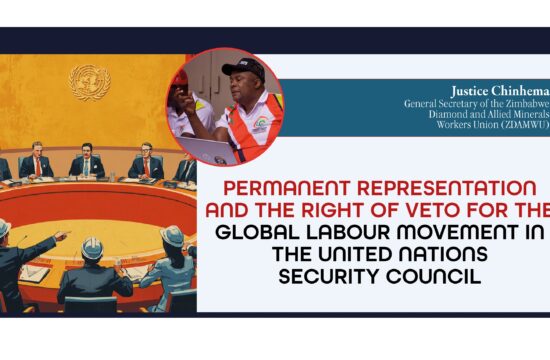
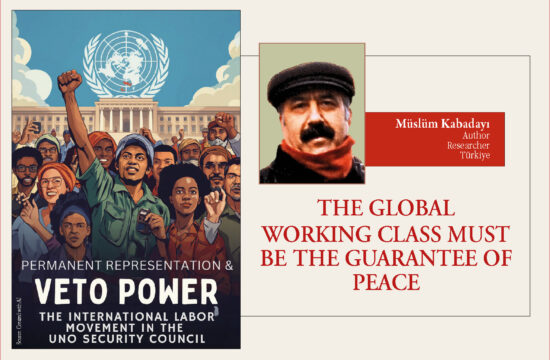
1. Designation: 1 permanent representative of the “Global Workers’ Movement,” jointly designated by the Director-General of the ILO and the Secretary-General of the ITUC for 5 years. *
2. Rights: Right to speak, right to propose agenda items in accordance with Article 35, access to all non-classified documents.*
3. The “Suspensive Social Veto”*: On any resolution having a major social impact, the representative may trigger a 30-day suspension. During this period, the Council must seek an opinion from the ILO on the social impact. This is not a blocking veto, but rather a right to delay and to require justification.
B. Compatibility with the Charter
This seat does not vote. Consequently, it does not modify Article 27. It is an addition. It is the same mechanism as the invitees under Articles 37 and 39, but made permanent. The P5 retain their veto. However, they must now justify the social impact, just as they have already been required to justify their veto before the General Assembly since 2022.
C. Scope
This reform does not resolve everything. But it desacralizes the State monopoly. It creates a precedent: collective security can no longer ignore social security.
CONCLUSION
International law is not fixed. It evolves through practice and interpretation. Giving a seat to the global trade union movement on the Security Council is not a question of introducing trade unions into geopolitics. It is a matter of introducing social reality into the law of peace. As long as Article 27 allows a single State to block action, at the very least Article 24 should
require that State to hear those who will bear the consequences. This is the minimum condition for the Council to regain its credibility.
BIBLIOGRAPHY
Texts
1. Charter of the United Nations, 26 June 1945.
2. Vienna Convention on the Law of Treaties, 23 May 1969.
3. UNGA, Resolution 76/262, Veto and Responsibility, 26 April 2022. Books and articles
4. MALONE David, The UN Security Council, Lynne Rienner, 2004.
5. WOUTERS Jan, RUYS Tom, Reform of the Security Council, Leuven Global Governance,
2021.
6. COMBACAU Jean, SUR Serge, Public International Law, LGDJ, 12th ed., 2016.
7. ILO, Declaration on Social Justice for a Fair Globalization, 2008. *
Jurisprudence
8. ICJ, Legal Consequences for States of the Continued Presence of South Africa in Namibia, Advisory Opinion, 21 June 1971.
- Charter of the United Nations, Art. 25.
- J. Combacau, S. Sur, Public International Law, p. 789.
- Charter of the United Nations, Art. 27, para
- D. Malone, The UN Security Council, p. 12.
- United Nations, Data on the right of veto, http://main.un.org
- UNGA, Res. 76/262.
- Charter of the United Nations, Art. 23.
- ILO, Constitution of the ILO, Art. 3.
- ICJ, Namibia Advisory Opinion, 1971, § 53.