Jonas NANDO
General Secretary of SYNAFETP-CI, Abidjan
For nearly eighty years, the debate on reforming the United Nations Security Council has centred on the same questions: should new permanent members be admitted? Should Africa finally be granted a permanent seat? Should the right of veto be restricted, reformed or abolished?
These are legitimate questions. Yet they overshadow a more fundamental issue: whom does the Security Council actually represent?
The answer seems obvious: nation states. But this assumption now deserves to be questioned.
In 1945, when the United Nations Charter was adopted, the world was structured around sovereign states. Wars were mainly fought between national armies, economies were largely national in scope, and governments were seen as the natural representatives of their peoples. The Security Council was therefore conceived as a forum where the major powers would preserve world peace on behalf of the states.
The 21st century presents a profoundly different landscape.
Contemporary conflicts do not merely destroy military infrastructure. They disrupt global supply chains, trigger food crises, destabilise energy markets, accelerate migration and undermine employment systems across several continents. A decision taken in New York can have immediate consequences for a farmer in Abidjan, a factory worker in Shenzhen, a seafarer in Rotterdam or a nurse in Buenos Aires.
Against this backdrop, a new question arises: are states still the only legitimate actors capable of representing all the interests affected by Security Council decisions?
This question in no way calls into question the sovereignty of states. It simply invites us to recognise a reality: global governance has gradually opened up to actors who were not envisaged in 1945.
For over a century, the International Labour Organisation has brought together governments, employers and workers to develop international standards. The United Nations Economic and Social Council consults with hundreds of civil society organisations. The European Union has institutionalised dialogue with the social partners. In climate negotiations, scientists, local and regional authorities, businesses and indigenous peoples now participate in international discussions.
Why should this trend stop at the doors of the Security Council?
The question is all the more pertinent given that this body’s decisions have repercussions far beyond the military sphere. Economic sanctions, embargoes, peacekeeping operations and reconstruction programmes directly influence employment, working conditions, social protection and the economic prospects of millions of people.
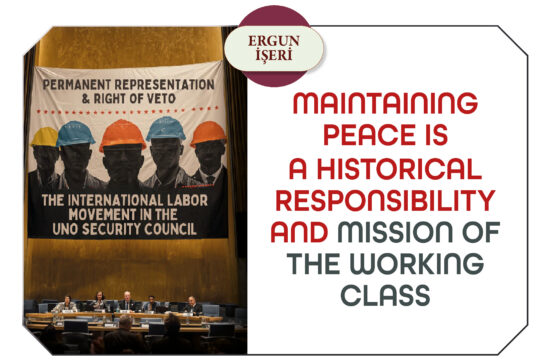
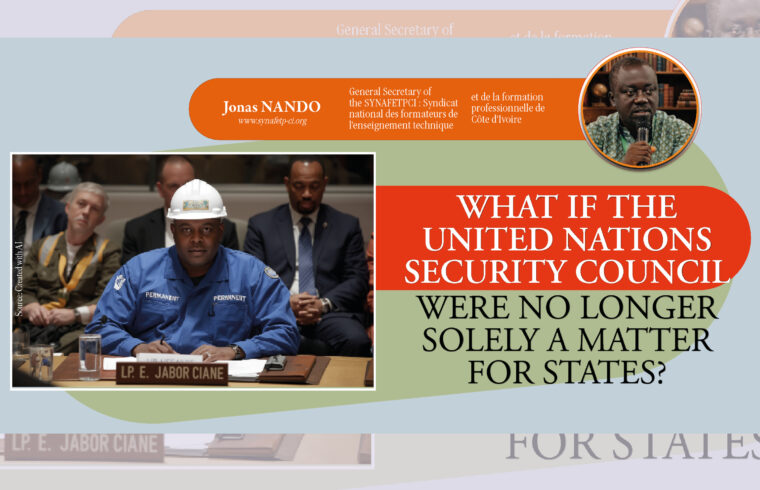
Among the stakeholders involved, the global labour movement stands out. It already has a recognised international organisation, institutional experience gained within the International Labour Organisation, and legitimacy built on its representation of hundreds of millions of workers. These characteristics make it a credible partner when it comes to assessing the social consequences of international decisions.
But does this mean it should be granted a permanent seat on the Security Council or a right of veto? The question is worth debating, but it is perhaps not the most important one.
The real issue lies elsewhere.
It is a question of whether international institutions should continue to represent exclusively territories and sovereign states, or whether they should also incorporate, in an appropriate manner, the major stakeholders in global security.
This line of thinking leads us to move beyond a strictly geopolitical view of United Nations reform. It invites us to consider a more functional form of representation, in which certain transnational actors could contribute to deliberations not because they control a territory or possess military power, but because they are directly affected by the consequences of the decisions adopted and possess expertise that is useful for achieving the objectives of the Charter.
Such a development would not mean the end of the role of states, nor would it call international law into question. It would simply reflect the gradual adaptation of an institution founded in 1945 to the realities of the 21st century.
Ultimately, the debate on the Security Council should perhaps no longer be limited to a redistribution of seats or a reform of the veto. It should also focus on how international institutions can better listen to those who experience the effects of conflicts, sanctions and geopolitical crises on a daily basis.
Peace is not merely the absence of war between states. It is also the protection of societies, workers, families and economies that bear the human cost of international decisions.
This is why the representation of the global labour movement must not be seen as a corporatist demand. It forms the starting point for a broader examination of the legitimacy of international institutions at a time when global security extends far beyond the framework of relations between states alone.
At a time when the international community is reflecting on the future of the United Nations, one question deserves serious consideration: should Security Council reform merely determine which states will have a greater say, or should it also take into account those who, whilst not being states, bear a significant share of the consequences of decisions taken on their behalf?