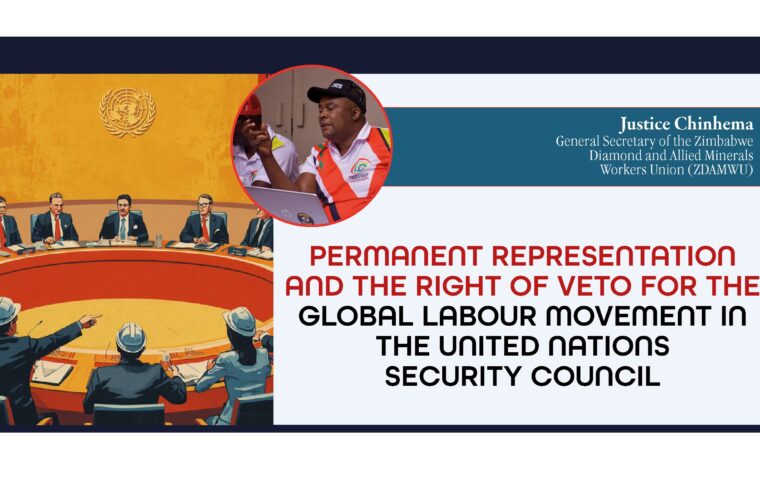
Comrade Justice
General Secretary of the Zimbabwe
Diamond and Allied Minerals Workers Union (ZDAMWU)
A Contribution to the August Issue
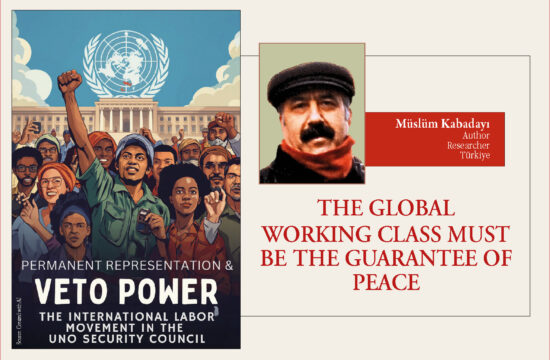
There is a sentence in the Charter of the United Nations that workers of the world have never been permitted to write, yet it has governed their fate more than any other clause in modern history: the veto. Since 1945, five states — the United States, the United Kingdom, France, Russia and China — have held the singular power to block any substantive decision of the UN Security Council, the organ charged with matters of war, peace, sanctions and, increasingly, the economic order that shapes whether mineworkers in Zimbabwe, garment workers in Bangladesh, or dockworkers in Durban live in dignity or desperation. Labour, the class that produces the wealth over which wars are fought and sanctions imposed, has never sat at that table. It is time to ask why the organised global workforce — represented through its democratically constituted trade union federations — should not hold a permanent seat, and a voice equal in weight to a veto, in the Security Council.
The UN’s founding architecture reserved permanent Council membership and veto power exclusively for the victors of the Second World War, a choice rooted in the geopolitics of 1945 rather than any principle of democratic legitimacy. Since then, reform debates — from the Group of Four’s proposals to the African Union’s Common African Position and the ‚Uniting for Consensus‘ group — have asked only which states deserve more power, never whether mass-membership institutions like the global labour movement deserve any power at all. Even civil society initiatives that call for a more representative Council still imagine reform purely as a rearrangement among states, not as an opening of the chamber to organised labour as an independent voice.
Yet the principle that workers must sit where rules are made is not new. The International Labour Organization already embodies tripartism: governments, employers and workers share institutional power in setting international labour standards. If this is accepted wisdom for labour norms, there is no coherent reason it should be unthinkable for the body that decides sanctions regimes, peacekeeping mandates and the security dimensions of resource extraction and post-conflict reconstruction — all arenas where workers bear the immediate human cost.
The Security Council is often treated as a distant arena of generals and diplomats, but its decisions are felt on the shop floor. Sanctions regimes can determine whether mines stay open or close, whether investment flows into extractive sectors or flees, and whether workers in conflict-adjacent economies retain their jobs. Peacekeeping mandates influence whether mining communities operate under protection or under militia extortion. Council paralysis — including repeated vetoes blocking humanitarian and ceasefire resolutions — has left millions of working people exposed because the permanent members prioritised strategic interest over human security.
Zimbabwe’s mineworkers extract diamonds, lithium, platinum and gold that sit at the heart of an intensifying global struggle over critical minerals. That struggle is increasingly framed in security language at the Council and in other elite forums, yet the workers whose labour makes these minerals available have no institutional voice in the body whose decisions shape the conditions under which they work.
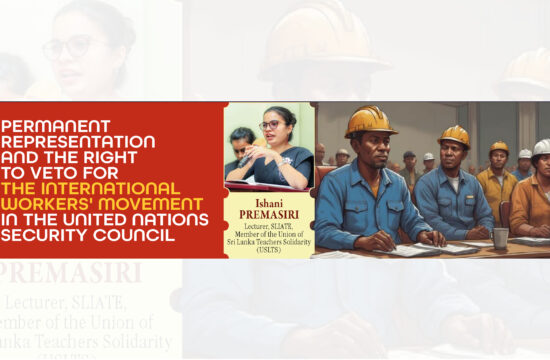
A permanent seat for organised global labour — anchored in recognised international trade union structures and analogous to the ILO Workers’ Group — would extend tripartism into the field of peace and security. It would ensure that no sanctions regime, peacekeeping mandate or post-conflict economic settlement is negotiated without an institutional voice explicitly mandated to defend working-class interests.
The veto is the most contested element of Council reform, and many states oppose creating new absolute veto powers for fear of deepening paralysis. The labour movement’s demand need not copy the P5 model. A more defensible claim is to a qualified veto or suspensive power: the ability of a permanent labour representative to trigger mandatory review, public hearings or a supermajority requirement whenever a resolution would materially affect employment, labour rights or the human security of working populations.
Such a mechanism would give workers real leverage, without simply adding another absolute veto to an already gridlocked system. It would operationalise a basic principle: when decisions threaten the livelihoods and lives of millions of workers, those workers must have a structured way to slow, interrogate and amend those decisions.
For a union rooted in the mining sector, this is not an abstract diplomatic exercise. Zimbabwe stands inside a global contest over critical minerals that is increasingly securitised and discussed in great-power terms. A labour movement without voice in that architecture will always be an object of decisions taken elsewhere, never a subject participating in those decisions.
As General Secretary of the Zimbabwe Diamond and Allied Minerals Workers Union (ZDAMWU), I write from the concrete experience of mineworkers whose livelihoods are directly shaped by global security and resource-governance decisions. ZDAMWU, together with the wider African labour movement and its global counterparts, has a direct interest in asserting the principle that no global security architecture governing the minerals workers extract should exclude those workers. This is the unfinished business of decolonisation in the twenty-first century: political independence was won, but economic and security representation for the working class remains an open demand.
The Security Council’s exclusivity was born of mid-twentieth-century power politics, not enduring justice, and every reform proposal already concedes that its composition is out of step with today’s world. The demand for permanent representation and a meaningful check on Council decisions by the global labour movement is not a plea for charity from the powerful. It is the logical next step in a long struggle that has won the vote, the eight-hour day and a seat at the ILO table. It must now win a seat where war, peace and the sanctions that can starve or sustain mining communities are decided.
| Current UNSC structure | Proposed labour-inclusive structure |
| Five permanent state members hold veto power | A permanent seat for organised global labour |
| Reform debates confined to state representation | Reform expanded to include class representation |
| Decisions on sanctions and peacekeeping without worker input | Labour voice on resolutions with direct economic and employment impact |
| Civil society treated as external lobby | Labour and civil society as institutional participants |
Comrade Justice, General Secretary of the Zimbabwe Diamond and Allied Minerals Workers Union (ZDAMWU), writes for Project Article 26 and PoliTeknic.
Reach out on: +263772976261/jchinhema@gmail.com