Prof.Ana Carolina Prof. Dr. Cezar De Mari
Fernandes Gonçalves DPE/PPGE UFV
Contributor ASPUV – S. Sind.
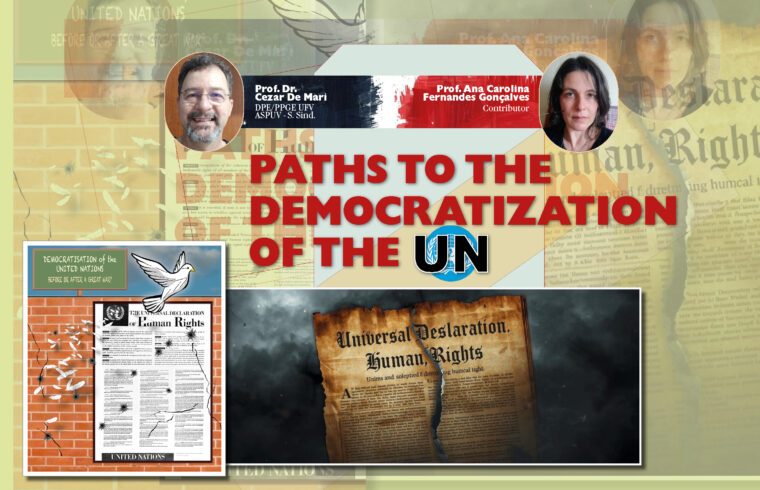
With the election of the new UN Secretary-General approaching— scheduled to take office in Janu- ary 2027—new perspectives have emerged in the long-standing debate on the democratization of the UN, introducing fresh viewpoints and opening up strategic fronts. Although decision-making power rests with the General Assembly and the Security Council, the world’s largest intergov- ernmental organization has made the candidates’ proposals available to the entire global community, and part of the selection process can be followed worldwide. This public disclosure of the election process—along with a list of candidates that is predominant- ly female and hails from the Global South—may signal the institution’s effort to demonstrate that it has em- braced democratization as a way out of the moral crisis it faces.1
In addition to the financial crisis, a larger crisis has been escalating, eroding the institution from within; its credibility has been eroded follow- ing recent global events, including the wars between Russia and Ukraine and between Israel and Palestine.2 From a broader perspective, the problem is identified as a weakness in multilat- eralism, manifested in the Security Council’s ineffectiveness in preventing, resolving, and mitigating conflicts and in achieving the overarching goal of peace. Viewed more closely, it can be identified as a structural problem inherent in its very foundation, as its charter provides for five permanent members—the U.S., France, the United Kingdom, Russia, and China—on the Security Council, each with veto pow- er over General Assembly decisions and the election of the Secretary-Gen- eral. This elevates the Security Council above the very institution of which it is a part.3
A legacy of World War II, this structure creates an imbalance of power among Member States, causing the organization to become paralyzed and leading to its discredit. As early as the 1960s, the struggle for internal hegemony between the U.S. and Russia led to a reform in 1965 that expanded the number of seats for non-permanent members. Dissatisfaction with the lack of results from this change, however, brought the issue of democratization back into international debates, particularly beginning in the 1990s .4
In the academic sphere, international relations researchers, based on a critical analysis of reform models and their impact on the organization as a whole, advocate for two proposals in
their scholarly publications. A structural reform that, like the previous one, focuses on expanding the membership of the Security Council, or a procedural reform focused on introducing mechanisms to limit the veto power and ensure greater transparency in the decision-making process of the five permanent members.5
In the diplomatic arena, member states present their plans to the committees during assemblies, and these are published as recommendations to the Secretary-General and the Council. Many of these recommendations have already become actual measures to strengthen the General Assembly, such as the “Uniting for Peace” resolution (Resolution 377A) of 1950, which empowers the General Assembly to issue resolutions to member states when there is no consensus in the Security Council, and more recently, in 2022, the Liechtenstein Veto (Resolution 76/262), which requires the General Assembly to convene a meeting to review the report of the member state that exercised the veto. Another important measure that helps limit the veto power of the five permanent members was the drafting of a code of conduct, the “Political Declaration on the Suspension of Veto Powers in Cases of Mass Atrocities,” presented in 2012; today, it is supported by 120 member states, including two permanent members of the Security Council.6
All of these initiatives, however, seek to circumvent the power of the veto by appealing to morality, through public exposure and condemnation. However, the problem persists when the UN’s moral authority is insufficient to redirect the way member states’ interests are defended.7 This is especially true when only two of the five non-permanent members elected in 2026 support all these measures.8 It is in this context that the call for the democratization of the UN gains prominence and takes on different meanings within the international arena.
On the one hand, democratization is expressed through participation on the Security Council; for this reason, some initiatives invoke Article 99 of the UN Charter, proposing structural changes to increase the number of permanent members—as advocated by the G4 group—or the number of non-permanent members—as advocated by the “United for Consensus” group and the African Union’s Ezulwini Consensus.
On the other hand, democratic expression lies in participation in the work leading up to the Security Council’s decision-making, which could prevent deadlocks in the Security Council. A coalition of 27 countries has been working on this since 2013, known as the Accountability, Coherence, and Transparency (ACT) Group, which has been seekng to improve the functioning and working methods of the UN Security Council. The ACT was responsible for coordinating the Code of Conduct on Atrocities among other international actors; it advocates for the right of countries that contribute troops to peacekeeping missions to have an active voice; and it calls for expanding the role of the penholders, whose task of drafting resolutions is currently concentrated among three permanent members of the Security Council (the U.S., France, and the United Kingdom). They also advocate for greater openness to allow civil society to monitor processes, such as meetings and consultations, as is currently happening in the 2026 election for Secretary-General.9
In light of all these debates and the recommendations of the General Assembly, a document was drafted titled “Elements of Convergence on the Positions of Member Countries,” focusing on two vital areas of reform: the relationship between the Council and the Assembly, and the number of permanent and transitional members of the Council.10 The result of this study, combined with the recommendations of the 75th General Assembly and a consultation with civil society, was the Secretary-General’s report *Our Common Agenda*, which called for the organization of a meeting with member states—the Summit for the Future—from which the Pact for the Future emerged. In it, the section “Transforming Global Governance” included Security Council reform as a provision for signatory member states, promised in actions 38–42, and one of the tasks assigned to the Secretary-General, who must lead this process.11
Therefore, hearing what the candidates for Secretary-General think about the UN provides civil society with a minimal window into what member states are envisioning for the future of the entire world. In terms of democratic participation, this may represent very little, but it strengthens the moral mechanisms for holding Security Council members—in general—and permanent members—in particular—accountable and subjecting them to scrutiny. With the public debate held on July 23, 202612—available on the UN website—along with the individual Q&A sessions and the letters outlining the candidates’ proposals, the procedures have become more visible, though they are not yet fully transparent.
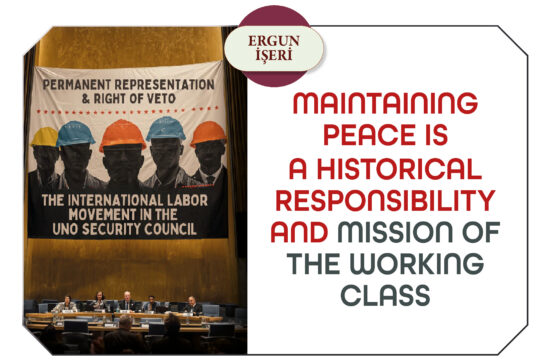
Therefore, independent observatories—whose publications serve both to inform and to provide critical analysis—take on new significance in this opening of debates and the scrutiny of decision-making processes that have finally been revealed, as they constitute the public forum in which the decisions of Member States in the General Assembly and the Security Council will be publicly judged. Among them are the Civicus Lens platform of the Global Civil Society Alliance; Pass Blue, awomen-led news organization that covers UN debates of social interest; the news portal for the campaign—supported by various local and global social institutions— for a women’s secretariat, 1 for 8 Billion; and, of course, the international journal *Politeknik*, which discusses proposals for the democratization of the UN, the right of the working class to a veto, and the expansion of Article 26 of the Charter of Human Rights regarding education, in addition to coverage of the situation of student organizations and labor unions.
- https://unwatch.org/analyz- ing-the-candidates-for-un-secre- tary-general/, https://passblue.com/ sg-candidates-home/
- https://lens.civicus.org/un-security-council-new-members-old-crisis/
- Patriota, A. de A. (2022). Democratizing International Relations. CEBRI-Revista: Brazilian Journal of International Affairs, (3), 14–29. Retrieved from https://cebri-revista.emnuvens.com.br/ revista/article/view/49
- https:/www.securitycouncilreport.org/un-security-council-working-meth-ods/the-veto.php
- Winther, B. Z. (2020). A Review of the
Academic Debate on United Nations Security Council Reform. The Chinese Journal of Global Governance, 6(1), 71–101. ht tps://doi.org/10.1163/23525207-12340047 - https://www.securitycouncilreport.org/un-security-council-working-meth-ods/the-veto.php
- Roy, Sanjoy. Democratization of the United Nations: A Question? July 24, 2023 https://politeknik.de/p13531/
- https://lens.civicus.org/un-securi-ty-council-new-members-old-crisis/
- https://lens.civicus.org/la-asamblea-general-de-la-onu-sin-espacio-para-la-sociedad-civil/
- Whinter. Ibid.
- https://www.securitycouncilreport.org/un-documents/document/elements-paper-on-convergences-and-divergences-on-the-question-of-equitable-representation-on-and-increase-in-the-membership-of-the-security-council-and-related-matters.php
- https://webtv.un.org/en/asset/k1h/k1hkyf9mo0